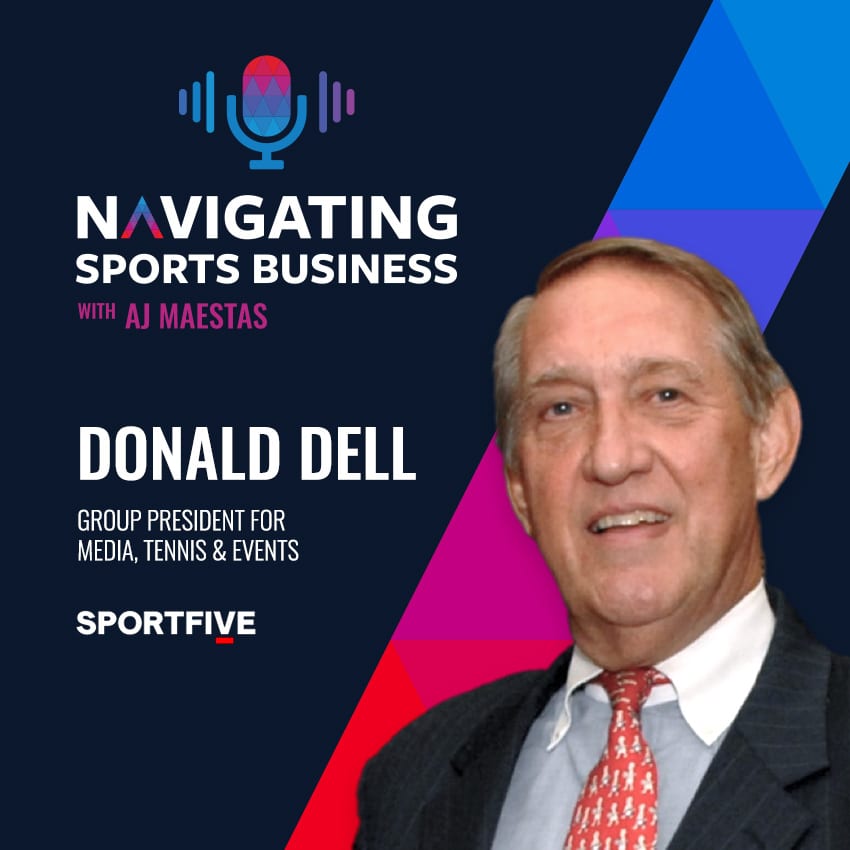
Podcast Alert: Donald Dell – Part 1
Donald Dell is one of the most impactful agents in the history of sport. As the founder of ProServ, his list of notable clients includes Arthur Ashe, Stan Smith, Patrick Ewing, and of course, Michael Jordan.
He negotiated some of the largest and most important apparel deals ever, including Michael Jordan’s first deal with Nike, and Stan Smith’s contract in perpetuity with Adidas.
Details:
00:00 Donald’s Background
6:40 Arthur Ashe, Stan Smith, and the creation of ProServ
11:20 Michael Jordan
30:50 Negotiating Apparel Deals
[iframe style=”border:none” src=”//html5-player.libsyn.com/embed/episode/id/17361119/height/100/width//thumbnail/yes/render-playlist/no/theme/legacy/tdest_id/2518988″ height=”100″ width=”” scrolling=”no” allowfullscreen webkitallowfullscreen mozallowfullscreen oallowfullscreen msallowfullscreen]
Check out this episode!
Transcript
+^Donald Dell: [00:00:00] If you like the people you’re working for and with, and a passion about what you are doing, which I still have today, some 45, 50 years later. That’s why I’m still working.
AJ Maestas: Hello, and welcome to the Navigating Sports Business Podcast. I’m your host, AJ Maestas, founder of Navigate a data-driven consulting firm, guiding major strategies and decisions in sports and entertainment. Today I am grateful to be joined by an industry great Donald Dell. Currently group Vice President of Media, Tennis, and Events for SportFive. But before we start, I can’t resist sharing some of Donald’s career highlights for those that don’t know him well, he was a three [00:01:00] time All American at Yale and Tennis.
He played on the US Davis Cup team in 1961 and 63, and he was captain of undefeated teams in 68. In 69, he was somehow also special assistant to the Peace Corps founder, Sergeant Shriver. He worked on the presidential campaigns of Robert Kennedy, as well as Sergeant Shriver. He was co-founder of the ATP, along with Jack Cramer and Cliff Drysdale. He also founded the ATP Players Union. He worked as a tennis broadcaster for PBS and NBC in the seventies and eighties. He founded possibly most famously ProServe in 1970 started as a law firm and became a full-service firm, and they won and represented clients such as Arthur Ashe, Stan Smith, Jimmy Connors, and many more.
When they expanded into basketball, they were the first representative Michael Jordan. They also represented stars like Patrick Ewing, James Worthy, the list goes on. He personally negotiated Jordan’s shoe deal with Nike Stan Smith’s shoe deal with Adidas. I’m actually lucky enough to have been in his office on the day of the most recent Stan Smith renewal. We’ll definitely talk about that later. [00:02:00] He began negotiating TV deals for the NBA at one point in his career and even represented some stadium naming rights deals like the Staple Center and FedEx Field. Where Washington plays football. He’s written two books minding other people’s business and never make the first offer, and in a surprise to no one, he was inducted into the Tennis Hall of Fame. There are so many things that I’m not mentioning on this list that Donald Dell has done but Donald, please share with us how does one person do all of.
Donald Dell: I think I’ve lived a long life, a happy life. I’ve been very lucky because the timing of different things came on. For example, the tennis world became open tennis in 1968, which meant amateurs and pros could play together. I had played the tour earlier and retired from the tour in 66. There was no money. You were under, you were paid amateurs, really. You got paid expenses depending on your ability. I was about a $200 a week player and a guy like Roy Emerson, Fred Staley, that they were dominating the Australian [00:03:00] side. Cause the better players on the Australian labor, Hode Rosewell had all turned pro with Jack Kramer’s tour. So a. Like Emerson was making about a thousand a week and suddenly when I retired, I’d gone to law school to University of Virginia Law School previous to playing on the tour. And when I retired, I went to work for a big law firm in Washington called Hogan and Hartson, which I enjoyed. And the game of tennis, went open in 1968. I was about 18 months into working full-time, 20 months, and judge Kellerher, who had been the president of the USDA that year asked me to be the Davis Cup captain. So suddenly as the game was turning professionally, I ran the Davis Cup team as the non-playing captain in 68 and 69. And in those days it was a different Davis Cup. Format. We had to play six countries in 68 to win it. We hadn’t won it in six or seven years. So it was a mission that we all went on the team. And then I had some great players on that team, starting with Arthur Ash, Dan Smith, Bobby Lutz, Charlie Pastoral, and Clark Graber. [00:04:00]
And those guys dominated American tennis. In the days when. Before the pros of open tennis, so we moved into that, won the Davis Cup in 68, and then defended it in a thing called the Challenge Round where the best defender waits for everybody else to play out, and you play one match. The challenge ran. We played Romania that year with Jan Tiak and Illy Nastasia in Cleveland, and we beat him five zero. So I was the youngest captain ever picked in Davis Cup for America at 29 and in 1970 January. After winning it twice, I resigned and decided to set up my own law firm and manage athletes, primarily tennis. And it was in 1970 we started and we had a law firm, Dell Craig, enters and Benton were four partners. Three of them had gone to law school with me at, university of Virginia. Knew that Frank Craigo was my roommate there. He was my partner. In 1976/77, we changed the marketing arm, not the law [00:05:00] firm, but the marketing arm to ProServe because under the cannons of ethics in the legal profession in the sixties, we were not able to recruit.
We were not able to solicit, we’re not able to advertise. We couldn’t sell assurance, we couldn’t give marketing advice. All those things were prohibited. By the canons of ethics in law. So we changed it to marketing and called it ProServe and ran on our business side, , into that and our law side stayed on the legal side, so the law firm, but it was a very good luck and good timing. And you mentioned why and a just a long-winded answer, but it’s really because of passion. Enjoyment, if you like the people you’re working for and with, and you have a passion about what you are doing, which I still have today. Some, 45, 50 years later. That’s why I’m still working. I’m working not full time. I keep my own schedule. Sports Five has been very respectful of my time and effort, but I am full-time from time to time [00:06:00] on my own basis. And so I think the secret. To that is a passion and good people around you that keeps you motivated.
AJ Maestas: You’ve certainly interacted with a lot of people that was interesting to learn. You are a teammate of two superstars that you end up representing for the rest of their lives, Arthur Ashe and Stan Smith. I’m sure there’s dozens of stories in there. Is there anything you can tell me about that? I recall you sharing with me? Cab ride in Manhattan to take Arthur Ashe to a law firm trying to find him representation. I don’t know if you can finish that story for me.
Donald Dell: Sure. We won the Davis Cup in 69 in September in Cleveland. So around November, Arthur was going to turn pro and I took him to a guy named Mark McCormick, who was really, in my judgment, the pathfinder of sports marketing. And he was running a company called IMG. I took Arthur to meet him no less than four times. We generally had early morning breakfast in different places, wherever we were in that time. We were in New York and we had breakfast with Mark that morning. And [00:07:00] after the meeting we were, it was about 10 o’clock, we were driving down the east side on the river there, and Arthur turned to me in a cab and I said, why do you keep taking me to meet McCormick?
I said, cause I think he’s the best. I said, he’s got John, Claude Kelly in 68. He represents the Olympics in television. And I really believe he’s the best in golf. He’s dominating golf right now. He’s got three guys named Arnold Palmer, Jack Nicholas, and Gary Player, all under contract. He’s going to make you more money than any of these guys that are talking to you in tennis. And the president of this and the captain of that, they all want to represent you, but you’re not as good, well off. And he said, well, why don’t you do it? And I said, why don’t you do what? And he said, why don’t you manage it? Represent me? I said, no, no. I’m going back to Hogan and Harson, and I want to be the next Clarence Darrow.
I want to be a trial lawyer. Oh, no, I can’t. I’m, I have no interest in doing that. He said, well, you’re making a big mistake because if you and I worked together, Stan Smith would join us. Probably others on the Davis Cup squad or team would join us, and we’d have a business and it’d be a lot of fun. Well, that kind of [00:08:00] stunned me and, mark, who became a good friend over the years, Mark McCormick. We used to compete all over the world in various places. I mean, he was global. I was global. The. Eighties, we had about 300 employees in sports marketing and television and client representation. We had 300 employees and 16 offices around the world because tennis and sports are global. And mark had a thousand employees and about 26 offices.
I know that those numbers because we had to compete against him. But in the process, he became a good friend. And he always said to me, why do you tell that story? About meeting Arthur and then he went with you. I said, because it’s true. He said, I know, but I hate that story. Anyway, so that led to a lot of good things. But the thing I’m proudest of really is in 70 Arthur and Stan and I, we signed a three page letter agreement for one year, and both of them had exactly the same agreement because I was starting out and I [00:09:00] didn’t want any animosity one toward the other. And I said to both, look, we’re going to try to get endorsements, exhibitions, all kinds of revenue. And if you all talk to each other about what your deals are, one of you is going to always be unhappy and in most cases may be unhappy with me. So I’d asked you all, and they were great friends from two years on traveling on the Davis Cup team with me. I said, I asked both of you just to keep it separate. I’m not going to talk about it, but if you guys share back and forth, it’s not going to be comfortable. Good relationship. Somebody’s always going to be unhappy, thinking they should have gotten more or whatever. So that contract lasted for one. I then went on a handshake basis with both and for Arthur 23 years before he died, in 1993, February and Stan Smith, I still represent on a handshake 46 years later, so I’m proudest of the fact that.
We never had to have a written contract when a lot of these big deals developed. And I think that was a demonstration with the character [00:10:00] of the people I was representing. I used to tell people, both Arthur and Stan were ranked one in the world at different times. Both of them won Wimbledon and the US Open and the Australian Open, and everyone in the French because they didn’t like to play well on Clay. But if you really thought about it, that was a great testimonial. To them and the character of them. And I used to introduce them as really good players in tennis, good players, but great people because the character and the discipline and the way they treated others, their people skills. So that’s a very happy point for me. The handshake with two great players.
AJ Maestas: Unbelievable honestly, that you played with them and that certainly points back to your comments about. Relationships, which certainly makes sense no doubt as teammates and traveling together.
AJ Maestas: But I do want to ask you about Michael Jordan. As you know, I think he’s top of mind right? With the last dance and he is as relevant as ever today. And to think of what it was like to recruit him. I assume that you didn’t have a preexisting [00:11:00] relationship with Michael Jordan, given basketball in a new division at Prosser.
Donald Dell: It was really strange and unusual. I got a call from Coach Dean Smith at Carolina and we were chatting and I said, coach, I’d like to propose something very different to you. Everybody’s always complaining about the agents or hustling the talent so forth, particularly in colleges. And remember in those days, Michael graduated and didn’t graduate, left as a junior in 1984. Everybody normally stayed four years. So I went down and saw Coach Smith. I said, look, my client, my, my staff, my whole employee will never come on campus at Carolina.We will never call or write any of your players until the season ends. And you call me and tell me who you want me to come down to meet so long as I can meet them in your office with you there, or if not with their parents there. That’s your call. So Dean loved that because then he controlled the whole program and he ran a great program at Carolina. Well, as it turned out, the [00:12:00] first time I went down there, I’d only met him a couple weeks before. I went down there and he said, I want you to meet Dennis Weiss and Bob McAdoo. I said, great. I’d love to. Weiss was the captain. We had about an hour and a half together with each. At the end of that, I went in Dean’s office and I said, he said, what do you think?
I said, I’d love to represent both. I’d love to represent Dennis. He and I related very well. I said, but Coach, I hate to tell you, but I think he is signed. He said, and he pounded the desk. He said, don’t ever say that. Nobody in my program’s ever signed as a college player, we’re right in the middle of the season.
I said, well, I can just, I’m not going to tell anybody, but I’m just telling you know, he was there. He looked up the ceiling. He never answered any questions. He gave me one-word answers. He didn’t want to be there, but it was obvious he was there cause you asked him to be there. So I got on a plane from Raleigh Durham, flew back home and about nine o’clock the same night. It’s an hour flight. I got home about nine o’clock and I get a call from Coach Smith and he says, God damnit. He said, [00:13:00] Bob did sign a contract with Earl Foreman of the Virginia Squires. In those days, they had the A, B, A and the NBA. That’s how long ago it was. And he said to me. I’m going to get that contract back, but please don’t say anything to anybody. I said, well, of course I’m not going to say it cause you’d lose your all the players’ eligibility and some of your games. So about two weeks later, Dean called me and said, I got the contract back from Earl. He agreed and we tore it up. Everything’s fine. And now the season was about a month from ending. I said, well, obviously coach, I’d love to represent him .He said, no, no, I can’t. I can’t have you do that. I’m going to give him to another player, another agent. And it happened to be a guy in New York that I knew went to Yale. Two years behind me and I said, you can’t do that. I, why are you doing that coach? He said, no, I just, I, you know, I don’t want you too involved with him.
And the real reason was, I think he always worried that I, as an agent would be telling the story. I’m telling you right now, co coach Smith has [00:14:00] died. So it’s a different world anyway. The result of all that I represented every kid coming out of Carolina for 14 years. Uh, we got everybody from Phil Ford to James Worthy to Tommy Lagarde, to Michael Jordan, you name it. And on one day, on a Saturday morning, I get a phone call from Coach Smith. He said, you, would you be interested in representing Michael Jordan? And I said, yes, of course. He said, well, I’m here in my office with his mother and Michael, uh, he was a junior that year, just finishing his junior year.
They had won the national championship the year before, and so he thought Michael should come out. So they put Michael on the phone. It was sort of unusual Saturday morning around 10 o’clock, and I said, hi, Michael. Hi, how are you? And he said, well, I’m fine, but you know, I really love Carolina. I I really am not sure I want to leave. Coach Smith says I should go now because the market. Stronger, what do you think? And I said, well, I’ll go check the market for you and try to give Coach Smith the information. But he said, all right, well I’m going to follow his advice. You [00:15:00] know, Dean Smith was God at Carolina. Uh, I mean, those players loved him. I’ve never seen a man that did more for his players, worked harder with him, and the only comparable example today would be Mike Zeki at Duke. Who is a sensational human being and a great recruiter like Dean was. Anyway, to make a long story short, Michael said, well, I’d like to come up and visit you. Uh, if you don’t mind, I’m going to ring my father James with me.
So I said, no, I love it. So they came to Washington and stayed at my home here in Potomac, Maryland for two nights. And uh, we then signed Michael. Never dreaming, he would necessarily become what he has become to the sport of NBA basketball because, uh, in that particular year, 1984, he was a junior and the draft went like this, Elijah won, won, and then the kid from Kentucky. Trying to think of his name in a minute. I will went two and broke his leg early on and was a disaster for Portland three went Michael Jordan to Chicago with Jerry Reinsdorf, who’s a great owner. [00:16:00] And they got lucky because Jordan went three in the draft and he of course, became probably certainly arguably one of the best, or if not the best player that ever played in the NBA.
LeBron may disagree with that, but I think it’s a question of era. The era you’re playing in. And certainly Jordan dominated that tremendously as LeBron has dominated now recently. So that’s how I met Michael Jordan and we signed him. The first time, I believe, was for a a three year contract. And you got to remember in those days you couldn’t sign a player. Until the season was over or he was, he was ineligible. The team was ineligible. So Coach Smith used to use me to go out with general managers and owners and quote, test the market and this was all done verbally. Then I’d come back and say, yes, I think Tommy La Guard is going to go three in the draft by so and so, and I think you’ll get a five year deal paying X.
And so that was. The way we operated until the NCA changed that rule. Now you can talk to agents, you could sign an agent, put your name in [00:17:00] the draft for a limited period of time, and if you decide you want to come back and go to college, you can and finish your college. Most players, when they do that. Don’t come back, but that more flexibility from the NCA was really a direct result of Dean Smith fighting that battle along with some other great coaches. Uh, they all felt that was fair to the player to give him a chance to test whether he won, you know, to try out with teams. And then he could put his name in, but he could take it out before the NBA draft and still be eligible.
For his last year of NCA or whatever number of years. Cause now all of them are doing what’s called one and done. They all go one year and come out earlier. cause that’s allowed. So the whole world has changed in, in NBA basketball. The game is now much more global. The television is phenomenal all over the world, particularly in growing countries. You know, like China, that’s enormous audience. Russia is a big audience today. So that’s how I really met and got to. Managed Michael Jordan for the first nine or 10 [00:18:00] years of his career. He was a proser client and, uh, the biggest one we had at some stage, we had about 12 people working on different Michael Jordan stuff. We did a thing with Gatorade called, uh, a song called Be Like Mike. We just did a number of, you know, no, we did a, the obvious, the obvious one, we ended up being Nike. That was an enormous couple of deals that I negotiated, so that’s where it all evolved out of that first trip up to my home with his father.
AJ Maestas: Well, we definitely would like to hear about that Nike deal and that relationship as it developed, and Adidas and Stan Smith relationship given that it exists today. To now learn that you’re still on a handshake, year to year contract is incredible, but I can’t resist asking.
AJ Maestas: In all those years with Michael Jordan, there must be a story that stands out.
Donald Dell: Oh, there are a couple of tremendous stories and fun stories. Michael, you know, loved to gamble. I mean, you never heard any problems with him with drugs or women or, I mean, he had a great career that was free of all that, except for one that he loved [00:19:00] to gamble. He would, he liked to play golf and gamble. He liked to bet on the casino in the, in the blacks or the, the, uh, black and red, or he played blackjack. He loved to gamble and, and of course he could afford it. But one of the problems was, uh, he went down to Atlantic City the night before a game, uh, a playoff game against the New York Knicks. In New York and the press saw him there and that was blasted all over the next day. That, the night before he had been gambling before a playoff game in New York. And it was a true story. I know he didn’t deny it. And so, uh, there’s a lot of pressure on all that. And, uh, David Stern, who’s then the commissioner of the NBA was developed a very good. Personal friendship with me, uh, really respected David. I thought he was the smartest marketing thinker and creator of anybody I’d ever dealt with.
And we had a good, very good relationship. And a, a couple years into the Michael’s playing so well, and the, the Bulls had just won the World Championship and suddenly David and Michael sat down and I don’t think, uh, this is just a guest. [00:20:00] David never, we’ve never talked about this for obvious reasons, but I think David Stern always felt, number one, this was his superstar. Three years in and he did not want to have that story told anymore about gambling. And for some reason Michael loved baseball. And lo and behold, the owner of the Birmingham, a double A team in baseball was Jerry Reinsdorf, who also owned the Chicago Bulls. So between the three of them, Jerry, David, and Michael, they worked out arrangement.Michael retired very young and went to play baseball in Birmingham. Everybody was stunned in the NBA and I always dreamed or felt that secretly that was David’s way of avoiding, uh, having to penalize Michael for gambling, which is prohibited in a lot of ways in the, uh, it’s one thing to bet on a casino and it’s another to bet on your own team. He didn’t never do that, but gambling was prohibited in some of the NBA rules. So David tread lightly, cause this was his superstar and this was a great out. And Michael went down to [00:21:00] Birmingham. Played there for two seasons and was a, a very good fielder, but a terrible batter.
He was batting, he was batting about 1 48, but he kept his popularity down there because he bought a new team bus with air conditioning and television and music you know, in inside of the bus. And the team used to go from, you know, stadium to stadium by bus. So Michael bought this bus personally for the team and obviously became very popular, however. He wasn’t a very good batter, and so after two years he decided for whatever his reasons were, I, I was not managing him at that stage to come back and, uh, play in the NBA, which he did, and came out, as you saw in the last dance. The greatest thing about the last dance in my mind, knowing Michael, was you never realized how competitive instinctively he was. You talk about passion for winning, you won’t ever see another, another player like that. I mean, it just oozed [00:22:00] out from him. And of course when they were playing the Celtics in one of the playoffs and uh, he scored 63 points against a team in Boston that had four.
Hall of Famers on that team headed by Larry Bird and the game ended. Byrd says to the press we, we won by two in an overtime, but we physically could not stop Michael Jordan. He may be the greatest player there ever played. That was a quote in the middle of the playoffs from a guy named Larry Bird.There’s not much for to be said. I thought the last dance done by the NBA and ESPN was very well first class in lots of ways, and it really brought Jordan back to the public. So aj, that’s, that’s one story. There are several others. I, I’ll tell you one, one last one, which is fairly unknown, but very unpopular or popular as the case may be.
AJ Maestas: Well, don’t let me stop you.
Donald Dell: No, uh, Michael, as I say, loved to gamble and one year he came to me, I [00:23:00] think it was December, and he said, you know, I want ProServe, uh, to write a check to this, this fellow for $350,000. I said, what on Earth for? He said, well, I played golf for them all summer in California. I kept losing and he always beat me by one or two strokes and we’d adjust the stroke, but he always won and I lost a lot of money to him. And I said, Michael, did it ever occur to you that maybe he was better than you?
AJ Maestas: Yeah.
Donald Dell: You know, Michael was in my office and we were having this guy. He said, well, you know, I have a deal with my wife that if I win, I keep the money in gambling. If, if I lose, I’m supposed to pay her sometimes three times what I’ve lost.
This was a big loss and I don’t want to pay her that kind of money. So I want you to write the check on Pro Serve to this guy in California and then I’ll reimburse you from my account. You know, we had control of his account and the banks. I said, fine. So like a dummy. I wrote the check and, um, things went on this season, kept going.Then suddenly we [00:24:00] get to the spring about three months later, and out pops a, a federal indictment in North Carolina for a guy. Uh, for income tax evasion. Well, that guy happened to be the guy playing golf with Michael in California. So now in the depositions and the discovery, the check pops out, ProServe, and so immediately the press comes to me and why are you writing a check?
Did you bet with this guy? Who is the guy? Blah, blah, blah. And, you know, I’m saying to myself, oh God, this is going to be a nightmare. So I say to Michael, you know, we really got to deal with this. When he comes in, I, I actually had him sit down with a, a group of lawyers from a law firm in Washington called Williamson Conley, Edward Bennett, Williams’ firm.
They’re great litigators. They’ve been my outside counsel at Pro Surfer a number of years. And Michael said, look, we’re just going to tell him that we were investment, we were investing together, you know, we were going to build a miniature golf course together. And, uh, I said, no, Michael, you know, there’s a thing called perjury and when you raise your right hand and take an oath, I’m not going to go to [00:25:00] jail for five years.
cause you want to build a miniature golf course, and I don’t think you should either. He laughed, he said, no, no, you’re right. You’re right. So the trial starts and they get two weeks into the trial and I’m going to have to testify about this damn check, and then Michael’s going to have to testify. And suddenly, two weeks into the trial, what do you think happened?
The person unnamed from California is in the courtroom, dies of a heart attack in the trial. Two weeks in. Unbelievable. And everything stops. And I said, said to my wife, you know, I’ve never wanted someone to die, but I ain’t too unhappy today.
AJ Maestas: Brutal.
Donald Dell: I mean, that is a true story. It’s never been, you know, printed anywhere.
And uh, we don’t talk about it. I’m sure Michael wouldn’t want to talk about it now, but you talk about a lucky break. Uh, and, and timing. Uh, that was one of the great ones.
AJ Maestas: Did it ever concern you, the, the gambling and some of the risks being taken?
Donald Dell: Well, it did concern me, but more importantly, I [00:26:00] think it concerned David Stern and the NBA, which is why, as I said, uh, they all collectively, the three of them, Jerry was very involved.Michael and David agreed to have him take a hiatus and play bas uh, play baseball, and Birmingham was a double, a minor league team. If he had played very well, Michael would’ve. Maybe stayed and played major league baseball because he loved baseball. That’s what he did in high school. He was a very, very good baseball player before he came to Carolina at all.And Michael was not a well recruited, highly regarded athlete. He was recruited by Dean Smith slightly, but baseball is what he loved in high school, what he wanted to play. So al’s Well that ends well, let’s just leave it at that.
AJ Maestas: Well then we will, you had mentioned, uh, I think it was three championships.
Losing Michael Jordan as a Client
AJ Maestas: He wins after he comes back from playing baseball, a stint in baseball. Uh, but he was no longer represented by your firm. I, I’m sure there are negatives in, in losing them and you know, they say, you know, the clock’s ticking on losing a client from the day you sign them. Right. That’s just the cycle of life.But, uh, [00:27:00] if there were. Any positives from that story? Anything that we could take away from, you know, that transition? I would love to learn. I bet our audience would love to learn.
Donald Dell: I think, uh, what, what happened, Michael was with ProServe for about nine and a half years, and, uh, I had an assistant who worked for me for eight years every day, uh, helped me in my stuff.I had been a special assistant to Sergeant Shreiber at OEO in the. And the Peace Corps and I valued the special assistant relationship. If you have a good one, that’s smart. It really lev, it really helps you spread your work and do more things. As I was the chairman, uh, and CEO of the company, I owned a hundred percent of proser when we started.
And, uh. So I had a lot of pressures on me, and my assistant was named David Faulk and he stayed and worked, um, at Prosser for 18 years. But in about 92, uh, I made him the president of the basketball division. And we again had a handshake that he would stay three more years. He wanted to be president and he had certainly earned it.Very bright, very capable. [00:28:00] And after three year handshake, about six months later, uh, Michael. Jordan decided to leave a proser and go with, uh, David Faulk and his other guy friend, uh, named Curtis Polk, who managed my financials side of the business for me. He was very bright, very smart. He’s now Michael’s representative on the Hornet’s, the Charlotte Hornet’s basketball team.
Curtis is. David has really, after Michael retired, has very little to do with him today because Michael doesn’t want to do more things. He’s gotten remarried, he has twin children, and so he is doing less and less in the endorsement field. But in, in any, in any event, what I learned from that experience was you gotta stay focused.And I, I took my eye off the ball very seriously and, and turned over Michael. Uh, and to complete the story, uh, I got a note from Coach Smith. Or he read an article about Patrick Ewing in the New York Times. I, I actually negotiated Patrick’s first signing with the NBA Knicks. And, uh, [00:29:00] David was at that time out at a board meeting at Nike with John Thompson.
John Thompson, the, the Georgetown coach was on the board. And so actually David was in Seattle, Washington at a, at a, excuse me, Portland. It was where Nike was. And he was there at a board meeting with John when we, uh, negotiated Patrick’s. Contract. But the point of the story was, uh, it said David Faulk, Michael Jordan’s agent, and didn’t mention proser in, uh, the New York Times article.
And Dean wrote me a note and said, please make sure you change that. I don’t like the sound of that. I don’t like that at all, uh, in writing. And this is how smart Dean Smith was. And about a month or two later, when, when Michael left with David, I got another note from Coach Smith and he said one sentence, sadly, I told you so.
And that one hurt because it was so true. And, uh, of course Michael, to his credit, has gone on to phenomenal career things. Uh, I did negotiate his [00:30:00] first two contracts with Nike. The first one was a five year deal when he came out of Carolina and he had been playing with Converse, uh, at Carolina. All the players were, were Converse.
And, uh, when he signed, he came out and he was trying to sob between Adidas and Nike. And, uh, we decided on Nike. Cause we thought they had a bigger marketing program down the road. They were, they were strong. Diaz was much stronger than Nike outside of America. In Europe in particular. In soccer, soccer, football.
Diaz was king over there. Nike wanted to, they were doing a lot in tennis with Uhmin Rowe and Samus, and a lot of good tennis players. They were a Andre Agassi, so they had a. A lock on the tennis market. So I knew from that and uh, I always liked Phil tremendously and we ended up signing, but the really,
Donald Dell: the story that people always ask about is how did the name Air Jordan develop?
And it’s a very simple, true story. The two guys from Nike, we were negotiating with Nike and [00:31:00] two guys from Nike named Rob Strasser. Who was a great marketer for them, and Peter Moore, who worked with him, him at Nike, flew into, uh, Washington to open a a Nike store in Georgetown. That was on a Friday and they asked if we could meet Saturday morning.
So Saturday morning we met my office at ProServe, which was 10 minutes from their new store, about 10:00 AM in the morning. And I was there on a Saturday morning with David Falk, my, who was then my assistant, and we started negotiating and their side wanted a Nike shoe with Michael Jordan and our side wanted Michael Jordan named Shoe.
In every way, all in all the products that they, anything they wanted to use his name on, but mainly shoes, he’d get a 5% royalty. And suddenly in the conversation it had been going for about an hour. And we knew Rob and Peter very well, and one of them, I believe Peter Moore, said, well, what about Air Jordan? And it just popped out. And all four of us were kind of stunned. [00:32:00] I mean. And it just sounded, and I said, wait a minute, God, that sounds perfectly. You get what you want. We get what we want. It was a perfect, phenomenal thing. And so I said, let’s go, let’s do it. So that’s how the, the actual brand name Air Jordan developed with Nike, uh, in my office in Washington DC And David was there with me. And, uh, it was quite a, as it turned out, it became a phenomenal branding name,
AJ Maestas: no question. Kind of amazing to, to think about that moment. Uh, and the impact and the size of that business today, right? This is a billion plus.
Donald Dell: Oh, yeah.
AJ Maestas: Franchise.
Donald Dell: Well, in, in the second contract, Phil Knight came into Chicago and we negotiated a second contract for Michael.And in that contract we, we did something very unusual. Phil was saying, you know, we’re, we’re going to really get strong in basketball. So we made two deals. We made one 5% royalty on Jordan’s shoes and a separate bucket, a 3% royalty on. Any other basketball shoes that Nike made. The game of basketball and shoes [00:33:00] exploded in the next few years, and the royalties became enormous, particularly in the 3% bucket.Because we were getting a royalty on all the shoes. As a result of that, in the third go round, which I was not involved in, Phil came in to negotiate another contract for Michael. And I, I know about the contract because it had to be disclosed to me, but I was not involved in negotiations and, uh, basically said, look, I don’t want to keep paying all these damn royalties.
They’re ridiculous. Let’s start another company and we’ll be partners in it. Michael and, and Nike and Michael Jordan. We use your logo and we’ll, we’ll do the marketing. We’ll hire the staff, we’ll run it for you outta Portland, and we’ll be 50 50 partners. Well, that little company is called Jump, Inc. With Michael’s logo.
Several years ago, I’ve lost track of it now. It was a $2 billion sales company, so that’s enabled Michael to have enough money to buy the Charlotte Hornets and announce he’s going into NASCAR racing. So [00:34:00] trust me, that was probably the most lucrative deal that’s ever been made, uh, in the NBA and shoes. I don’t know what LeBron’s deal is now. And of course, money’s all the prices and everything, endorsements and so forth have gone up and up and up. But that was a hell of a step forward and a very, you know, cleverly designed and thought of by Phil Knight.
AJ Maestas: So that was Phil Knight’s idea to pay a royalty of 3% to Michael Jordan for the whole basketball platform, or did
Donald Dell: Well, no, that’s what we, we negotiated.
That was our idea. We, because mm-hmm. And the background to that was very simple. I had, uh, represented Arthur Ash and we went to the head ski company when, um, they were just coming out with the first graphite rackets at head. Remember everyone, nobody forgets this now, but everybody in the, those days when I played, we played with wood rackets and I started managing Arthur in 1970 and about 72. Uh, Howard head at the head ski company was over in Baltimore, Maryland, about an hour from my home. They were developing a [00:35:00] big oversized racket that was not made, couldn’t be sustained by wood. It was made out of a graphite. So I went over and negotiated with Howard and we did a five year deal. And when that five year deal was over, we made a second deal for Arthur, in which we had a 5% royalty on ash name products.
And we had a separate. Arrangement of 3% on all other rackets made by head. And I learned that, that idea, I wish I’d created myself, but I learned it from Jack Kramer because Kramer was my greatest hero in, in sports and a great friend. And one day when I was going strong in the seventies and he and I started the a TP in 72 players Union representation company.
And uh, Jack said to me, you know, you, you’re out, uh, making 5% deals with Wilson for. Connors and other players, Stan Smith at Wilson for tennis rackets, and I, I was smart Donald. I took 2.5%. I said, what? He said, I only get two point a [00:36:00] half percent, but I’m on 12 different models, so I’m making a hell of a lot more money than your young, how amateur stars.
And he was right. And he gave me the idea of having these two buckets. And in the case of head ski rackets. Second contract with the two bucket idea. Again, we were getting a percentage on five other rackets that head started making besides the Arthur Ashe racket, and that gave me the concept and the idea to try to do the same with Phil when the royalties and, and the growth of Nike basketball just took off. That was just great timing. Wonderful, wonderful timing again. And, you know, some foresight. And that, uh, is what led to, uh, the creation the third time, which I wanted to state, I was not directly involved in at all, uh, to create a company called Jump, Inc. To build a company as opposed to royalties. And I think that’s one of the smartest things. Certainly any athlete’s ever done. And, and Michael and Phil Knight deserve the credit [00:37:00] for that.
Stan Smith and the Adidas Partnership
AJ Maestas: So this reminds me, uh, about three years ago. I’m in your DC office and you were wrapping up yet another renewal with Adidas and Stan Smith. As an outsider, I, I couldn’t help but think how many of these young people running around wearing Stan Smith’s are even aware of the man. Or his tennis history. And, uh, now that I know this is an annually renewable contract and it’s a handshake type deal, and what you’ve just shared with us as far as royalties, I would love for you to share some of that story. Cause if I’m not mistaken, a couple of years ago as they started to make a comeback, there were more Stan Smith sch than I think the top three NBA player shoes combined. But, but correct me if I’m wrong, and please do share that story.
Donald Dell: No, that’s correct. And that was one of our great. Leverage. Stan Smith, uh, won the US Open in 1971. He won Wimbledon in 1972. Uh, he was the number one player ranked in the world in 72. At the end, in December, I got a phone call around [00:38:00] September at Wimbledon’s, always in July and about September I got a phone call from a fellow named Horse Tossler.
LER was the, uh, president and CEO of a company in Germany called Aidas and horse’s. Father was named Adi Dassler. I met him. I was very fortunate before he and his wife died. I was young and I met them in their home in Hertz for lunch one time with Horst. And the name Adi Das came from Adi Dassler, horse doer’s father, and they just combined the name and we called it Adidas in America, they called it Adidas in Germany. After the father and, uh, so we were, we were very, very fortunate and got to know Horst on a great basis and. He called me after Stan won Wimbledon a few months later and said, I want to sign this American Star, Stan Smith, cause I’m coming into America with my Adidas shoes. And I teased him. I didn’t really know him then.
And I said, well, you can’t afford Stan. He is a world champion. He said, what do you mean I can’t afford him? I can afford anybody. I [00:39:00] said, I know that. And so we met and Stan met with Horst and the negotiations took about three or four months. And uh, what actually was the motivating factor besides Stan’s winning Wimbledon was that Horst was coming into the American market and when they first came in, they had five geographical distributors spread out all over the country, and they wanted to advertise and promote.
Shoes, the tennis shoes, but with, with an American player and Smith having just won Wimbledon in 72 and they’re coming in in 73. In 74, the timing, again was ideal, uh, to make that deal. And so we made a very reasonable, not a, not a major deal then for that type of money. I think the contract guarantee back in, uh, 73 was about a hundred thousand a year against the Stan Smith shoe, but Stan went on to. Be with Adidas for the next, uh, 42, 43 years. I, I negotiated seven other [00:40:00] contracts over that period of time with Adidas on behalf of Stan Smith. And, you know, like topsy it, it sort of grew and grew and Stan decided in 2018 the contract was up. One of the things that really happened amazingly was in 2012, I guess it was his seventh contract since 1972 was up for renewal in in December of 2012.
And so we signed a new six year contract, which ended in 18 2018. But in the contract they came to us and at Wimbledon, we sat down with them in the Adidas house there and they said, look. We really have screwed up the shoe and the model. Stan Smith, we’ve been discounting it all over the world. We’ve had great sales, but the shoe is, is really falling off now badly because the way, and they said this, we mismanaged it, so we’ll resign a, a new contract, Donald Stan on one condition.[00:41:00]
And I said, what’s that? And he said, the first two years, 13 and 14, we will go black and we will not sell one shoe anywhere in the world. With the name Stan Smith on it, but who will pay you a minimum guarantee of 50% below what he was making in 2012 when the contract had ended. So you give up 50% and then we’ll come back in the third, fourth, fifth year and really market it, uh, a new shoe and reintroduce it to the world market.
Now at that stage in 2012, once that, uh, eight years ago, stand today is 73 years old, so, uh, he would’ve been about 65. When that happened, and I said to Stan, and they also gave us a 34 page marketing outline. And I said to Stan, do you want to do it? And he said, what do you think? I said, we don’t have many choices. You’ve been with them for 40 years. Nobody else is going to take, somebody’s been with one company for 40 years and 65 years old, and you haven’t, you haven’t been playing competitive tennis until [00:42:00] 19 70, 72. I mean. He was still applying in the 72, so he, but now I’m talking about 1990, so it’d been a long period of time that he had retired.
And he said, well, what, what’s your advice? I said, well, let’s look at this marketing. So we studied the marketing sheet and I said, if they do 50% of this. And it’s all on, you know, a verbal good BA basis. We don’t have any way, we can’t force them to do it. We can’t sue them, but I think we ought to take a shot at it. So Adidas, to their credit, honored every single page in that marketing program. So we signed a six, uh, a six year deal, which ended December of 2018. It went black in 13 and 14 and started off in early, uh, 15. They sold. So the last quarter they sold some shoes and in 16 they really pumped it up and they did a phenomenal marketing job.
They, they had people wearing it. You can believe this. Uh, Tom Brady’s wife, who is the model, did an ad for the shoes where she was turning sideways. The [00:43:00] only thing she was wearing was the Stan Smith shoes, and that ad went all over the world and then they hired musicians to wear it and actors to wear.Anyway, they did a phenomenal job in 15, 16, 17. So we get to 18, 2018, two years ago, and the contract’s about to expire. As you mentioned earlier, uh, our biggest leverage was the volume of sales. It was just exploding all over the world. The shoe, the Stan Smith Jew, which had changed because in 73, 74 when we started the Stan Smith shoe that came into America was a performance shoe.
It was a simple leather shoe. Green tab on the back. He had his photograph in the tongue of the shoe under the name stands Smith, with a picture of his head, which was kind of unusual. And then he had the name Stan Smith in engraved on the side of the leather, the left side of the shoe. And that shoe went on as a performance shoe.
And he wore it and played it [00:44:00] Wimbledon in the seventies with that shoe. Uh, and that’s what they were distributing and selling in the seventies in the United States. Then about 10 or 15 years later, as the shoe was slowing down, they changed it much more to a fashion shoe. So by the time of 2012, when they went black and then they re induced the shoe, reintroduced the shoe, it was, it really had become, uh, an entertainment shoe, a fashion shoe, which is why they went out and signed many of the artists to wear the shoe.But in any event, when we started to renegotiate the contract in two 18 to begin in 19. Adidas came to us and said, you know, we want a, a life, a lifelong agreement. And I said, you mean an in perpetuity agreement? They said, yeah, we want it forever. Well, that wasn’t hard to sell us on. So when we signed the contract, effective January 1st, 2019, and Stan doesn’t talk about this much, so I’m not going to go into all the details except to say [00:45:00] that.
The contract was not only it was in perpetuity, which meant, and that, that’s the words in the contract, which means it goes to Stan’s estate. When he dies, his children goes to their estate. And if 50 years from now they’re making a Stan from issue or a shoe that is the same model and design of the Stan issue, whoever is then living in the Smith family, uh, they’re gonna continue receiving a royalty on the original contract.
Which we signed back in, uh, 2018. So it’s a lifelong, but it’s much greater than a lifelong contract. In several of those, before I had a lifelong contract for Arthur with, uh, the head ski company in rackets. Then he suddenly died in 93 of age, so that was cut short. This supersedes and extends beyond death, and he goes to Stan’s Children, Stan’s Children, estate and Estate and Estate and State thereafter. In theory, it could never end. Now they can stop making the shoe. [00:46:00] And if they stopped for a period of time of not making it several years, they could then terminate the agreement or would die of a natural death. But that’s not their plan at the moment. So if you had to really go back and compare it, that’s comparable in a way, not dollar wise, but sort forward thinking to the Nike Michael Jordan contract and.
Stan Smith, Adidas contract is still, uh, going forward now and selling very well, even in a, uh, tough times of the pandemic because they’re selling a lot of their shoes now. Adidas has 14 of their own shops around the world, but many of those are closed down. They’re selling a lot of shoes on the internet, uh, which anybody can. Go to and, also, uh, the, the price changes a little bit. They give you a discount when you buy it on the internet, so it’s extremely popular. So that’s my story and I’m sticking to it.
AJ Maestas: Well, thank you. What a gift to their family. What an unbelievable, uh, story and deal. So I hope they are making them in 50 years. 500 years. Honestly,
Donald Dell: we won’t be around for that [00:47:00] one, aj, but it’ll, it’ll hopefully, hopefully it keeps going.
AJ Maestas: My thanks to Donald Dell for joining our podcast. If you’d like to join the conversation, email us at INFO@NVGT.com or check out our website @NVGT.com. I’m AJ Maestas. Join us again next week for Navigating Sports Business.