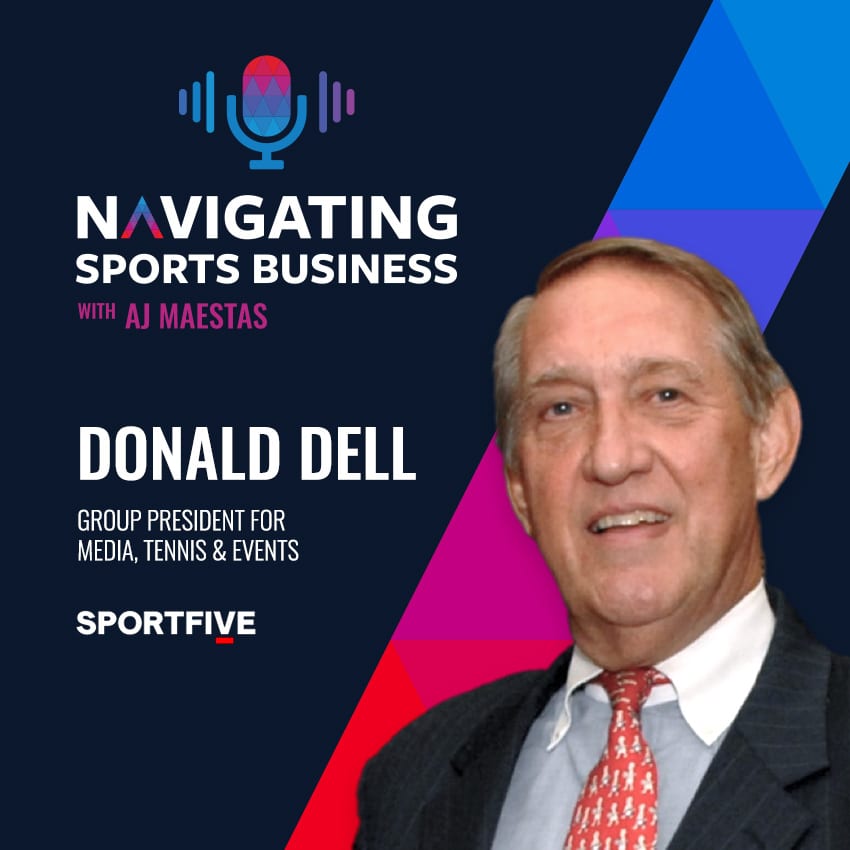
Podcast Alert: Donald Dell – Part 2
The second part of AJ’s conversation with the legendary sports agent to Michael Jordan and Stan Smith focuses on advice learned over the course of a successful career. Donald Dell also gives his takes on current events including COVID-19, and NIL in college athletics.
If you missed it, check out Part 1 for stories about Donald’s work with Michael Jordan, Arthur Ashe, and Stan Smith.
Transcript
+^Donald Dell: [00:00:00] At the end of the day as I get older, the one simple thing I think is passion and perseverance, but it’s really ultimately people skills. How do you relate to other people?
AJ Maestas: Hello and welcome to the Navigating Sports Business podcast. I’m your host, AJ Maestas founder of Navigate, a data-driven consulting firm, guiding major strategies and decisions in Sportfive’s and entertainment. This week is the second part of my conversation with a legend in Sportfive’s management, Donald Dell. In part one, he told me how his Sportfive’s management company began and flourished, shared his adventures, managing tennis greats, Stan Smith, Arthur Ashe, and [00:01:00] basketball legend Michael Jordan. This time we get to hear his thoughts on his family, the Sportfive’s industry as a whole, and his philosophy for building a successful company.
Donald Dell: How are you doing today? I’m doing great. I’m very lucky. My wife and I bought a farm here in 72. We live in Potomac, Maryland, which is a suburb about 15 miles outside of Washington. And we have 49 acres in Potomac. And my wife loves horses and animals, dogs. She breaded German Shepherds for a number of years. We still have. Three horses out in the fields there. And so we’re very, very fortunate. I had twin identical twin daughters who also went to Yale and also went to Virginia Law School. And they are both happily married and one of them has two boys, five and eight. And all of them have been living in our guest cottage since about mid, by about March 15th, they all lived in New York and they drove down from New York when then pandemic had hit hard. And until about two weeks ago, they were still here all summer. So, and then they had to go back to New York [00:02:00] because the two kids had to enter school again in, in mid-September. But can you imagine having seven months with your two grandchildren. Five and eight. And remember, I only had girls. I never had boys always wanted a boy, and they’re running around your backyard. And so we’re extremely happy. And I feel really guilty because we’re doing very well and a lot of people are not, and both financially and, and physically and dying. And we just, we don’t have a national program. We don’t have, you know, it’s all hit or miss. And, and it’s a very simple thing. And I’m not trying to be a.
A prophet or, but it’s not, it’s not hard to understand. All you have to do is listen to a guy named Fauci who gets it 10 times more than me. And that is, you’re never going to have the economy until you control the virus without putting the virus under containment. Your, your economy’s never going anywhere. It’s never going to grow. It’s going to always be diverse and spread out and open and closings. And so you asked me how am I [00:03:00] doing? We’re doing great. And we couldn’t be happier and we’re very, very fortunate. So I hope things change and we get a national policy and we get a new president and we get something going for the country.
AJ Maestas: Well, I’m glad to hear you. Express essentially gratitude in a difficult time. Cause I do think that is a key to happiness and, and grit and resilience and I feel the same way. I feel disturbingly lucky and fortunate given everything that’s happened to our industry during COVID to be in the place that we are. Navigate is somehow thriving. And it wasn’t a strategic move that was just good fortune. Just for fun, you’ve accomplished so much. You know, there’s a feeling sometimes when someone has your life experience and your resume that there’s something you’re doing that others aren’t. I’d love to know your top life hack. Is there something that you do, for example, that makes an outsized impact on your life relative to the investment of time or money?
Donald Dell: Well, I, I think a couple things. You know, my daughter Alexandra, has done very well in digital stuff and when she came to work, she’s now working with us in, in New York, in Sportfive, and [00:04:00] she handled all the digital programming content for Sportfive in America. She’s 47 years old and she’s bright as hell. And when she started with, I told her. You know, two, two things. One, always keep your word. Never. If you make a bad deal, you eat it. If you make a good deal, great. Don’t, you know, be, be humble about it, but keep your word and secondly, have a passion for what you’re doing. I didn’t tell her to come work with us. She’s been with us about seven years, but she was in the movie business before she. I said, worked for a movie company. She worked in California, the move, you know, for all kinds of new, new videos and stuff. So that’s been her love. And I said, you know, you have to have a passion for what you do and you have to keep your word. And I, I believe that very strongly. At the end of the day, as I get older, the one simple thing I think is passion and perseverance, but it’s really ultimately. People skills. How do you relate to other people [00:05:00] now? I think how people deal with other people. Is that whole name of the game. I teach law school for 22 years at the University of Virginia.
I’m still doing it now, and I tell them first day of class, two words, if you never see me again. Two words I want you to remember, build trust, which creates relationships and the whole world is based on trust and personal relationships. And if you can accomplish that. You’re going to be very successful in any endeavor. You don’t have to be a Sportfive’s agent. Sportfive’s lawyer. You could be a chemist, you could be a doctor, you could be anything you want to be. So it’s all about people skills in my mind.
AJ Maestas: I appreciate that and I like that. And I’ve had the good fortune of in our work with what was then, LA Air to meet Alexandra and, and I agree. Who stands out to you, other than all these incredible names, all these famous characters that we’ve talked about, who stands out to you when you look back at all you’ve done and been involved with, you know, those key characters in your life story that we haven’t [00:06:00] talked about yet?
Donald Dell: Well, to me, obviously Arthur and Stan really got me into the business, started my business, and they are both the godparents of my twin daughters. So that’s pretty hard to compare to or accomplish better. So I, I think thinking back to all the different athletes and so forth, I, I think you really try to pick people that you remember, you know, that have great character. Just for example, out of the blue. Mark Murphy was the defensive captain for the Washington Redskins and I represented him only three or four years while he was in Washington. And Jack Kent Cook was the owner of the Redskins and we were renegotiating Mark’s contract. And mark was so bright and Abel I wanted him to be. And, and I had done some deals with. Jack can’t cook. He was living in California and when he, when he had owned the forum and he owned the Lakers for a while. And so I’d done some basketball deals with the, with him. I knew him well and he’s a kind, he was kind of a inconsistent quacky sort of guy. He had a lot of, he [00:07:00] was, he was interesting guy, but. You know, he was very domineering in conversation, you know, and I, so I invited Mark to the negotiations and we went out to, to his farm and sat in his house and ended up negotiating.
This is, this is now Mark Murphy, who was the defensive captain for the Redskins, very important player, and we ended up about 10 or $15,000 apart in the contract. And Jack was adamant and wouldn’t give an inch, and so we didn’t make the deal and we left. And I said to Mark, I wanted you to be in that meeting cause I wanted you to see what I’m dealing with. So the next day I called Jack and I said, Jack, look. We’re five or $10,000 apart in a three year deal. That’s kind of silly. This is your defensive captain. He wants to go to night school, part-time at Georgetown Law School. He’s going to play full-time, but he wants to go to night school cause he is really bright.
He wants to become a lawyer. And I said, if you just pay his legal costs, the first. We have a deal that’s good for both. It’s good for [00:08:00] you, it’s good for him. He doesn’t have to pay taxes on a lot of benefits, and it’s going to cost you about five, $7,000. Jack said, absolutely not. I’m not doing that. I told you it was my final offer and it’s final. And I said, well, that makes no sense in the bigger picture, but I’ll tell. So I go back on the phone to Mark and I said, mark, you know, he, he doesn’t want to budge. He thinks last offer is the best one. And Mark says, well, tell him I’m retiring. I said, wait a minute. Wait a minute. Are you serious? He said, yeah, I’m retiring.
I’ve had enough of this and I want to go to law. I’ll go to law school at Georgetown full-time. So I called Jack and I said, he’s retiring, and I’m sorry we couldn’t make a deal. Jack Slough though. I said, Jack, I want to ask you something. Just as a friend, I made a lot of deals with you. I said, what’s, what’s the deal? Why would you turn down $5,000 of the tuition grant? And he said, I’ll tell you why. He said Mark was very able, but he was a player representative in the league, you know, and when we had all those squabbles and fights in 86, he was a big leader of the players’ union for [00:09:00] football. And that always turned me off.
That’s why I’m not budging. I said, you’re making a mistake because, he’s going to retire. I mean, he’s not, this is, I’m not bluffing. You know me. I tell you my word. I give you my word. I tell you. That’s it. That’s it. And he said, I know, I know, but you know, I really didn’t like him being a player’s rise. Okay. Anyway, long story short, Mark Murphy goes to Georgetown, comes the ad. At Colgate a few years later comes the ad at the military academy. And guess what? Today he’s the president of the Green Bay Packers. Now there’s a guy, has great intelligence, great character. I don’t know Mark that well cause I only represented him a few years.
But I can tell you he made a decision and it changed his life a hundred percent for the better. So I think character matters what I’m trying to say. It’s all about character. When you’re in the field today, you know, managing or representing players, it’s a great business, except the recruiting today is terrible. Why? Because the money has gotten so big that [00:10:00] everybody’s out there hustling and chiseling and so forth. The, if you said to me, well, you know, name four or five guys who are really good in basketball or football or tennis. You pick the ones, the agents, the lawyers, the managers, the representatives who have character, who you can talk to. It’s just like owners. I could make a deal on the phone with Jerry Reinsdorf or Jerry Bus in Los Angeles, and it would never, we didn’t have to have a condo. We’d write one up, but if we said it’s a done deal, that was the end of it verbally. And so I think character is the most important. And of course, I’ve always felt I had two of the greatest characters that I started my business with in Stan Smith and Arthur Ashe.
AJ Maestas: Well, I love that Mark Murphy story. I, I have the good fortune of having met him in his time as the athletic director at Northwestern. And no question. He’s a high character individual. I believe he also was the head of the players union as far as being a representative. And to think, now in hindsight, you see a success as the president and [00:11:00] CEO of the Green Bay Packers, and you’d say easy decision. But at that time, can you imagine the gut wrenching decision to retire when you’re staring at a. Contract when you’re the defensive team captain. That’s character revealing, let’s put it that way. You, you may have answered this question in a way, but in case you haven’t or, or, or this changes your mind, for what in life do you feel most grateful?
Donald Dell: Well, I feel most grateful for my wife or Carol and my twin daughters, Alexander and Christina. Cause you know, at the end of the day. What are we here for? What do you leave behind and what, what do you create? And you know, when you’re gone, your legacy really is your family and your children. And so I feel that I’ve been blessed by, you know, a phenomenal wife and two phenomenal children. That’s my greatest accomplishment. I really mean that since.
AJ Maestas: I love that. So to help anyone young out there in the beginning of their career or aspiring for career in Sportfive, I’d love for you to share something that you wish you had known when you began your career.
Donald Dell: [00:12:00] Never be the smartest guy in the room when you’re negotiating a deal. If you’re negotiating with somebody who, who you don’t think is as knowledgeable or as experienced as you are, and that happens sometimes, don’t take advantage of that in the sense of being obnoxious or arrogant. It gets you nowhere and you know when you’re really negotiating, at the end of the day, it’s all about compromise.
I make deals. I, I don’t blow deals. I don’t always try to get the very most, you know, when you negotiate, you don’t. And this talk took me a long time in the business under, you don’t have to win every point. Win what you think is really important to your client and win what’s, and, and give in on what they say is very important to their client. And the example, you know, I always believe there’s sort of a, a moment of truth. And, and I’m talking about a serious negotiation where you’re talking about millions of dollars. I’m not talking about a $20,000 endorsement deal for a car locally or something, but in a [00:13:00] big deal, there’s always a moment of truth and you say to the team, I have to have a four year no cut guaranteed contract.
We’re just not going to make a deal. Or the club says to you, our maximum money under the cap, we can only pay him x $10 million a year. We, we can’t pay him 15, we can’t pay him 12. The maximum we can afford for four years is 10 million. I’m just making up hypothetical. Four years, both ways. Well, at that moment of truth, if he believes me or I believe him, we’re going to make a deal. If one side really doesn’t believe the other is telling the truth or means his word, you’re probably not going to make it. You certainly aren’t going to make that deal. Then things go down from there. So I always believe keeping your word is a form of that, and I think it’s stood me in good stead over the years because the reputation gets around.
It’s a very small industry, Sportfive that is very lucrative and wealthy, and there’s [00:14:00] a lot of money and it grows and grows and grows because of television every day. The people in it. There may be 800 football agents today, but 20 of them are the ones you want to really talk with, and the great ones are going to be four or five. It’s just that simple. And so I really do believe that you’ve got to learn how to make a compromise. Compromise is good for both and also a compromise gets you referrals. If you make a deal with the company and they may not got everything they wanted, but they felt they were treated fairly and they made the deal, chances are they’re going to come back to you. And so when I was going strong at Proser and we really dominated tennis and for a number of years, we dominated track and field and the NBA. We were, no, we didn’t do much in, in football because frankly, a lot of the football programs were, in my opinion, dishonest. A lot of these major colleges, alumni were already paying the players.
They couldn’t [00:15:00] prove it, but we could tell when we’d go in there to recruit, you know, who was what team, what programs? I mean, there’s one college, I’ll remain nameless, and I sent two people down to go there for what they called Athletes’ Day and Agents’ Day, and they went down there and, and they came back and said, there’s no chance of us in football with this university. I said, why is that? He said, the assistant coaches are all doing that and they’re all on the take. They’re controlling who goes where. So we didn’t get into football in, I represented boomer size and was one of my best clients in football from the University of Maryland, but they were doing it honestly and above where they weren’t paying players to come and play the revenue producing Sportfive, which are basketball and football.
That’s why you’re seeing. Colleges desperately wanting to play in the Big 10 and the SEC and the Pac 12 because there’s so, there’s so much revenue being produced for the colleges there. I mean, take Maryland for example. They didn’t, couldn’t play football and basketball. They’re going to lose 40, [00:16:00] $50 million. They can’t make that up very easily. Unless the state gives them more money, which they won’t at State University. So it, it’s a, it’s a tough time right now for college football and basketball for, for example, it is not as tough for the NFL because television contracts in the NFL are so enormous, just much, much bigger than college.
AJ Maestas: No question. This is a really painful time for collegiate athletics. The, the budget cuts are. Dramatic based on how much season gets played here. I imagine you know about, or have heard about name, image, and likeness. It starting this, yeah, coming summer 21. Athletes for the first time will have the right to monetize their name, image, and likeness as any professional or even amateur athlete would, such as Olympians in a free and open market. I’d love to know your opinion. What do you make of that?
Donald Dell: Well, it’s very simple though. At the same time, the major leagues. The major conferences, I should say, you know, they’re all banding together and they’ve been to Congress and they’re begging, they’re hiring [00:17:00] lobbyists to go to Congress and get Congress to pass a law. Limiting that the NIL you just spoke of. So you know, the only way they could stop it or not prevent it, but contain it, was through a congressional passing law. Now that, that presents a lot of problems politically on both sides, so it hasn’t moved off, it hadn’t gotten done. But you can be sure that, that these colleges are spending a fortune when you, when you look at the NCAA and basketball alone and their Final Four contractors about, you know, for, I don’t know what it was, eight years or nine years, was $9.2 billion.
The last one I mean, they, they can’t afford. To not have these major Sportfives in college, but the players certainly deserve to be paid some reasonable share of that. And the question is, one, what’s a fair formula? How much, and two, how do you, how do you protect and, and honestly conduct it and [00:18:00] distribute whatever they’re earning? It’s a massive problem. And the NCAA, in my judgment, is not competent enough. An objective enough to want to take care of it fairly. Some of the conferences do, and the Power Five is really struggling right now and trying to lobby Congress to pass a federal law I, I won’t say to be unfair, but to certainly contain it because the NCA wants to continue controlling it. Why? Because they’re making millions of dollars. Go look at their budget sometime, or their personnel staffing make you sick.
AJ Maestas: You referenced the professional leagues working to prevent this. Why do you think the pro Sportfive leagues would not want these athletes to have name image?
Donald Dell: Number one, when a kid comes out, they want to be able to come out and be a pro whenever he, whenever they can, they want, that’s their lifeblood. So they don’t want to, they don’t want to contain it and on the other hand, they can play with the pandemic on is what I was leading to because of the television contracts [00:19:00] in the NFL are so strong now, they’re, they’re all still losing money at the NFL level, but they can afford to lose it for a year or so, whereas many of the colleges can’t.
That was the point I was trying to get at, because the colleges by and large. The big ones, they really don’t want to play the pay the players. They certainly don’t want to pay the players what their fair share is. And then you have a different problem. What about a non-revenue Sportfive? Do you pay a a tennis player or a swimmer? They’re non-revenue Sportfive or a women’s lacrosse. Do you pay them? And, and how do you regulate that? So it’s, it’s really complicated and it’s not just simply, oh yeah, we ought to do this, or we ought to do, that’s. Much more complicated than that.
AJ Maestas: Can you share something that you’re working on right now with Sportfive five?
Donald Dell: Yeah, I’m working on a, a life document, a lifetime documentary on the life of a Stan Smith, which is tied in very much to the Adidas, career and his [00:20:00] tennis career and his life and his family life. And we’re, we’re talking to them, we’re actually working with LeBron James’ Company in Los Angeles in television called Uninterrupted, which is looking to do a lot of the content stories for Sportfive. And they approached us about it and we’re working with Stan right now to. See about that, and that’s right. Underway currently as a Sportfive five project,
AJ Maestas: when do you think we’ll be able to see this for ourselves?
Donald Dell: Well, I think it’ll be a while because the pandemic will slow it all down as to, as to when we’re, we’re looking, talking to different. They are proposing, we’re looking at several directors, and then you got to get a, a distributor like Amazon or Prime Video or whatever, and Hulu and Sling and all these different big companies out there, which they’re doing un, that’s what UN Uninterrupted does. That’s LeBron James’ Media Company and they’re damn good, I must say. They’re very, professional. They’re very organized, they’re easy to work with, and my daughter’s very involved with that side of it for us as well. So it’s been a, [00:21:00] Stan is, is my client, but he’s a client with us on this. And it’ll be a Sportfive five deal because of my daughter. I don’t know when it’ll come out. It could be, you know, it could be two or three years from now, but we’re working on it. You asked what we were working on. That’s a big one right now.
AJ Maestas: Very interesting. Well, I’ll be looking forward to that. Last question. You shared what you want to be and believe your personal legacy will be, but professionally, what do you believe your professional legacy will be? Or, what do you want it to be?
Donald Dell: Well, I think I’d like it to be that I was a small part and help start and create the whole Sportfive’s marketing industry really with Mark McCormick, who became a great friend. Mark was the pathfinder. He was five or six years ahead of me, and I, I really followed and copied a lot of the stuff he did. For example, he was with a, a big Cleveland. He went to the Yale Law School. I didn’t know him at all. He was working for a major law firm in Cleveland. He decided that he couldn’t, he really couldn’t do the things he wanted to do in Sportfive’s management. So he left the law firm and started his own company about six years ahead of us, and it was [00:22:00] called IMG International Marketing.
And he really, for a number of years, stayed in his lane, which was. Mainly golf. And I stayed in our lane, which was tennis, and then we crossed over, you know, and he went into everything. And I went into a lot of different Sportfive. He was about two and a half times bigger, but he was a real genius at all. I’ll give you a concrete example. He did the first deal. He was the first one when he had Arnold Palmer in 68 and 69 when he went out to sign Arnold Palmer to a, a golf club endorsement. He didn’t sign him globally, he signed him in America only Then he signed him in China, then he signed him in Australia.
Then he signed him in a European pa. So he had about five golf club deals for Palmer, you know, and it’s just phenomenal. And that was his creative thinking. We did some of the first packaging. We did a lot of the. You know, packaging of events with television and all those things. We, we did the first group photo deal for the NBA. Now it’s a big deal. You know, you have [00:23:00] six players and we did that years ago. And so I think we did a lot of good things. I, I hope and believe we did it honestly, and I think Mark was a terrific leader. You know, he was so successful that a lot of people, you know, criticized him. Cause people sometimes criticized success, but he was always honest and trustworthy.
And with me, our staff fought like hell all over the world. As I say, he had 26 offices. At his height, we had 16. You know, and it sounds great. Until you have to fly to Hong Kong, you got to fly to Australia, you got to fly to Beijing. That, that’s pretty tiring. I couldn’t do that today. Wouldn’t want to. But I do think Mark left an indelible stamp and we sort of went along with him in a lot of ways. And of course now he’s dead. And so I, I’d like my legacy to be that we really contributed as something to the Sportfive business, but we tried to do it in an honest. Decent way. And I think how you treat people and [00:24:00] how you keep your word is really important. And the great ones and the good ones do that.
AJ Maestas: I’m confident that will indeed be your legacy. Donald, you shared with us today, you know, you’re in a car heading up Manhattan to take Arthur as your dear friend to be represented by that very Mark McCormick. And now what we have is you get to be the co-founder. Right of the business of Sportfive.
Donald Dell: Well, I only took him, I only took him there four times. Is that right? Yeah. And, and Arthur, that’s what made Arthur mad after the fourth time at breakfast, mark always liked to have breakfast, like at 7 30, 8 o’clock. Arthur hated that. And that’s when Arthur turned to me. He said, why don’t you, why do you keep taking me to McCormick? I don’t really relate well to him. I don’t feel comfortable with him. Why don’t you do it? And I said, do what? Manage me. And really that. Got me started with Arthur and Stan. So that’s a funny story. It’s all about life.
AJ Maestas: And I think that that legacy is secured, right, as a, as a co-founder of the industry. So [00:25:00] I’m unbelievably grateful for you sharing your time with us. This is so interesting. I hope we can do this again someday and please stay well out there. My thanks to Donald Dell for joining our podcast. If you’d like to join the conversation, email us at INFO@NVGT.com or check out our website at NVGT.com. I’m AJ Maestas. Join us again next week for Navigating Sports Business.