Podcast Alert: Steve Berkowitz
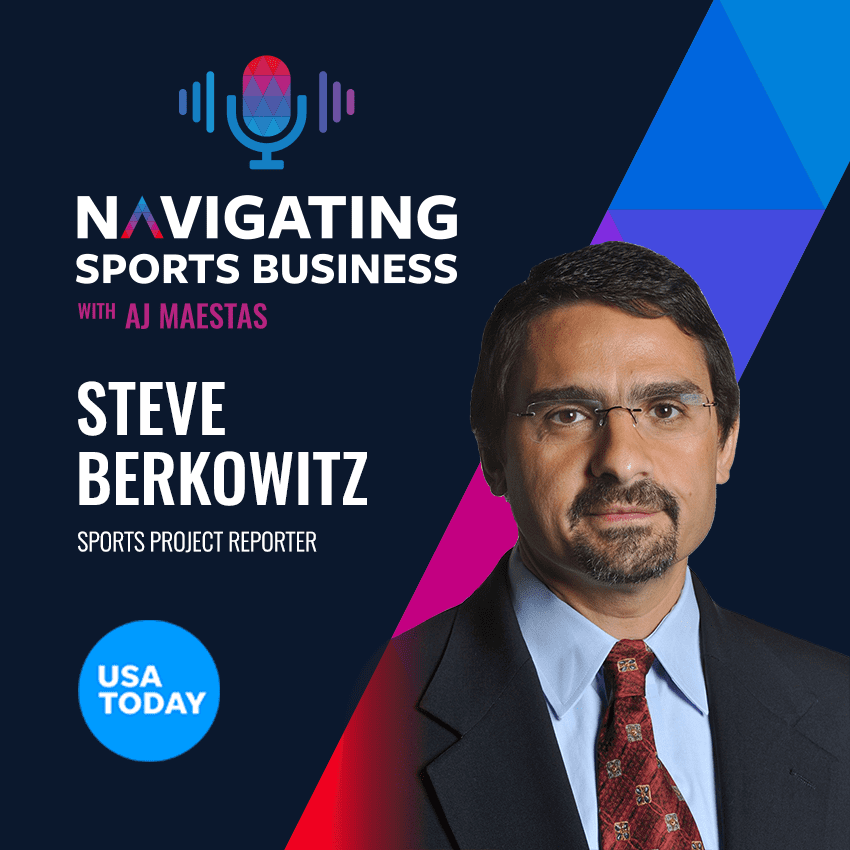
College athletics has experienced a turbulent period over the last 12 months. In that time, Steve Berkowitz – Sports Project Reporter for USA Today – has covered coaches’ compensation, COVID-19, NIL, and more. He brings his unique perspective on the sports industry to this week’s episode of Navigating Sports Business.
In this episode, Steve gives his outlook on the next few years of college sports, and how NIL fits into that equation. He and AJ also discuss journalism in the 21st century and the relationship between the speed and accuracy of reporting.
Transcript
+^Steve Berkowitz: [00:00:00] I think there would be some fans who would turn away from college sports. The greater the compensation is available to college athletes. But there are also a lot of folks who believe that college athletes. Are being taken advantage of and who I think would welcome athletes getting greater compensation.
AJ Maestas: Hello and welcome to the Navigating Sports Business Podcast. I’m your host, AJ Maestas, founder of Navigate a data-driven consulting firm, guiding major strategies and decisions in sports and entertainment. We started this podcast hoping to share the interesting stories and experiences of the amazing people we get to work with at Navigate. And even though they’re visionaries and famous, in many instances, their true stories aren’t often heard. [00:01:00] Since they’re not on the playing field, our hope is you get to know them better and learn from them as we have. Today we are joined by Steve Berkowitz, who I’m proud to say is a friend and spent the last 20 plus years. Covering many topics, but mostly collegiate athletics. For the USA today, one of the things I’m most impressed by Steve and, and grateful that we get to work together and, and talk so often is that he’s one of the few remaining journalists that really rolls up his sleeves and does research. A lot of his work is based on. Really comprehensive research, and I think we all understand that you know, investigative journalism is a dying sort of practice given budgets and constraints and the pressure that that world has faced as far as ad revenue and just the way the business model works. So one of the [00:02:00] last men standing that I think leads with facts and his objective, and that’s what makes it so fun to be able to talk today with Steve about collegiate athletics. So thank you Steve for joining us.
Steve Berkowitz: Yeah. Thanks for the kind words.
AJ Maestas: Yeah. Well, I mean it, I think it’s true. So if you don’t mind, just for a, a teaser how does one dedicate 20 years of their professional life to collegiate athletics and, and covering the subject?
Steve Berkowitz: Well, I started out as, as a reporter covering college sports, and this goes back to before I was with USA today. So just over time, I mean, I ended up doing a bunch of different things as a reporter and then moving in inside as an editor and then over time as a, as an editor, both at the Washington Post and at USA today. And then I ended up coming back more involved in college sports after we did the first of the what become the annual football coaches compensation stories, which went back to 2006. So subsequent to that. I became much more sort of [00:03:00] centered on what doing things with regard to college, college sports.
AJ Maestas: Well, if, if you don’t mind me asking a question on that subject, cause there is a data, USA today has incredible databases, right? Covering collegiate athletics, revenue sources, costs, et cetera. But the coaches’ salary data I think that’s one of your most cited sources. Beyond the obvious, you know, wages have far outstripped inflation. What do you take away from that? Having spent 14 years right? Working with that, what do you see that we might not see?
Steve Berkowitz: Well, I mean, I think as we’ve added different components to it, when we started out, we were just looking at the compensation paid to the coaches. We, over time have added components to the database, including information about not only the bonus maximums that are available to the coaches, but the actual amount of bonus money that was getting paid to a given coach in a given year. And then we’ve also added information about. What it would cost to buy out the coach’s contract if the school wanted to fire them without cause. So we’ve [00:04:00] added stuff with it over time. And, you know, adding different things to it has sort of illustrated different things. So, and I think. Readers have been pretty surprised when you sort of put out there empirically the amount of the buyouts that are connected to, to various coaches and how those have gone up over time. I mean, I think within the, with obviously within the industry, it’s well understood that if you have a longer term contract and contracts have gotten longer over time and contracts, you have more money and more of their amounts being guaranteed that the buyouts will go up. But seeing those numbers. Sort of in black and white for folks, I think has been, you know, a little bit eye-opening.
AJ Maestas: Do you think it’s fair, I mean, knowing everything you know about the business of sports and collegiate athletics, does it seem appropriate, hey, that’s the fair market, or do you think this is an indication of something else?
Steve Berkowitz: Well, I mean, all of these things are negotiated. I mean, you know, everybody gets into it, sort of both sides looking at it. So to me, question of whether or not it’s appropriate or [00:05:00] right or whatever is kind of, sort of beside the point. I mean, this is what. Schools agree to do, and this is what the coaches are able to negotiate to get. So, you know, everybody sort of goes into it, eyes open as to as to what they’re doing. I mean, I think college coaches in some instances, you know, it can be argued that on any given year that a coach is overpaid or underpaid. So I mean, I think there, there are certainly some coaches in certain situations who arguably are being overpaid, but there are other coaches who are making a lot of money, who arguably within. The, just the strict construct of return on investment, even sort of the most highly paid coaches can arguably be said to be being underpaid relative to their return on investment. So, I mean, I guess it depends on sort of the metric within which you view this. I mean, the other side of it is that all of this is, has to be viewed in the context in which. The coaches work. I mean, they’re working for higher education enterprises, they’re working as public employees [00:06:00] and they’re working in the nonprofit sector. So when you look at it against those three. Backdrops. You know, I mean obviously these coaches, the coaches and assistant coaches and athletics directors and coaches in women’s, particularly in women’s basketball, are among the most highly paid people in their state, at their colleges, in the entirety of the public sector. So, I mean, again, I think it depends which metric, you’re looking at these. Compensation amounts and buyout totals. And how does that, you know, what whatcha comparing it against?
AJ Maestas: Well, just comparing it against inflation, you know, it’s way outstripped inflation, which that’s, you know, that’s a generic market metric. But let’s say CEO compensation has experienced a very similar thing, you know, far outstripping, let’s say average worker compensation. You know, if you look at 20, 25 years, you know, if you look at some of this longer range data. I’ve read a few theories on it, you know, sort of saying, okay, well the high performing CEO or coach is worth it, and everyone making a higher believes they’re, they’re hiring that, you know, [00:07:00] outcome. But it is more often than not, you do not, you know, reach that sort of, you know, perfect marriage and success that you are intending to. So that was at least one of the theories on CEO and coaches compensation, right. That each time you believe you’re hiring the person to take you to the next level. And that is actually true. Less than half the time.
Steve Berkowitz: No, I mean, but, but I would say it’s, it’s the same way with entertainers and people in show business or again, like you talked about in, in the corporate world. I mean, those compensation packages have been, again, going against metric of inflation. Those compensation packages are going way up. As well. And same thing in professional sports. I mean, I don’t track what pro sports compensation looks like, but you know, among those coaches that those salaries have been going up as well. So, you know, again, there are a lot of different ways where you’re making comparisons or how do you, how you look at this as to what is reasonable or not reasonable within. Different constructs. Right.
AJ Maestas: Well, how, how has [00:08:00] journalism changed social media? I mean, we all see it, right? We all experience it, whether it’s sports or politics, but, but from your perspective, how has it changed your job and for better or worse,
Steve Berkowitz: Mean it just, I mean, the biggest. Piece of it is that everything has become more immediate. I mean, when I was starting out, it makes me sound like I’m 112 years old, but not that long ago. What you were doing in the print version of your reporting was the controlling piece of how you went about doing things. Now that ends up taking a back seat to getting information out. Quickly. And so, you know, there’s obviously the pressure with social media and everything else to get it first, and obviously the overarching demand on this is to get it correct. So those pressures have, have, have ramped up over time. But that’s, to me, that’s the biggest piece of it is that, you know, through social media and everything else that it’s become, you know, it’s become, [00:09:00] have. As, as fast as possible in all, in all instances, right?
AJ Maestas: I picture it having pressure on you for speed, but you know, that comes with the consequence of something which has to be accuracy. I mean, it’s one of the reasons we enjoy contributing to your work so often, right? Which is that it’s more rare than before and, and probably. Less than the average topic is covered inch deep. Right. You know, so fewer people are taking a longer look at things, a deeper look at subjects. So, I don’t know. I thought it might have put pressure on you.
Steve Berkowitz: Well, no, I mean, I’ve just been, I mean, I’ve, you know, that’s one of the things I’ve been fortunate with is that I’ve been given the ability. By US A today and to have the time and the latitude to try to work on things over a longer period of time. I mean, there’s still certainly instances where the expectation on me is to produce something quickly, as quickly as possible and make sure that it’s correct, but for at a lot of places, which have fewer people than we do in our department, a lot of those folks don’t have that luxury to be able [00:10:00] to make lots and lots of open records requests and analyze that information and, and go through it. So, you know, I’ve been fortunate in that regard that people who are my bosses. Have been willing to allow me to be able to do that.
AJ Maestas: Well, I certainly appreciate the work you do. I just believe it’s balanced and far too often it’s opinion based writing. You know, we can’t really tell the difference between an opinion article and, you know, journalism and, and quite often you just get someone to comment on something, you know, in the moment as opposed to taking a perspective, you know, from both sides. You know, you know, what does the data tell us about coaches salaries? Right. Using that as example since we just chatted about that. What is appropriate, you know, what is fair? You recently wrote a story about, 2020 NCAA revenue being down 50%, and what, what are the consequences of this $600 million one year decline? I’d love your perspective on that. What do you think this means for the NCAA now? What do you think it means for the NCAA going forward?
Steve Berkowitz: Well, what it meant for the NCAA in the period of time that was covered by [00:11:00] that document was that, you know, the biggest thing was the reduction in. The distributions to division one schools and conferences and when the men’s basketball tournament was canceled and the NCAA sort of reconciled all of that, you know, it was pretty clear what was going to end up happening there. Certainly that, that was the biggest consequence for the association and for the schools that are in the association. As far as the future goes I mean a lot will depend on how things unfold with this year’s. Men’s basketball to you know, if they’re able to provide the number of games and the inventory for the television broadcasts and CVS and Turner consequently make their full rights payment to the NCAA as scheduled then for the association and all the stuff that it does with that money, you know, everything should, should level out. And it’ll be just that sort of one year anomaly. You know, obviously if the men’s basketball tournament is impacted. [00:12:00] By the pandemic. Then the amount, the degree to which it’s impacted will obviously. Have an impact on what their revenues look like, and then what ends up being distributed to the schools. Operationally, the central office in Indianapolis has been impacted in some ways. I mean, they’ve had to reduce salaries. They’ve laid off people, they’ve furloughed people. The associations operations have gone on. It’s just, you know, certain things have taken a little longer than they would normally. So on a central office basis, you know, they’ve been, you know, they’ve been dealing with a lot of the same things that athletics departments have been dealing with.
AJ Maestas: Can you help quantify that for me? What does that mean to average power five University versus, you know, lower divisions? What did that cost me on a campus level?
Steve Berkowitz: Well, I mean, it’s the, the dollar figures themselves. I don’t want to say they’re irrelevant, but the issue is the percentage of an athletics department’s revenue annually that comes from the distribution that they get from the NCAA, whether it’s directly from the [00:13:00] NCAA, cause some parts of the NCAA revenue distribution to schools are direct to schools, and some of it goes to the conferences, which then have their own revenue sharing plans for all of their revenue. So what I’ve found in looking at this across the board is that for most. Schools, whether it’s Texas and Ohio State, or schools that are in lower resource situations, and in division one, you know, it’s sort of roughly two to 5% of their annual revenue every year. So obviously that dollar amount is much bigger for Ohio State or Texas than it is for a school in the Big Sky Conference. But in terms of the, the impact on the budget. That’s roughly what you’re talking about. And so, you know, that’s not an insignificant piece of the puzzle, but you know, again, depending on where you are within the ncaa, the dollar values involved relative to television, all, all sorts of other pieces of schools budgets, that’s roughly what we, what you’re talking about.
AJ Maestas: You know, as I understand it, some of those smaller schools, you know, in [00:14:00] your example Montana State, it, it, it tends to be on the higher end of that range, right? It’s more important to their budget and less so, you know, to big schools, you know, that might be, you know, football dominant or have pretty lucrative conference television deals. Keeping that in mind and knowing that what do you think this could indicate for the NCAA? And there’s a lot more than just the, you know, lost revenue from this year. There’s, there’s this, you know, sort of. Public, you know, and national conversation about should these schools all be playing one another? They’re certainly not on a level playing field. Does it make sense, you know, to have a university with one 10th the budget of another university playing what is supposed to be an open, fair, you know, tournament and competition. I’m sure you read the stuff from, you know, the night commission. Highlighting some of these disparities and what that could mean for another entity other than the NCAA, you know, over certain divisions like the Power five. I’d love to have your opinion on it, or I’d love to know what you think about that, or you know, is this a catalyst toward that? Or if it isn’t, where do you see things going?
Steve Berkowitz: Well, I’m not sure that the [00:15:00] dropout of basketball revenue for one year related to the pandemic is gonna deal. Future of what the association looks like, the bigger sort of fulcrum points may end up being other things. I mean, what you were talking about with the Knight Commission had a lot to do with commission’s view of the impact of football revenue, and since football revenue isn’t coming through the NCAA, since the NCAA itself doesn’t have anything to do with the college football playoff or postseason football in the well football bowl subdivision. That, you know, you have those revenue distribution disparities because of how football works and, and, and how all of that is controlled. So there are sort of those underlying issues. And then there may be some fulcrum point as well, depending on how things work out with name, image, and likeness and what schools are willing to do or not willing to do, or what they’re [00:16:00] required to do.
Whether it’s gonna be under NCA rules and whether that’s gonna be permissive or whether or not it’s going to be required by state law or federal law, or a court ruling. So there are still a lot of different things up in the air about what. Maybe driving the future of the association as it stands now as a group of schools. I mean, obviously as you, as you pointed out, I mean there are this, this gigantic disparity between the revenue of schools at the top end and the revenue of the schools, at the bottom end of the revenue scale. And the viability of those schools continuing to compete in different ways remains to be seen. It’s a difficult question. I mean, obviously. You know what, what’s buying large, what a big piece of what binds the schools together are the national championships, particularly in basketball where, you know, at least in theory, you know, any school in the country that’s playing in Division one at least has the opportunity [00:17:00] to go up against, you know, one of the big schools to participate in a national championship.
And how attracted that is for division one schools. And you know, at the lower end of it, you know, obviously a school like UMBC doesn’t beat Virginia every year. In the men’s basketball tournament and UMBC, you know, likelihood of winning a national championship seems pretty remote. But at the same time, you still have schools like Gonzaga and Butler that have managed to compete for national championships in basketball. And as you go into different sports at that are non-revenue, so-called non-revenue sports, you have schools across a much wider spectrum that are able to compete nationally. So sure, there are a lot of different things and reasons why you could, for, you know, why you could see further sectioning within the NCAA or. A group of schools choosing to go their own way. But again, a lot, a lot of what may drive that is still left to be, it still remains to be seen how it’s gonna unfold.
AJ Maestas: What would you predict? [00:18:00] I, you know, it feels to me like we’re inevitably heading toward a division of, division one, a separation of those levels, or, you know, a different rule book, whether it’s driven by a name, image, likeness, or whatever. It just feels that. Anytime you’re in some sort of partnership or economic system where there’s these producers here, you know, at this level with this amount of revenue or whatever your metric might be, and this ecosystem has these very unrelated players, you know that inevitably, even though of course they still need administration, they’re still gonna need some sort of collaboration in some form of association.
It just seems a less and less likely every day to me that that remains in the NCAA. To your point, football is outside of their. Purview, at least for the playoffs and what have you, bowl games and things like that. So you have these decades of experience in watching the evolution of what happens in the collegiate landscape and what drives that change. I feel like your prediction would be as good as any, what, what do you think, uh, three, four years from now, what does this all look like?
Steve Berkowitz: Honestly, I I’m not trying to [00:19:00] evade the question. I just think it’s really hard to gauge. I mean, I, you can make arguments for a variety of different models. You know, they’re, I, you know, I, I can make an argument. For continuation within the current construct of what is now the NCAA, but having much greater federation by sport, I mean there are folks who argue that’s a much more sensible way to go about it and to allow schools to make, you know, conference affiliations based on, you know, individual sport and what makes sense for them geographically as opposed to tying them across all sports into the same conferences where you have. The arrangements sort of, you know, like you have the situation within for example, within the big 12 of having West Virginia in the same conference with schools in the state of Texas, and the reasonableness of. Of having the West Virginia teams in sports, for example, like women’s volleyball having to make those, those travel arrangements back and forth in the same way for the schools in the Big 12 that are in Texas.
As a, [00:20:00] for instance, whether or not it would be a better model to have, allow schools to affiliate based on, you know, what sports they’re playing and what makes sense for them geographically. You know, I, you can equally see another subgroup within the NCAA forming, whether it would be at the top end economically. Or at the lower end, economically, there are a lot of different ways that it could go. And don’t forget that even within the conferences as they currently exist, within the Power Five, there are still huge disparities in what those revenues and budgets look like. I mean, Washington State is playing a different economic game than USC within, not just within the Pac 12. So, you know, these, these disparities are always going to exist and how that all. Falls out is, you know, again, I think it’s really hard to say if schools are given the options to make decisions about whether or not, or to the degree to which they want.
To participate in, you know, different models of athlete [00:21:00] compensation that could end up driving it. I could see a, a future where there is some level of realignment among conferences or competitive sub classifications that would be driven based on that. Just in the same way the Ivy League schools coalesced around the idea of not offering athletic scholarships through May school, BV schools that coalesce around what types of compensation. If they’re prepared to offer their athletes based on, you know, what comes out of. Legislation, either whether it’s federally or across the states, or how various of these court cases unfold.
AJ Maestas: Knowing all that if you had a gun to your head, where do you think in August of 2021, so we passed this deadline for all of this law going into effect in certain states around the country, where do you think we’ll be at? What will name, image and likeness look like, at least for the 2021 football season?
Steve Berkowitz: Whether or not it goes into effect this fall or whatever. I mean, it seems really clear that athletes are going to have a greater opportunity to make money off of their [00:22:00] name, image, and likeness. What the consequence of that will be is still a little bit hard to tell. You’re gonna have different outcomes depending on what’s allowed. And I know aj, you, you and your staff have studied this in terms of what you project. The impacts will be on revenue for the schools. Mean. Obviously there is concern about the impact on revenue for the schools depending on what level of activity athletes are able to partake in. And some of it will have zero impact on revenue for schools, but some of them. Depending on how it works out, may not have immediate impact, but over time could have impact on school revenue. I mean, so I mean, I think your, you know, you and, and, uh, your research team are actually in a better position than I am to predict what all of that is going to look like I said, the one thing that seems clear though is that that’s.
What what’s gonna change is that the athletes are gonna have [00:23:00] greater ability to leverage their name, image, and likeness. Whether or not they will be allowed to get other forms of compensation, I think is still too early to say. And you know, the more ability that schools have, the greater latitude that they have to provide greater compensation. For athletes will potentially be a driver of what the future of college sports looks like and how schools are aligned and potentially what the composition or the segmentation of the NCAA looks like within its membership. I think you’re in a better position to talk about this from a, from a numbers standpoint. And what are the potential impacts on athletic department revenue of athletes. Varying your different outcomes within the NIL. NIL system.
AJ Maestas: We haven’t studied as extensively as you might think, but, but, but you know, we definitely work on a lot of multimedia rights deals, which are the [00:24:00] sponsorship and, you know, deals like apparel deals for universities and campuses and things along those lines. Intelligent deals as well for the, for the conferences and, and. It will cannibalize some of that revenue on the campus level. There’s no question. You know, these multimedia rights, which were often outsourced to companies like Learfield to sell on behalf of the university, there’s no doubt there’ll be some headwinds in those sales, but we’re actually not that concerned about how painful that will be for the economic model of the university.
If you look in the anywhere else in the world, and there’s different models, right? Player unions in the us there’s some of that doesn’t exist, you know, in some of the global leagues, but, but generally speaking, you have to deal with the ability of that athlete to do an endorsement deal versus official partners of the team and broadcast partners and all these things. And it’s not easy and there’ll be mistakes made, but it, it’s sorted out fine, just fine. Right? And it works just fine.
As far as consequences, you know, it does feel like the rich will get richer. It does seem like it’ll [00:25:00] push us towards it’ll change recruiting. I’d be shocked if it doesn’t in a pretty meaningful way. And if you look at sort of a global game of football. There are football clubs in leagues that maybe aren’t, you know, near the top of the world in competition, but some of their clubs can be, Royal Madrid and FC Barcelona have their top three in almost every metric you can imagine as far as social media and global reach and interests. So they’re not in the English Premier League. It doesn’t matter. They have fans all over the world and it affords them the ability to, you know, invest in players in ways in which you couldn’t if you were just thinking domestic or local. And I think that’ll matter for, for university teams, you know, there aren’t restrictions on geographic footprint, so you could have a massive social media following, which helps those players build their following and earn money.
In name, image, and likeness and it can affect your recruiting. There are plenty of examples of talent going all the way across the com country, you know, virtually coast to coast in a place they’ve never been before in a place they probably won’t spend a lot of time with after they graduate [00:26:00] college. But you know, that’s their fit as university. So I see some pretty significant impacts on sport and ironically, I don’t see the concept of name, image, and likeness and the revenue that will go to endorsements as being that big of a deal. On the economic model that it competes with sponsorships media, right. It’s the other stuff where I see it being a real game changer.
I don’t know if that sparks anything for you, but I don’t even know if I should call that a concern because to consider collegiate athletics, a level playing field is a little silly. It is a level playing field today. Right? We just talked about division one football programs where the athletic department budget is one 10th out of someone they might play on any given Saturday. So that’s not a level playing field. I don’t know. You see the numbers every day, right?
Steve Berkowitz: No, I mean, and, and the differences between, in terms of the budget of schools that are in the Mid Eastern Athletic Conference and the Southwestern Athletic Conference. I mean, the disparity between the budgets of, of some of those schools and schools like Texas and Michigan, it’s greater than one 10th. I mean, it’s, it’s bigger than that. [00:27:00] And we get into the recruiting part of it right now. I mean. Even in the current environment, you’re seeing Alabama gets pretty much, you know, a lot more of the better football players than schools in the Mid-American conference.
So I mean, how all this will tilt recruiting in the bigger picture. Again, I’m not sure how much of a difference that will make. I mean, the bigger, the bigger and better resourced schools will continue. By and large to draw most of the best talent it would seem. But there were some interesting things that went on, you know, within the culture socially and in a number of different ways where you saw, for example, this past year in basketball, there were a number of really prominent recruits who chose to pick HBCU institutions to go and play. So, you know, or what the impact of the G League would be, for instance, in what, where basketball players go, you know, so I mean, there. There are variety of, of different things, but I think as you pointed out, I mean the, the rich tend to get richer and the, the [00:28:00] level, the competition, the, the playing field, you know, at the moment is not level. And I don’t think anybody in college sports would tell you otherwise that that’s why you have different stratifications within the NCAA’s membership. What sort of consequence this ends up having in how schools are aligned, I think is a much tougher puzzle.
If schools, for example, like Duke or Vanderbilt, choose not to want to go a certain way within a certain compensation environment. For athletes, whether or not that would be a driver of something remains to be seen. I mean, so I can easily foresee a scenario in which not much changes in terms of how schools are aligned or what the NCA looks like. But you know, like as I mentioned before, I mean, there are a lot of different potential models for what the NCA could look like. I mean, and the association within Division one is trying to take a look at the big picture of the vi, you know, the future financial viability of division one and what that looks like. I mean, [00:29:00] and that’s like a gigantic area for the NCAA. For the schools to tackle, but they’re gonna take a look at it.
AJ Maestas: Yeah, no question. This is no knock on the NCAA. I know it’s packed full of great people trying to do great things with a great intent and mission in mind, but it’s just not realistic to see them being able to reign it in. And, you know, if Congress is push, put it, you know, what can they do anyway? Right. If this is written into law.
Steve Berkowitz: No, and, and realistically it’s very difficult for the association. Again, when you talk about. The central office, this is different. I mean, the association is the schools and I think college sports fans generally lose sight of that, that the, the association’s rules are made. By the membership in division one. It’s not one school, one vote the way it used to be, but it’s still a form of governance where representatives of each of the conferences have a say. There is weighting of those votes, which gives a little more influence to the schools with, with greater revenue. But you know, the association and the [00:30:00] rules and all of those things are made. By the schools and their representatives.
AJ Maestas: Well, I don’t mean to put you on the spot, but to force you to answer yes or no. I’ll qualify it by saying, will athletes in the next decade receive cash compensation above and beyond academic credit tuition? Beyond. Other, you know, in-kind benefits from a university, but cash compensation from athletic departments, not from external sources like name, image, likeness. If, if you were forced to predict in the next decade if that’ll happen or not, is that a yes or a no?
Steve Berkowitz: I think there is a decent chance that that will happen unless the Supreme Court bars it. I mean, there’s a, and I think there, and I think there’s a decent shot that the Supreme Court will give the NCAA. Some relief relative to the injunction that is currently in place. So that may tell the tale. I mean if, if the model that was left in place by the injunction that’s being challenged, if that was [00:31:00] left in place, I would say, I would say there’s no doubt that cash would be, and that would be being paid to athletes because I think schools would be willing to provide if they were allowed. I think there are some schools that would be willing to provide athletes with cash. As reward for academic achievement, and you would see, I’m not sure that every school would do it, but I think that some would.
But you know, again, if legally there’s greater precedent that’s put in place by the Supreme Court, that could potentially prevent it. Unless, again, unless Congress comes in and says. Do this, and so far, even the most liberal version of what Congress has talked about, which is the legislation that was offered in the last session, the Booker Blumenthal bill does create a mechanism where there would have to be revenue share with athletes in certain sports that bill contemplates a form of [00:32:00] revenue sharing with the athletes, and that would be cash, revenue share. Whether or not that piece of that bill could go forward. You know, remains to be seen. That’s a pretty far reaching idea. And I’m not sure that there would be a majority of legislators in Congress who would be willing to set up that kind of an arrangement.
AJ Maestas: It’s interesting that these athletes have the same perspective.
You know, what you would hear from, I think a large amount of fans and traditionalists would be that, hey, this is runs the risk of killing collegiate athletics. It’s gonna destroy it. I’m not gonna be a fan anymore. They might as well be pro sports. You know, it’s becoming the NFL as an example of talking about college football. What would you say what would you say to those folks? Do you think that’s a real risk? You know, we, we study these things. That’s what we do at Navigate, right? We just did this Gen Z study looking at the next generation of fans, and 21% are NCAA football fans as compared to about 33% of other generations. Now, that’s not unique to college [00:33:00] football. I mean, but much of sports is losing the fight against these devices, and there’s still time since about half of Gen Z still hasn’t entered college. You know, that would be an indoctrination moment, right, of course, for fandom.
Even when you look generation over generation, they’re lagging interest in the sport. So there’s certainly that challenge, right? The the next generation of fans. And then there’s the past generation of fans, you know, people our age and older, many of which are uncomfortable with this, you know, or disagree with this being a part of the mission of the university or fitting with their vision of amateur athletics. To summarize that all or, or to wrap it up, I would love to hear your feelings about that. Do you believe that we are running the risk of harming collegiate athletics?
Steve Berkowitz: I think there would be some fans who would turn away from college sports. The greater the compensation is available to college athletes. But there are also a lot of folks who believe that college athletes are being taken advantage of, and I think would welcome athletes getting greater compensation. And [00:34:00] I think also in as it as pertains to the broader. Fan affinity, and I know this is stuff that you and your colleagues at Navigate look at. And I’d be curious what you think that in places like Alabama and Nebraska and other states where there is huge passionate interest around the teams, not just football, but in any sport of, of a college team, and that is a big driver of fan interest, intelligent ratings and everything else, whether or not that would be diminished.
By the introduction of greater compensation, when there isn’t a competing professional sports team in that state or in that area or in that region, whether or not folks will root for the school’s teams, sort of in whatever way. They are fielded whether those athletes are getting much greater compensation than they’re getting now. Will people, you know in Alabama be less passionate about [00:35:00] Auburn and Alabama and UAB than they are now? I would’ve a better sense of that than I would.
AJ Maestas: I certainly have a hypothesis, and in that it fits with what you’re, I think what you’re indicating. And, uh, we do have evidence from related type topics that we’ve researched and that is true. Rural markets obviously stronger connection to those universities. If you look at the SEC footprint and you look at the growth of pro sports, they were later to those markets than they were in others, and there’s still not that many pro teams in those markets competing for time and attention as there are in other markets. The Big 10 lot of rural, you know, locations of those major universities juxtapose that to the PAC 12 and it’s not a apples to apples, obviously because. Fan apathy is a thing across pro and collegiate athletics in the West coast. There’s just other priorities. I think there’s just other socioeconomic reasons, right? That that is true. But even on a relative basis, you see a lot of those universities in major markets [00:36:00] and having to directly compete with the open arms and fandom of all the pro sports leagues. And that’s a challenge. There’s no question that’s true outside the West Coast big market. Universities have a higher hurdle to clear, you know, in attracting fandom and passion and loyalty. So yeah, I I think what you were indicating was that it won’t bother folks in some of those markets as much as in, let’s say large markets and major cities and those teams that are succeeding. You know, one of the unfortunate things about sports, but it’s pretty consistent, is if you win, people tend to look the other way, whether they consider exploitation or ethics or whatever it is. You know, that is supporting that, let’s call it cheating. When we talk about collegiate athletics, I think people have an issue with it when you’re not winning. But unfortunately, I think we’re, we’re, we’re able to rationalize a lot of things away if our favorite team is successful,
Steve Berkowitz: and I’m sure that there are to, to, to some fans that if that there concern will be. Not whether athletes are allowed to be compensated, but it’s like, okay, well if these are the rules by which [00:37:00] everybody is playing or by which everybody can play, there will be, a segment of fan bases that want and expect their school to do whatever it takes to attract the talent necessary. It’s permitted, but not required. That athletes get cash compensation of some kind. The expectation I think in certain segments of fan bases will be, Hey, you know, do what you gotta do in order for the team, in order for our, for our team, for our school to attract those players that will allow the team to be successful.
And that may well be balanced by some people who just turn away from it and say, you know, I’m not interested in seeing athletes who are, you know, who I view as being paid, you know, as opposed to being students. I think there are things that sort of counterweight it. And it’s really, again, it’s difficult to gauge what the end outcome of that looks like, particularly given the other factors [00:38:00] that you talked about that are already eating at the future fan base of college sports. Like when you played, like you held up, held up the phone, how so, and how all those things interact and you know how. Future generations. The younger generation of people view the importance of college athletes not being paid in a, in a way that is comparable to pro athletes and whether or not that really matters. To younger people than it matters to people who are accustomed to a certain way of the things being done.
AJ Maestas: Well, I liked your earlier point that there are people who will be disenfranchised, but there are also people who view it as exploitation and, you know, they will be. Cheering for the rights, you know, for those athletes to be compensated in whatever form it might be for their time and talent. You know, one of the things I don’t think is discussed often in these circles are the alternative paths that [00:39:00] student athletes have. We spent the last three years working with the G League. They are progressive, you know, and they are proactively moving themselves toward. An alternative there, a secondary league to the NBA which, you know, they’re wholly owned and operated by, you know, NBA people. There is a path to go straight into the G League and the teams are, they’re looking for a 30 for 30 model. You know, each NBA team has a near, geographically nearby. G league team making it really easy to move back and forth across that roster. And the movement across those rosters are more than I think most people would realize.
I think it’s, well more than half the players, you know, move up at some point. So the fluidity of that creates a pretty quick and easy path to getting yourself to the NBA being paid. Not as well as NBA players, obviously, but I think the future involves. The G league paying better and doing the things that commercially would allow them to pay better. So there’s a path there for basketball in which you, if a degree and the experience of what happens on a university campus, you know, is not a priority for you, you have an alternative. The [00:40:00] same is true for what will be, you know, version three here of the XFL, and there’s been many other attempts.
Can navigate, got to work on the launch of the XFL and it’s not easy and it’s not gonna make money overnight, but we believe that there’s absolutely, you know, demand and a marketplace there for another pro sports Football league Spring seems like a good fit to me, and that would, again, offer another path. In fact, there were some existing student athletes who weren’t eligible yet for the NFL. They hadn’t served their three years of time right, to make them eligible. Who took that option to play that second or third year or what have you in the XFL and to head on to the draft. So there are alternatives it’s coming. Which, which takes me back to that question. If I could put you on the spot with a yes or no answer.
Does the NCAA look materially different in the next few years? You know, whether that be the Power five and, you know, administering themselves as a separate entity or, or massive rule changes beyond what we’ve discussed today. If you were to look in a crystal ball and say, yeah, you know, next 3, 4, 5 years, I see. [00:41:00] Radically different NCAA or, or, no. I just see an iteratively changing.
Steve Berkowitz: I tend to think that current structure will continue to exist. You know, athletes will continue to get more benefits, whether or not, and what that’s gonna look like. Whether it’s gonna be cash from the schools, or money that comes from names and likeness deals, or whether they’re benefits like enhanced health benefits or. The opportunity to have grad paid for all those things, I think are continue to get greater benefits still. And, and also how you, how you measure change within the NCAA. I mean, I, I think it is possible that some of this stuff will trigger another round of conference alignment or realignment. So, but even if you had a breakaway by a group of schools from what is currently. A A, there would still be a desire among those schools for some sort of [00:42:00] centralized structure in some ways that they would work together collectively.
That is going to look something like the NCAA, the way things look right now compared to the way they looked five years ago or 10 years ago prior to the Ed O’Bannon case being launched. Things look a lot different there, but the basic underpinning structure of the NCAA and the alignment of those schools still looks a lot the same as it did then. So until, you know, you see something that triggers, you know, like a big conference realignment or something along those lines, or where the NCAA enough schools in the NCAA want there to be sort of a different dealing with football. Revenue. There are a lot of things that lean towards the sort of basic existing setup, remaining the same. It’s just a question of what does it look like within, there are a lot of different ways to rearrange the pieces [00:43:00] inside that same box. There are a lot of different ways to arrange the pieces.
AJ Maestas: Well just to wrap some things up, we have a couple quick hitters that just, you know, just for fun stuff. What is the best piece of advice you have ever received?
Steve Berkowitz: I’m not, I’m not sure that it’s necessarily a piece of advice as opposed to just sort of an ethos is to try to, you know, is to do everything that you can to get it right. Yeah, that’s fair. Get it right and get it fair.
AJ Maestas: That’s fair. I’ve had some guests recently say, Roger Veer Notre Dame Legends, say always do the right thing. I’ve heard I can’t remember it was phrased differently, but I believe I believe it was Greg Sanky, the SEC commissioner said. You know, never the wrong time to do the right thing. Something along those lines. I’m doing this off the top of my head, but I like that it’s in line with other guests we’ve had. Okay. Last question, I promise. What’s your top life hack? Like, what is the top practice, which yields great returns to you personally or professionally?
Steve Berkowitz: See, not nearly smart enough to [00:44:00] have those kinds of things. I’m still, I hate to admit it. I’m a sufficient ludite that I’m not sure that anything that I do could actually be considered a hack. Which is, which is kind of sad, I admit.
AJ Maestas: Well, you know, it’s fun to learn things from others. You know, I’m, I’m most people listening to this will not have dedicated a career to covering, you know, collegiate athletics. They won’t know the pressure of deadlines and, and the need for accuracy or the pressure for storytelling while adhering to facts. I was just hunting for possibly something that makes us all better because. We learned something from you.
Steve Berkowitz: It’s, I sort of always seem to tend to end up doing things the, uh, the long way or the hard way. And learning, learning, learning. By making, learning, by making mistakes.
AJ Maestas: You probably live with more peace than the average person since you’re probably not running around looking for those kind of things. Well, it’s always a pleasure to catch up with you. I am so grateful for all that we get to do together when we’re. [00:45:00] You know, investigating collegiate athletics and trying to learn more or more accurately reflect what’s going on. So thank you for that. And thank you for joining us today. Again, Steve Berkowitz, for those who are meeting you for the first time.
Steve Berkowitz: Thanks a lot for having me on.
AJ Maestas: If you’d like to join the conversation, email us at INFO@NVGT.com or check out our website at NVGT.com. I’m AJ Maestas. Join us again next week for Navigating Sports Business.