Podcast Alert: The $30B Lakers Pitch & the Birth of Skydance

The Lakers just sold for a record $12.5 billion. Their new owners are already telling investors the team will be worth $30 billion by 2037.
AJ & Charles debut a new episode format: each brings one major sports business story to the table for their discussion.
AJ breaks down the Lakers’ sale, the investor pitch behind the $30B target, and how Navigate’s Franchise Intelligence Tool valued the team within 1% of the final price.
Charles covers Paramount’s $110 billion acquisition of Warner Bros. Discovery, now officially Skydance and what it means for CBS Sports and TNT Sports. For more, you can revisit how our predictions held up from when Netflix was the buyer, in an episode we published in December of 2025.
Timestamps:
- 0:25- Story #1 – The Lakers’ $30B price projection
- 12:35 – Story #2 – Paramount-WBD deal closes
Transcript
+^Charles Rolston: [00:00:00] Welcome to another episode of Navigating Sports Business. I’m Charles Rolston, joined always by Navigate’s founder, AJ Maestas, and we’re doing a new format this week. We each brought one major sports business story to discuss and break down the numbers. AJ, what are you starting us off with?
AJ Maestas: Well, I, I wanted to talk about the Lakers just because they sold for 12 and a half billion, so record-breaking price.
It’s 25% more than they sold for just a year earlier, which was a record-breaking price. This is for all of sport, not just, you know, uh, the NBA or the Lakers. And I think it surprised a lot of people. Um, our model, by the way, uh, pegged it at 12.6 billion, so I’m proud of our team on that. Uh, I, I wouldn’t have guessed as much.
Uh, but yeah, um, m- even more exciting, I think, actually, than just what they sold for is their investor pitch deck. What they did is set out expectations for 10 years from now, [00:01:00] in 2037, that the value will be 30 billion. That’s their expectation. They have a bold case or an optimistic case that projects it being worth 62 billion.
So I don’t know if you’re an investor or you’re just following this stuff and you think it’s interesting and you’re like, “Wow, how do these prices keep going up so much so fast?” You hear someone saying, “Well, hey, folks, expect 30 billion in 10 years from the 12 and a half billion to be paid,” that, that kinda catches your attention, right?
Um, so you’re an institutional investor. You’re, uh, looking at these private equity transactions. You’re thinking about what college athletics might be worth. Uh, whatever. I mean, if you’re someone who cares about sports business, you’re noticing these numbers, and you’re asking yourself, “What the heck’s going on here?”
Uh, just for some background, the, the biggest assumption in this projection that says they’ll be worth 30 billion in 10 years is, uh, that the NBA media rights will double in that timeframe, and that the next deal lands, you know, right around, I guess, before that valuation, so it could just take a big step up there right before, you know, 2027.
Um, some of the other levers are they are projecting a doubling of [00:02:00] overall revenue, so that includes ticket pricing, sponsorships, international. So as an example, they identified 6,000 broker-held season ticket plans that they plan to take back and sell on a single-season basis. Um, they expect that to yield almost a million per game or 35 million over the full season just from that one little ticket arbitrage opportunity.
Obviously, they’ll look to cut costs, but, uh, but yeah, the Lakers. Lakers sell for 12 and a half billion, 25% more than a year before. Expectation that in 10 years it’s worth 30 billion. I, I think that’s worth talking about, right?
Charles Rolston: Yeah, I mean, the 25%, uh, essentially a year from when it was sold prior, I mean, that’s shocking to me.
Um, kudos to our team, you know, uh, getting within $100 million of a $12.5 billion valuation is a pretty good day for our model. You know, what really jumps out to me is the difference and the gap between those two targets, that 30 billion you mentioned, and then the 62 billion on the upside. You know, $30– $30 billion is the big headline, but [00:03:00] that 62 billion is the number that you put in front of investors if you’re raising a fund.
So what do you think about that $30 billion, uh, dollar number first? Do you think those are realistic numbers when you do the math?
AJ Maestas: I, I actually do, and it took me a second to get there. I mean, it’s my job to be good at forecasting like this, but it, it, it, it caught me off guard at first, uh, and I had to dig in a little bit.
So as I mentioned before, they need to double their revenue in 10 years. That’s pretty realistic. Doubling your revenue in 10 years is only growing at 7.2% per year on a compounding basis. Uh, the NBA’s actually done better than that in the last decade or even 20 years. In fact, uh, they, they clearly more than doubled over the last 10.
So the question is, can that steep pace of growth hold? I do think that’s realistic. You know, the Lakers are a prestigious team, an incredible marketplace. There’s so much potential, right? With international revenue and the way the world’s cha- changing from like a technology perspective. But, um, but there, there’s some parts that would need to hold that, that I’m a little more skeptical of.
[00:04:00] But backing out of fundamentals, because let’s be realistic, these sales aren’t really about fundamentals. I mean, you wouldn’t even do a valuation based on revenue if we’re talking fundamentals. It would be on like profit, earnings, or potential discounted cash flow analysis or something like that, right?
So we’re really talking about scarcity here, and, and I think it’s a, a good reminder for our friends listening that, you know, we’re, we’re talking about something that is like a fine piece of art. If this were a Picasso, you wouldn’t be asking about the economics or fundamentals. It’d be about scarcity, and there’s no doubt there’s scarcity with what the NBA offers, right?
There’s only so many teams. Um, so the question to ask is, 10 years from now, will there be more billionaires, or in this case deca-billionaires, than there is today that want assets like this? And I think that’s a pretty safe bet, especially when we’re talking about prestigious asset like the Lakers. You know, this just isn’t any pro team globally.
This is one of the five, six, seven, eight, um, clubs in the world that instant relevance, right? So, um, I’m getting down the rabbit hole a little bit, probably too much here, but think about it. Will it have enduring value? Will people wanna buy it [00:05:00] 20 years from now? A lot of really wealthy people are into sort of, um, asset protection and wealth, you know, preservation.
Uh, they want a diversified portfolio, but it’s a lot more valuable to avoid going to zero if you’re this rich than it is, you know, doubling, uh, your, your net worth. So there’s reasons beyond this. Um, a lot of people don’t know that you can depreciate a, a pro sports team over 15 years, so that’s a nice little sort of tax shield if you’re earning money over the next 15 years.
But, um, anyway, uh, you can’t really think about it as far as fundamentals, and that’s what makes this assessment really hard. It’s hard to forecast. But, uh, yeah, the revenue multiple in this scenario is 18, 20x revenue. Uh, so 10 years ago it was averaging about 9x, and, uh, 20, 25 years ago it was about 3x. So will that revenue expansion keep taking place?
Uh, I’m sorry, the multiple, right? The valuation multiple, will that continue to grow? That’s a big question, and that’s the stuff that makes 62 billion start to look Pretty crazy. I, I, I [00:06:00] wouldn’t bet on that part. Um, but, uh, yeah. Am I being too skeptical here? Because I always feel like I’m the curmudgeon, and I’m the one that’s too conservative.
Because I wouldn’t have guessed 12 and a half billion. Our team did, but I wouldn’t have.
Charles Rolston: I just– I, I think when you see that $30 billion headline, you know, you, you just, you’re taken aback. You’re like, “Whoa.” Like, I, I, I didn’t, I didn’t think that sports franchises could get that high. Just because the sales recently that we’ve seen are just starting to cross that $10 billion threshold, so you’re saying to yourself, in 10 years, you know, we’re essentially gonna get to triple that?
You know, that, that, that does sound a little bit, uh, far-fetched. But yeah, when you do the math, uh, on, on the annual growth rate, it doesn’t sound that reasonable. And over the last 10 years, the Lakers grew something like 16 or 17% a year, so that’s where that $62 billion upside case is, is coming from. You know, that’s around 15% a year.
Could we see that type of, you know, sustainable growth over the next 10 years that we’ve seen from the previous decade? I mean, maybe, but, you know, there’s a lot of, uh, [00:07:00] different levers that you’ve talked about that, you know, the Lakers have to pull themselves, but are also extenuating factors that could have an impact on suppressing that valuation.
You talked about, you know, the, the media rights cycle. You know, we haven’t talked about the CBA, but there’s gonna be another CBA negotiation there. You know, half of what comes from that national media deal has to go to the players. So how do you, how do you suppress costs when, you know, 50% of your largest revenue piece is going towards player payroll?
Um, you know, I think that there’s, there’s a lot of different levers that you can talk about on, on what could capture that growth or potentially su- suppress expenses moving forward. But which of the ones of those levers do you trust the least moving forward?
AJ Maestas: Ooh, I’m gonna go in reverse order, uh which I, I know doesn’t make much sense, but, you know, let’s talk about that growth rate.
You know, 16% a year they’ve been growing. We’ve had the good fortune of, of working with the Lakers in the past, and there are and were some old school things about the way they were run. So, you know, when you talk about a growth rate, it’s over [00:08:00] against what base, you know, and what is the future potential.
So it looks easy to double in 10 years considering their current trajectory. I think they’ll be fine because of the global growth. Remember, you’re buying also into something that owns a piece of NBA Europe and Africa and, you know, uh, I think everybody knows the NBA’s done the best job at, at, uh, putting themselves in a position for global growth, global rights, et cetera.
Um, but again, we’re betting on the future here, not, not what they’ve done up to this point. So the growth rate, I think you can count on it. I think it’s pretty reliable. Uh, but, um, there’s I’d say two parts I think I’m more skeptical of. The media rights scares me a bit. Now, I think the league deal doubling in 10 years, I think that’s realistic.
Again, that’s a 7.2% a year growth. I mean, the last media deal grew at a much higher rate from the prior deal. Uh, we do see declining ratings, but, you know, there’s tailwinds, right? Global interest, all this other stuff, other assets they’re creating. So I think it’s a pretty good bet the league rights double.
But more than half of the Lakers media revenue comes from their RSN deal, [00:09:00] and if you look at the RSN deals, everybody knows that’s a tough landscape right now. You might say LA is a great market, but, you know, uh, the RSN doesn’t apply to global potential. So I think they’re getting about $180 million a year out of their RSN deal right now.
The average pro team that has an RSN relationship, you know, NHL, MLB, NBA, they’re getting about 50 cents on the dollar with their newest deals relative to what they had, you know, in the heyday. So that’s a little bit of a risky number. That would be my second one, and the one that I’m most skeptical of, the one that worries me the most is the, just the earnings multiple, the valuation.
Uh, now here’s where I’m gonna be wrong and too conservative. Uh, you know, this franchise intelligence model that we built has been shockingly accurate. Our team has been really accurate the last few predictions on franchise values. Uh, I was conservative. I was on the record on one of our prior podcasts if folks wanna listen to it on the Seahawks valuation, and the model was right on.
So I’m probably wrong, and I’m probably too conservative here, but here’s basically my opinion on the 18, 20X, [00:10:00] uh, revenue multiple, uh, that, that this implies It, it has again six plus X’d over the last 20 plus years. If you look at the stock market overall, we’re at all times high in a price to earnings ratio.
Every time someone says it’s a new world we’re in, you know, the old rules don’t apply, and that’s somehow true. You know, it’s not like a law of physics that we have to go back to fundamentals and the valuation of like, you know, the stock market or pro sports teams, but it just feels like a bit much.
We’re on a 17, 18 year run of the stock market going up, and I, I keep talking about that because it’s an interesting parallel. It’s pretty clear I think we’re in a bubble right now. Now, I’m wrong, of course, if AI is just, you know, creates incredible earnings growth for everybody in the world. But it seems like there’s– It just seems a little rich, it seems a little frothy to me right now.
And the reason it’s relevant to this world is that the majority of the wealth of these people, these people that are this wealthy that can buy these teams, is tied to the, their ownership in businesses and private equity funds and real estate and the stock market. So, um, how often has the US gone on a 27-year run [00:11:00] of that kind of growth?
It, it hasn’t actually. So, uh, this is the skeptical AJ sort of saying, “This just can’t continue forever. If there’s a downturn, what does that do to the revenue multiple that values pro sports teams?” Well, it might surprise you that the last really brutal downturn, ’08, ’09 didn’t impact the multiple that much
Charles Rolston: I read two different headlines, and I get two different assessments of, uh, the US’ financial conditions right now.
You know, stock market hit all-time high earlier today. Uh, yields are going up at a parabolic level. You know, inflation’s going up. I can’t really tell if we’re in tight or loose financial, you know, conditions. And, and I think that does have a lot of impact on, um, not necessarily wealth creation, although it will have some type of indirect impact on that.
But also, you know, where do these type of wealthy investors and potential prospective team owners want to park their money? And maybe it’s in a resilient asset like, uh, you know, sports franchises that are scarce and, you know, that are resistant to any type of economic [00:12:00] downturn. So, you know, I, I think that the argument could go b- either way in terms of is it gonna create even more froth for people trying to get in.
I think a lot of the stuff that you mentioned about what the leagues can actually do themselves by raising the debt cap and, um, you know, reducing some of the restrictions on institutional and private investment, I think that those are gonna increase the froth as well. So y- yeah, when I saw thirty billion, sixty-two billion, I thought it was crazy when I first saw it, but then when I actually started to do the math myself and, you know, take a diligent look and do a peek around the corner, I mean, yeah, I’m probably not gonna bet against it, to be honest.
And I, I think that this honestly transitions well into, um, the next topic that we’re talking about. You talked about the Media Lever, the national rights deal, uh, that’s gonna be up for renewal, you know, being one of the biggest pieces that, you know, are potentially up in the air and have a large impact over, uh, future revenue potential.
Um, big news was that the Paramount/Warner Brothers Discovery deal, you know, officially closed as [00:13:00] of this morning. The new company is called Skydance. You know, we talked about this back in December. At that point, Netflix had agreed to buy Warner Studio and HBO Max for eighty-two point seven billion dollars, and Paramount came in over the top with a hostile bid for the whole company.
You know, Paramount ended up paying thirty-one d-, uh, dollars a share in cash and about a hundred and ten billion, including debt, which Netflix decided not to match. And Netflix actually, due to a provision in that terms of, of their agreement, was that they walked away in February with close to a three billion dollar breakup fee, uh, that Paramount had to pay.
So I think we transition to the sports story The sports story is really the difference between those two bids. Uh, Netflix only wanted the studios and streaming. Paramount paid about $27 billion more to take everything, including the cable networks, and that’s where TNT Sports sits. And in December, we valued those cable networks at around 26 billion, so that number held up true.
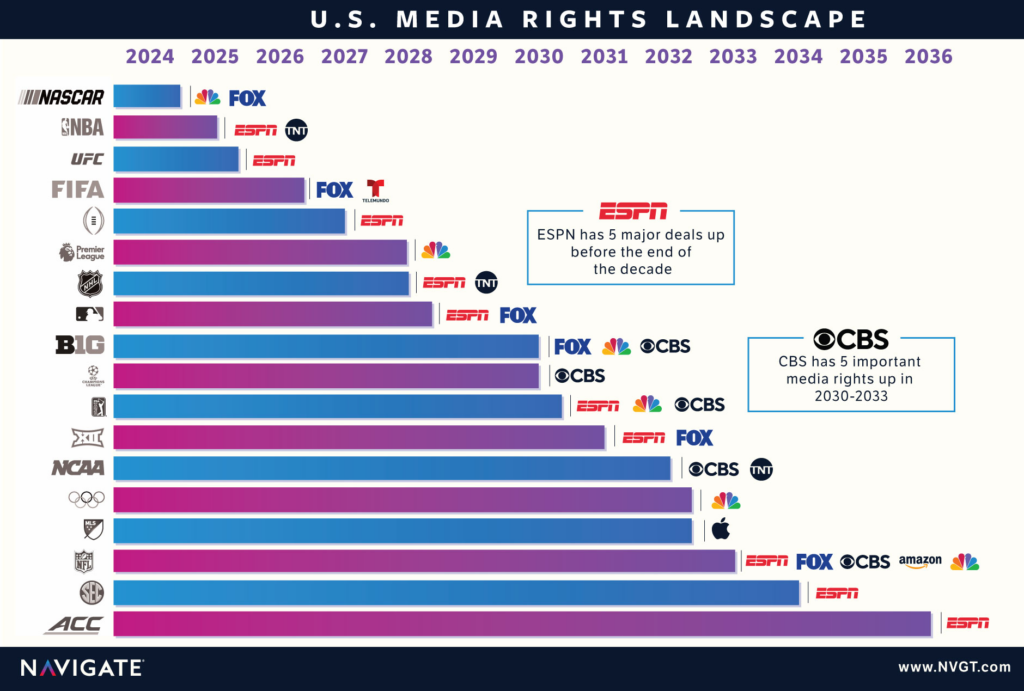
Um, so we [00:14:00] look at what is actually going to be part of this new company’s umbrella portfolio. We have CBS Sports and TNT Sports under one roof. That’s the NFL with rights at about $2.1 billion a year. We have close to all of March Madness at 1.1 billion, plus the College Football Playoff, the Masters, the UFC, the Big Ten, the Champions League, the NHL, and the MLB postseason, and whatever else that they can get their hands on within the next 12 to 18 to 24 months here.
So outside of ESPN, nobody really has a portfolio like that, and currently the big hole f- for Skydance, uh, that sits is, is obviously the NBA and TNT’s ad sales have already dropped pretty significantly since it lost, you know, the league on their last renewal opportunity. So we, we look at Netflix, on the other hand, of, of, of, uh, on the other hand, and we say, you know, it took $3 billion from that breakup fee, and it kept buying these big events.
Its MLB deal started this year to a great success. It streamed the World Baseball Classic [00:15:00] in Japan, and it’s talking to the NFL about more games. So I think really the question that, you know, a lot of people are having is who made out better and what is Skydance gonna do next? I don’t know. What are your thoughts on that?
AJ Maestas: Oh, wow. Okay, there’s a lot there. But, um, but it, but it’s a big deal, so I’m glad we’re talking about it. Um, don’t forget, by the way, that Netflix walked with $2.8 billion, you know, in that breakup fee, right? There was some politics involved here in who got to buy Paramount. Um, I hope I’m not saying too much in saying that we’ve worked with both Paramount and TNT.
Uh, P-Paramount is, is, was pretty old school, you know. They were kinda holding on there for a while with the old school model, trying to kinda squeeze blood out of a turnip, I guess you could say, right, with, uh, ratings and, and what have you, as they were going through their troubles. All of these legacy media businesses have this issue where they’re cannibalizing their own business to be in the direct-to-consumer space, but, you know, it’s eroding their profit.
Um, that’s a lot of debt. I mean, and that debt didn’t get cheaper, to your point, as far as [00:16:00] inflation and, and, you know, the, the debt he– the, I mean, like, that’s a little concerning, right? Uh, whatever their math was on the way into the deal, it got more expensive. So they’re taking on a ton of debt, and that debt got more expensive.
That worries me a little bit. Now, TNT, Turner, that team, they’ve been pretty innovative. They’ve done a lot of cool stuff. I mean, everything they did with the NBA was really impressive to me, but they lost the NBA rights. I think we all know that, that we’re here probably in large part because of that. So, uh, yeah, I’m, I’m, I’m pretty worried about the legacy media space.
Calling back to, you know, the, our, our discussion on, um, you know, the Lakers and just team valuations in particular. There’s all these giant tech players waiting behind the legacy players, you know, to pick up these rights and, you know, maybe even buy some of the legacy players. But, but, but it is a concern.
You know, there’s gonna be consolidation in the media marketplace. There will be changes. There are some serious challenges. You know this deal better than I do. You know the media landscape better than I do. So who got the better deal here? Who got the better sports deal, in particular?
Charles Rolston: Well, I, I think Netflix, and I don’t think it’s [00:17:00] really close.
You know, Netflix got- Really? …$3 billion to walk away essentially. So free money that, you know, they have used or they could use, uh, to purchase sports the way that they want them. I don’t think that Netflix, you know, is very close or at the time of doing the due diligence on this deal was very close to buying full season rights, right?
You know, as we’ve seen the streamers kinda come in, they, they, they pick their packages, things that are elevated and different from the regular season schedule that they can really highlight as appointment television viewing. And then they obviously fi- uh, they, they, they, they target the landmark events like all-star games or neutral site games and then, uh, you know, the postseason if they can get their hands on it as well.
So I think Netflix essentially just got $3 billion to be able to, you know, spend the way that they want to, and I don’t think that they have to totally change up what their strategy is by essentially, you know, be-being a business that takes on a lot beyond what, uh, you know, uh, [00:18:00] w-what Warner Brothers Discovery was, was essentially offering from the sports perspective.
I think, I think to be fair to Paramount though, you know, they didn’t buy Warner just for sports. I know we’re a sports podcast, so we like talking about the sports but, you know, they bought the studios, HBO Max, Harry Potter and DC, and, and TNT came along with the cable networks, which was that purchase on top.
So I think where Paramount can really win with this deal now that they have so many rights under their umbrella and it’s really just, you know, them and ESPN who have this type of breadth, is that they can win in sports on distribution. You know, CBS is still a broadcast network, and they now have two different streaming services.
You know, uh, when a league decides where its postseason is gonna go, you know, that broadcast reach plus the streaming element is something that Netflix can’t necessarily offer, and only somebody like an ESPN could realistically match with, uh, you know, their, their multifaceted offering. So I think that ultimately pays off over the years, but I think [00:19:00] if you’re just looking at it, Netflix got a cleaner deal with $3 billion to walk away.
AJ Maestas: Yeah, I guess so. It’s tough to be it’s tough to beat like no cost basis, just their time, energy and some legal fees to be in the process, and it’s not like we have to cry for Netflix. They’re gonna be just fine, right? They’ll, they’ll, they’ll clearly, despite all their claims that they weren’t gonna get into sports, they’re getting into sports and I mean, they don’t even have a serious advertising model yet, and they, they’ve got so much, so much in front of them that’s positive that, uh, I don’t feel too bad for ’em and, uh, but 2.8 billion is probably not Doesn’t hurt, but, uh, you know, they have strategies that go beyond this, right?
And, uh, obviously it fit in some way, otherwise they weren’t looking for it. But, uh, yeah, super interesting. Well, uh, uh, I can’t help but mention since we’re talking about these folks, uh, you know, we, uh, if anybody’s going to the Final Four or wants to, we have, uh, created basically, think the NBA Tech Summit for the NBA.
We’ve created that with TNT, Turner, Warner Brothers, Discovery, Paramount, Skydance, whatever we’re gonna call them now, um, for the Final Forum. We have some unbelievable speakers. [00:20:00] It’s gonna be really cool. I mean, you know, we’re talking billionaires and team owners and really impressive people, uh, just like the Tech Summit, keeping it really an incredible group of people to come together in that Final Four setting.
Um, so come meet some of these folks, uh, that we’re talking about or that, uh, and, and let’s ask them firsthand there. I’m sure it’s gonna be a, a discussion topic, uh, in Detroit, uh, this April. Um, so Charles, one question for you before we, uh, wrap this up. You know, um, the MLB and NHL deals are up, right? TNT had those rights.
They both come up in 2028. So are they gonna keep them? Renegotiate? Walk? I would love to hear your prediction just because when you talk about this giant portfolio that really the only people that could compare with that is Disney, ABC, ESPN. So yeah. Are they gonna keep the NHL and MLB?
Charles Rolston: I, I think for baseball, you know, renegotiating is not an option.
You know, MLB set up its last round of deals so that every national contract expires around the same time. So ESPN, NBC, Netflix, they all signed three-year deals to [00:21:00] line up with Fox and TNT’s longer deals. So Manford wants a big national auction. He’s gonna get it. Um, I think when it comes to hockey, you know, hockey’s a nice add, but it’s not really what moves the needle and, and you’re probably saying like, “I can’t believe a Canadian’s saying that,” but, you know, my answer is really just to stay on baseball for both the regular season and postseason.
The postseason is really where the value is, but the regular season gives you something to build towards every single week over the course of the summer, which is, you know, as we know, kind of a dead season in the sports media business. So now they can offer MLB postseason games on CBS, on over-the-air, you know, a real broadcast network which TNT couldn’t offer on its own, and maybe TNT holds some of these regular season games.
You have two streamers that you can, you know, put some of these games on exclusive to build your subscription basis and incentives there. You know, I, I think, I think you can do a lot more with baseball just based off of the tonnage that you could probably get from those packages [00:22:00] and, you know, as we’ve, uh, I’ve been d- digging into a lot of the, uh, the local RSN ecosystem, you know, people really, they sit down and watch baseball and, you know, people say that it’s a slog, 162 games.
The viewership from some of these, uh, from some of these local broadcasts is astounding, especially when you compare it to competitors like the NBA and NHL. So that’s, that’s my play on, on baseball and hockey, but I, I think honestly the bigger opportunity for Skydance and the thing, you know, that’s really the elephant in the room is the NFL.
The league can opt out of its TV deals after the 2029 season. CBS already pays $2.1 billion for the AFC package. You know, now Skydance can offer, uh, NFL on a broadcast network plus those two streaming services that I mentioned before. Again, you know, very multifaceted strategy here with a lot of different optionality, a lot of people to get– A lot of ways and incentives to get people into the Skydance ecosystem, and I think the, [00:23:00] the, the, the biggest incentive that you can offer to a sports consumer today, and has been for as long as I can remember, is the NFL.
So I, I really don’t think that they wanna lose that deal. You know, it’ll be really interesting to watch that as we’ve been watching, you know, uh, Commissioner Goodell try to open it up early for renegotiation to offer a little bit more stability to the current partners. But, um, I think when it does finally go to an auction, you know, be really interesting what all these players do and the position that they’re in financially and strategy-wise at the time when it does go to auction.
AJ, before we close here, an- any, any thoughts or reactions to what I just said there?
AJ Maestas: No, no, no, you really made me think about, uh, some of that. I mean, we’ve had the good fortune of working with MLB over these years, right? Going back to the rules changes, you know, 2019, starting to do homework on that, and the lockout really scares me, or the strike or whatever you wanna call this work stoppage, uh, threat, uh, ’cause the momentum in baseball is so good.
You’re right about the tonnage. Um, you know, you really made me think about the RSN situation. There’s a real [00:24:00] RSN problem here. There is so much, uh, inventory, but as we just talked about in the Lakers’, uh, conversation, you know, um, there’s a real opportunity to come fix or heal that problem. Um, the Brewers, you know, how impressive are the Brewers?
We could have the good fortune of working with them. You know, they, they look like a World Series contender yet again on a small payroll, a small market, but there are challenges for them on an RSN basis. You know, Milwaukee’s old school, and there’s a shockingly large percent of people that are, like, free to air over there.
So yeah, uh, your, your comments about free-to-air CBS combined with all this strict streaming stuff, it could be a real solution for baseball. So yeah, thank you. Uh, that, that, that’s, it’s an interesting take and, and, and God, I hope baseball doesn’t lose its momentum. Everything is going so well. Um, well, uh, maybe I’m wrong to be so skeptical and worried about all this debt and, and these businesses coming together because, um, there’s a lot of strength in the content and rights that they currently own.
So yeah, thank you. I feel like I got educated by my [00:25:00] own colleague here, so thank you, Charles.
Charles Rolston: I, I think that’s the goal here, and we’re, you know, we’re educating anybody who’s listened this far as well, hopefully. So, uh, I think the stories that we have in common is that, you know, sale prices are at record highs across the sports ecosystem.
Probably 10 years ago, if we were doing this podcast, we might have said we were in a bubble. Ten years before that, we might have said we’re in a bubble. I think 10 years from now, you know, I’m, I’m, I’m probably gonna give up on it. I’d say that if we’re doing this podcast 10 years from now, we’re gonna see this Lakers valuation above $30 billion, uh, and I don’t think people, you know, are gonna be shocked.
I think that we have to get accustomed to, to the, um, to the amazing growth rates of sports franchises and anything that touches sports across the board as the topic that we’ve talked about with the media players. So, um, AJ mentioned that franchise intelligence tool, you know, that accurately predicted the Lakers sale.
You know, that’s something that we’ve been really excited about for a while, and we should be publishing more about in the near [00:26:00] future. You know, thanks for listening if you made it this far. I’m Charles Rolston, joined by AJ Maestas. If you wanna reach out, always available at charles@nvgt.com, or find us both on LinkedIn or the website nvgt.com, and we’ll see you next time.