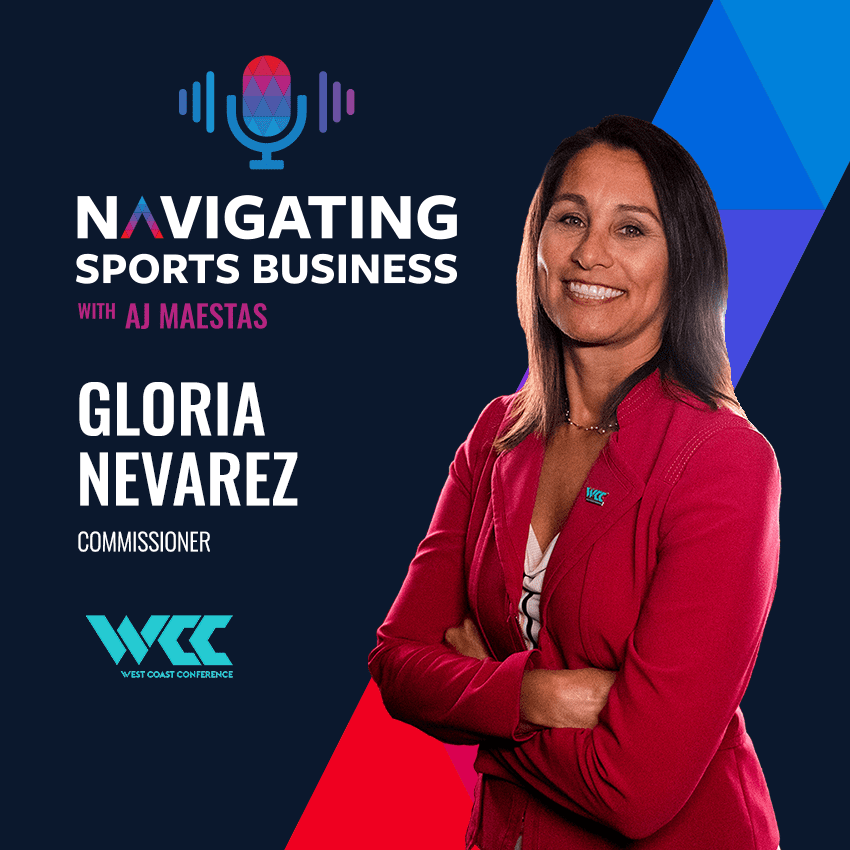
Podcast Alert: Gloria Nevarez – West Coast Conference
West Coast Conference Commissioner, Gloria Nevarez, joins the show to discuss the current state of college athletics and shares her thoughts on NIL, the one-time transfer rule, and why conferences and athletic departments tend to lag when it comes to racial and gender diversity.
Under Gloria’s leadership, the WCC recently created the “Russell Rule,” named after the legendary conference alum Bill Russell. The rule attempts to increase diversity by requiring athletic departments to include a member of a traditionally underrepresented community in the final hiring pool for all significant job searches including athletic director, senior administrator, head coach, and full-time assistant.
Transcript
+^Gloria Nevarez: [00:00:00] You know, this position does come with an obligation to use the platform to advocate. On the other hand, at some point I don’t only want to be pigeonholed as the Latina commissioner, you know? Right, right. I’m trying to do some great things in the business of college sports and, you know, wins national titles and advance the brand so. It’s a thing and it was never a thing for me before.
AJ Maestas: Hello and welcome to the Navigating Sports Business podcast. I’m your host, AJ Maestas, founder of Navigate a data-driven consulting firm. Guiding major strategies and decisions in sports and entertainment. We started this podcast hoping to share the interesting stories and experiences of the amazing people we get to work with at Navigate and even though they’re visionaries and famous, in many instances, their true stories aren’t often heard. Since they’re not on the playing field, our hope is you get to know them [00:01:00] better and learn from them. As we have today. I’m happy to be joined by Gloria Nevarez. Commissioner of the West Coast Conference, thank you for joining us, Gloria.
Gloria Nevarez: Thanks for having me, AJ. good to see you.
AJ Maestas: Yeah, good to see you too. How are you doing? How are you holding up during COVID?
Gloria Nevarez: You know, just about the same as everybody else. We’re playing basketball games and safely and we are in full tournament planning mode, and I leave for Las Vegas next week.
AJ Maestas: So your tournament’s gonna happen. You feel good about that?
Gloria Nevarez: I do. We have looked at every single scenario. There’s a guy in our office’s named Aaron, and if he had a dollar for every schedule and every tournament. Format that he drafted and then lit on fire, he’d be retired right now.
AJ Maestas: I can only imagine it’s one of those years we get to do that stuff, you know, with some of our [00:02:00] clients and it’s a good thing, I guess, for business. But I can only imagine what it’s like for the coaches and the student athletes and everything. So how many NCAA bids are we gonna get?
Gloria Nevarez: I think we’re, I don’t like to jinx it. But if I had to guess, we’re a locked for two. We’re hoping for three.
AJ Maestas: Okay. I like that. And who, who’s on that fringe? Who’s that third team?
Gloria Nevarez: It’s a battle right now in conference, but St. Mary’s probably has a stronger net ranking. Pepperdine made a strong showing in conference, and so they’ve got Kolby Ross one of the best guards in the country, so you can’t count them out.
AJ Maestas: And how about Gonzaga? Are they gonna win a national championship?
Gloria Nevarez: I just said, I don’t like to jinx things.
AJ Maestas: Okay. I’ll, I’ll let you off the hook. It’s a little disturbing as a, as a Huskies fan to watch the rise and sustain success, you know, out of Spokane. It’s just unbelievable. Sure. Looks like a pretty promising year for everybody. Some business stuff I’d love to ask you about, and because I think you were a part of the consideration of this in the PAC 12 and, and the first one’s about Esports you added Esports in 2019. We worked really [00:03:00] hard with the Big 10 to take a look at what that could mean for their network and being student athletes, scholarship student athletes, what that is for rights. It’s where the future’s going. You know, when you’re at the PAC 12, it, it got rejected by the PAC 12 president, so I’d love to know why you did it, how you did it. So we can learn from that.
Gloria Nevarez: So when I took over the WCC job, you know, it was definitely on my to-do list and horizon. And in year one we partnered with a company that allowed us to do kind of a beta year just to test the waters and to see what the interest level was like. And of course, just like any league. Within our 10 schools, you have some that have full-blown labs. They have academic programs dedicated to eSports and how to, you know, enter the business. They have a varsity team, they have a gaming center, and then you’ve got others who are a little bit more at the robust club level. But all 10 schools had some level of interest, and so we were really fortunate to be able to go in with low risk and have our first eSports league. And I can’t tell you how great it was. I mean, the, the eyeballs on it were [00:04:00] incredible. I mean, I just blew my mind for what we were doing at the beta level. You know, you know, those eyeballs are out there, but did I think we would have them on our WCC inaugural effort? So that was a really nice surprise. We had a Esports. Championship and a trophy. Now we’re not at that point where we’re considering them a varsity sport or trying to scholarship, although some schools have that set up. But as a league, we were really just exploring it as an ancillary event. Something that could potentially become an in-person thing, maybe, you know, enhance one of our in-person championships for another sport, perhaps basketball and Vegas. But COVID set us back a little bit, so we hope to get back on track post COVID.
AJ Maestas: Yeah, I get that. But. It’s kind of cool. It fits with the COVID world because you know, so much of it is virtual. Tell me about those audiences. Do you mind sharing how they compare to big audience sports like basketball?
Gloria Nevarez: Yeah. They actually compare well to some of our not as high profile games. EG games, Gonzaga [00:05:00] or top two or three teams aren’t in. But you know what I, I really liked about what we were able to build is it matches our mission and values. So inclusivity was a big piece. You know, we had. Co-gender teams, you know, sportsmanship. Even on the floor, on the field in our dick and ball sports, we make sure we treat each other respectfully and if you don’t, there are consequences. And we, that was a pillar of how we entered the eSports space as well. We proceeded with caution, but we really helped make it mesh with who we are.
AJ Maestas: It couldn’t have been easy with women in particular. That was one of the challenges. I know when we looked at it was, you know, that it was this 80 20 type ratio as far as serious gamers. But I’m glad to hear that.
Gloria Nevarez: You know, it was easy. We said it’s gonna be co-ed, and it became co-ed. It was that easy. There were women out there who wanted to participate. Now there were some teams that had, you know, initially had to go searching for, to open the door and let them in. But frankly, one team that [00:06:00] probably expressed the most difficult, not difficulty, but just, you know, we don’t have ’em, blah, blah blah, ended up doing really well in the league with women on their team. So it was that easy.
AJ Maestas: Is it something that could be Title IX compliant if it became a varsity sport? I mean, is it that even, is it 50 50?
Gloria Nevarez: It could be titled IX compliant. It would have to be, it became a varsity sport. Right now, I think if you looked at our participation numbers, they’re not, but I would argue it’s not for lack of interest. I think it’s just culturally and doors may not have been as open or recruitment not as public.
AJ Maestas: You know, I, I agree with some of this, right? I mean, I see STEM students, you know, in a lot of the data, right? That every school’s trying to attract. I see international students that are. Not only good for the diversity and experience, you know, of, of, you know, a college degree, but also lucrative for universities, right? They tend to pay for more than the cost to educate them without a state tuition and things like that. I see the numbers. You know, we spent last few years doing stuff with Twitch and when you look at the global audiences and, you know, you think of the bridging the gap to Asia, which I think is a real [00:07:00] opportunity for west coast sports. It looks obvious, but you know, the presidents don’t always feel that way. How did you get the presidents there? I mean, my memory. You can correct it ’cause you probably have a, a more accurate look at this from your Pac 12 days. But my memory was the PAC 12 president still felt like it was a sedentary sit on the couch, you know, unhealthy looking at screens type activity.
Gloria Nevarez: We, we did have different presidents at different places along the spectrum. Like I said, we have some that are sinking resources into it to make it a major. And then others that were like, you know, I, I’m not sure what our interest is on our campus. And of course. On every campus there is interest and it’s pretty deep. So we went through a little bit of an education, showed some clips how it works, because from a league perspective, it really is about that broadcast and about the branding, the 90 or you know, 120 minute commercial, you get you front of all these eyeballs. So really putting it in that context and explaining how, you know, the games we’re choosing are gonna match who we are. You know, try to stay away from [00:08:00] first person shooter or. Anything that objectify women and that type of thing, but also how social it can be on some of these. Now it can be isolating and sedentary, but there are games that, you know, require teamwork and communication and a lot of interaction. So it’s picking the lane within the universe of sports that fits.
AJ Maestas: Yeah, I agree with that. I’ve seen some really good stuff on the collaboration, right? The teamwork and the complex decision making. Right? With some of that, you know, of course if it’s all first person shooter, then you have other questions asked. But it’s blatantly obvious to us in the work we do at Navigate, you know, where the numbers are, where the world’s going. Like stick and ball sports is losing the competition for leisure time. Right on, on mobile devices. And there’s certainly positives in it, right? But it’s where it’s going. So I think it’s really cool you did that. I think that’s a model for other people to follow. So you’re on a number of NCAA committees, but the the NCAA transfer working group is one I wanted to ask you a question about. I mean, no, I know it’s sensitive, but. I mean, you know, I understand. I [00:09:00] feel this way. Collegiate athletics just, you know, is my passion. It’s my, it’s why I’m a sports fan. I actually don’t follow any pro sports teams, and so there’s a part of me that’s a traditionalist that is really uncomfortable with the idea that, you know, they’re, they’re not really maybe gonna get a degree at your university and it’s not gonna be their alma mater because they’re gonna freely move around to find themselves a starting position.
But I also can sympathize. Really, I can empathize. I’ve transferred actually in college. I mean like the need to have the freedom that coaches and everyone else in the world have to go where they need to go, right? For their career or their vocation or whatever it might be. But ooh, it’s so tough. It’s so tough to picture an idea of this transfer portal and the roster changes every year. I’d love to hear your position on that. I’d love to hear is this one time transfer thing? Is this gonna exist in perpetuity? And if you were in charge, what would the rule be?
Gloria Nevarez: So the one time transfer. Is happening, it will happen. The challenge in the committee I’m serving on is, okay, how should it look? Really operational, real technical. And [00:10:00] that’s where reasonable minds differ. And you know, there’s big pieces that. We’re considering, and one, the data shows that transfer negatively impacts graduation rates. And graduation rates are what we’re about. Let’s just clarify. All student athletes, except for football and men’s and women’s basketball, get to transfer and compete immediately.
So we’re talking about the subset of football, men’s basketball players that haven’t had this ability. So there’s a ton of data out there showing that transfer negatively impacts graduation rates. Okay, so how do we let folks transfer? Compete immediately? Not really take that hit or bolster and support graduation rates. You know, the other thing is the roster management. You know, is there a window when we should allow this to happen? Is there a deadline? You know, and on the one hand, you wanna give Max freedom. On the other hand, come on. Is it fair to transfer the day before your first game when you realize you’re not starting. Or the big elephant in the room is the poaching and the illegal [00:11:00] recruiting, and you can’t legislate morality and you don’t wanna policy down to the lowest common denominator. So these are the big tent poles that we’re wrestling with on like, okay, we wanna let student athletes in these sports transfer and compete immediately, but there are massive challenges that we need to figure out and solve for.
AJ Maestas: I see those challenges, but help me understand the lower graduation rate. Are you confident that’s causation? You know, it would seem to me someone transferring could have all kinds of challenges in their life, right? I mean, if you read anything about positive psychology, right? And things along those lines, right? You, if you are, if you’re unhappy here, you’re gonna be unhappy there. So is it because they transfer that they lower their chance of graduating? Or is it people who are less likely to graduate from school are more likely to transfer?
Gloria Nevarez: Excellent point, right? Because the data shows that student athletes more often than not transfer due to playing time. So you could be a great student but just not playing here, so you go to school B and play. But to your [00:12:00] point, are there other things going on in the student’s life and which. Kind of outside of our ability to policy. However, there’s so much dynamics, you know, transferable units, getting into majors, all of that has a very tangible impact on even the good students. Maybe it might not prevent graduation, but it could delay graduation, and that becomes expensive if you don’t have a, you know. Four or five year scholarship. So there’s so many factors under there, but your chances are higher by staying at this, a singular school of completing a degree in four years, if not five.
AJ Maestas: Right. Well that makes sense. Well, well why one time, you know, I think one of the really strong arguments people bring up about men’s and women’s basketball and football is the ratio of minorities, right? I mean, you’re a woman of color. As a Latina, I think cure. I have some of ’em in front of me. Over 50% of FBS football, D one men’s and women’s basketball players are are minority, and those happen to be the sports in which you can’t transfer. Those also happen to be the sports in which, [00:13:00] I know this is not an NCAA policy, but because of the pro sports leagues in football, three years in basketball, one year. Your, your path to a professional career requires staying in school. It can feel a little exploitive. Right? It can feel a little, yeah. I mean, is it because of revenue? Is it because of the makeup of the student athletes? Like do you think the one-time transfer rule becomes the anytime transfer rule? I, I, I mean, I’d love for you to, I’d love to hear your opinion on these subjects. ’cause I wrestle with it too, right? It, it, it’s, yeah.
Gloria Nevarez: Well, the other piece of data within those sports and the minority demographic is also the lower graduation rates. And if we’re trying to serve the student athlete population, sure, one and done, go pro, get yours, right? That happens. But really the vast majority of student athletes that aren’t going pro aren’t playing overseas. Our mission is to get them a degree, right? If they’re coming to our schools to play these sports and represent us, then they should be crossing the finish line and getting a degree. So that’s a huge, huge consideration when we’re talking about the transfer. [00:14:00] Your original question was why one time? Well, right now, that’s the rule in all other sports. One time you get to transfer and compete immediately. You can transfer as many times as you want. After that, you’re just gonna have to sit a year residency, and I think.
The general feeling is that’s pretty fair because one time if you make a mistake, you find out you’re not starting whatever your reason, you don’t have to have a sick relative to go home. You get to go make a transfer, compete immediately, and it’s the ones after that that would serve a year residency because after your first transfer, that second, third, fourth, all those other issues we talked about before are compounded transferable units, graduation rates, you know, roster.
AJ Maestas: Right? It, it’s really tough. I don’t want young people transferring and running from it every year. Right. ’cause there’s a lesson in that. There’s this great Thomas Jefferson quote that I’m gonna obviously inaccurately relay, but it goes along the lines of never neglect your education for your studies. It’s my favorite. And you know, there’s so much more going on there. I mean, I know you played college. [00:15:00] Basketball at UMass. When you look back at your time at UMass, I know how I look back at, I tried to play baseball. I didn’t exactly succeed, but I look back at my experience and I think, you know, where did growth come from? You know, the classroom was really a small part of that whole experience. So it’s hard.
Gloria Nevarez: The normal student, the non-student athlete, they’re transferring at higher rates. Than ever. Than, I mean, it’s just part of the culture of college. And shouldn’t student athletes be able to take advantage of that? Whether you made a mistake, whether you just wanna get close or not, whatever your reason, should you be able to transfer as freely as rest population and, and on the one hand, yeah. On the other hand, playing college athletics is a commit. I mean, you’ve been on a team, you picked your school based on the roster and who you might be playing with and your ability to start or not or learn from, grow into a position that changes the first week of season. How fair is that to the rest of the team and the roster and the people you made a commitment to? Yeah.
AJ Maestas: Well, I mean, as far as total growth, and I mean, you know, I very much view the adversity that comes with those as some of the strongest [00:16:00] lessons that I’ve had in life and maybe some of the social aspects, right, that you get through teamwork and collaboration, but. But yeah, I think losing is actually super important and failing in some level. You know? I mean, we all go to a place athletically, usually up to the point in which we fail, whether that’s interest or passion or physical ability. So I think it’s important.
Gloria Nevarez: Well said. Well said. Yeah.
AJ Maestas: Yeah. Yeah. I think it’s pretty, pretty important. More business stuff and collegiate, athletics. Name, image, and likeness. I can’t resist just because this is in the news, like every day. Well, let me start with what’s your opinion If you were the czar of the NCAA and someone really did have the power to bring their agenda and push it, I know it’s not how it actually works, but if you did, what would you do with name, image, likeness, and even compensation of athletes?
Gloria Nevarez: If I had the magic wand, I would love to scroll back time and start incrementally. Modernizing our rules in this area to keep up with the development and technology, and unfortunately we just didn’t do that. We’re a massive organization. We’re three [00:17:00] federations and you know, the difference between the highest division one and the least competitive division three is universes apart. So had we grown with the development of technology and social media and everything. Our task today would not be so huge. Now, on the one hand, there are some California bills and legislation out there that talk about. Completely upending the model revenue sharing directly with football and, and basketball student athletes.
And I’m not in favor of that because I think what’s great about our model, it’s very similar to the campus model, is, you know, some of the revenue sports do fund. IE, title IX, educational mission, all the other sports. On the other hand, there are some things that we’ve been preventative about that really it’s time that we were more permissive, and that’s the social media following name, image likeness, starting your own business. I mean, back in the day, starting a business was not as easy as now I’m on social. We have to allow that. I think it’ll be a [00:18:00] great promotional tool for those sports that traditionally aren’t seen on ESPN and the network stations, and I think you’ll see that all of the sports. Once you get to know ’em, you’ll love ’em. Once you meet the athletes, you can’t help but follow them and be a fan. Mm-hmm. And social media and this ability to capitalize on name, image, likeness during your four years helps with that. We’ve got women’s basketball players out there that have massive followings before they even come to college, and they actually bring in eyeballs that.
Our metrics as a league and I, I just think we need to get there. We will get there. We have a package of legislation ready to get there. There’s still a lot of stuff that needs to be decided, but I think with Alston case, being at the Supreme Court and a lot of state legislation kind of on the books ready to become active. There’s some hesitancy about opening ourselves up as an association to liability. Yeah. By putting something out there right now. But it’s there. It’s ready to go. Good.
AJ Maestas: I’m glad to hear that. ’cause you know, sometimes, you [00:19:00] know, I think a lot of outsiders, they look at collegiate athletics and they say it’s all reactionary. You don’t do anything until you’re forced to. In fact, if this, you know, legislation didn’t come about that, that it absolutely wouldn’t be being addressed right now, which I actually agree with that. Right. That it wouldn’t be happening right now. But I agree with you. We could turn back time. I’m glad to hear you’re there. We put out an article with D one ticker and a DU on, on what we see from our work with the pro sports leagues and you know, these marketplaces like endorsements and what reasonably these student athletes could get and, you know, the superstars could get some pretty serious money. I mean, now it all depends on where the rules lie with equipment and apparel and some of those categories that tend to lead to the biggest.
Endorsement deals, but there’s some pretty real money. What, what do you think this means for the WC? Like, you know is Gonzaga going to be able to compete for recruit then when, you know, x, y, z Pac 12 University in some major market, in a really big west coast city, can throw pretty real money. One of the things that I wrestle with and I have a hard time envisioning is how you prevent it from becoming [00:20:00] a, a recruiting benefit. How you stop supporters with their private businesses. And even public companies endorsing these athletes, you know, to keep ’em in Los Angeles or Seattle or Phoenix or wherever. Does it worry you, or what would, what do you think it means for the WCC.
Gloria Nevarez: I agree with you. I don’t see how the marketplace doesn’t become kind of a tipping point between some of those schools, and even if there are rules around it, how those don’t get abused. But within the framework we are in now, and granted the new framework, the dollars are, are much higher, but that’s happening now and we adjust. You know, you said it on the outset with Gonzaga. The key, I think, to what they’ve done is sustainability. Now they have some one and dones in their program. That’s certainly not what they built on the backs of, and frankly, it’s a 20 year build. I think the student athletes that choose to go to Gonzaga choose to go there for entirely different reasons than maybe someone else might choose to go to a [00:21:00] high power five. High Profile school. It’s a developmental program. It’s a winning program. It’s vying for a national title, but it’s certainly different than what you get at some other Blue Bud Traditional Power five program. So. Do I, am I concerned? Absolutely. Along with many other factors when you’re kind of in that cut right below the power five. But I also think our, our schools are, are built to last. We’re, we’re pitching a different experience and we’ve been pretty good at adapting and staying near the top.
AJ Maestas: I’m glad to hear you say that. It concerns me, but that’s good balance. I think honestly, it, it concerns me a bit just ’cause money in the sport, which is fair in my opinion, just to share my opinion. You know, anywhere else in this country, people have a right to earn what they’re worth. It seems, again, you know, it, it reeks of exploitation, you know, that they can’t Right. Or that they’re limited in their ability to do so. But it does worry me as a fan of collegiate athletics, you know, the, the closer and closer it gets to, you know. A free market enterprise. That [00:22:00] further and further it gets from being, you know, watching my alma mater, you know compete with other universities and other missions. You know, the, those other missions are beautiful to me and they matter. You did something really cool here. The last summer, the W CCC adopted the, the Russell Rule, which is minority or, or some form of disadvantaged candidate for everything. Senior administrators, athletic directors, assistant coaches, coaches. Do you mind sharing a bit about that, how it came to be?
Gloria Nevarez: No thanks for asking. It’s something our league, you know, really worked hard on. And after the incident with George Floyd and the whole nation was focused on social justice. I mean, it’s, it’s been boiling for a while, but it felt like it really came to a head nationally around George Floyd. And we just happened to have. League meetings the week after, and our presidents were all putting out statements and we had this great conversation in the room and they were like, look, we just, we wanna do something that has meaningful and lasting change. You know, I mean, these statements are all fine and good, but you know, what can we do? [00:23:00] And the idea of a hiring commitment had kind of been in my back pocket, and when I put it on the table, I, I can’t tell you how heartwarming it was that very quickly it was not whether we should do this, but how, and that was where the majority of our effort was. And. Frankly, getting Bill Russell to give permission and endorse it, being called the Bill Russell rule was unbelievable. I mean, not only is he a WCC alum, ’cause you know he went to USF, he was the first African American to serve as a professional sports coach in any. Major sport, not just basketball and you know, his lifelong work around social justice. It couldn’t have been more perfect. I think for us, we have smaller schools. We have many double digit year employees, which is kind of unusual. It’s a great testament to what great jobs these are and how we hold on to folks, but it doesn’t allow us. To kind of churn as much and get a lot of nationwide searches at some of our higher levels. So my hope is [00:24:00] that this will at least bring some deliberation and kind of more national reach when these positions do open.
AJ Maestas: It’s certainly progressive and something is missing. Right. And I’d love to hear you. What your diagnosis would be on this. ’cause somewhere between 13 and 15% of ADSD are women. Somewhere between 13 and 15% of athletic directors are minorities. Title IX is 50 years old now. So as many women have been collegiate athletics, athletes as men right, for 50 years, and you look at what’s happening on the field of play, I, I mentioned earlier, over half of. Women’s and men’s basketball and football players are minorities and it’s not what you see in the coaching ranks and it’s not what you see, you know, in the administration. Why is that?
Gloria Nevarez: You know, and that’s the question for the WCC. We’re in some of the most diverse cities in the world in our footprint, yet our athletic departments, you know, aren’t reflecting that. And one of it is the tenure. We’ve got a lot of folks up and down the, the rank order. From the highest levels to some of the lowest [00:25:00] that have been there for double digit years. So that’s kind of unusual. We have smaller departments, but as you know, you kind of go with what you know and you know, if you have an open position at some of these feeder spots. Do you go for a national search or do you grab the ga That’s been working hard for free for, you know, however long. I also think that since we instituted this rule, we had a school with an open position and it was in the external arts, SID, communication pr. And the person running the search said, you know, called me and said, I’ve been working to diversify the hiring pool.
I’m really having trouble. And I said, well, who’d you call? And they were all people like demographic to him. So I’m like, call me. Call this per, you know, help let us help each other diversify these pools. It shouldn’t all be on you, it should be on you ’cause it’s your job to hire, but you gotta reach out of you the circle of what you know. And it was really an, an interesting conversation. We were able to meet the rule with some help with my contacts and others, and it, it, so it’s really [00:26:00] just being deliberate. I mean, even this person was very well intended and. Trying to the best of their ability, but I think you just have to reach out over and across what you know
AJ Maestas: who gets credit for the birth of the Bill Russell rule. Where was the gymnast?
Gloria Nevarez: President’s group. Really, the minute we started talking about it, like I said, it was kind of a robust discussion about how we enact this. So it was our athletic directors, frankly, they were on board. Most of them were like, yeah, I think we’re doing a lot of this. Anyway, there was some concern about that. You know, third assistant, fill in the blank, water polo, tennis coach, whatever, because those typically aren’t national searches. You know, the interesting thing about this policy, it’s. Broad enough to say you satisfy the policy if you. Have a final candidate who satisfies a historically unrepresented demographic. So if you interview a woman for the head coach position of a men’s sport in college athletics, that would satisfy our policy. Mm-hmm. Because we are [00:27:00] really lacking in that area across college sports.
AJ Maestas: It’s hard for me to look at. Title IX being 50 years old, it’s hard for me to look at what, to me appears to be a true meritocracy, right? With what’s happening on the court or the ice or the field or whatever, and it not translating. I, I don’t know if you have an opinion before I move off of this topic, but I love that you’re addressing the end of the sales funnel, right, which is creating opportunity here at the moment of hire, at that top very visible job. I don’t know if you have any insight onto what initiatives are happening. Earlier, at earlier stages of people’s careers because where have the women gone to represent, you know, 15 whatever, 13 something percent of athletic directors? Like where, where did they fall off in their administrative sports careers?
Gloria Nevarez: Well, and I think that for us, one, one of the needs I saw is we didn’t, we lack data. And the Russell Rule provides us a need to at least collect the data and monitor the trends. To speak in your language. One of the interesting outcomes is gonna be okay if you have a school [00:28:00] that historically, after you know, three or four hires is just missing the rule, that’s one problem. If you have five different schools unable to meet the requirement in the same lane, third assistant, fill in the blank. Coach. Now you know you don’t have an individual school cultural problem or an intent problem. You have a pipeline problem. And if we can target that, we can proactively as all 10 or as the league office, help program to that need.
So you can start doing career fairs, resume banks, introducing, you know, whatever, but really target your efforts where the need is. And that’s what I think is gonna be so fascinating and. Now that you know, you have to meet this requirement, oh, I know AJ at his school just had an open job for this. He must have met the requirement. Let me call him up and get the, so I think it benefits the pipeline. As far as one signaling to the market, you are welcome here, but [00:29:00] two, providing that connection and incentive for the job hiring party to figure out the pipeline as well. And if there’s a trend that we can do collectively. We can target that as well.
AJ Maestas: Yeah, I like that. ’cause I, I am concerned about the pipeline. Certainly systemic racism is real, but how does it manifest itself, you know? And, and what are the challenges? And by the way, as one of the few women of color and women in the role that you sit in right now, have you felt glass ceilings? Have you felt discrimination or challenges in the progress of your career?
Gloria Nevarez: You know, that’s such a difficult question for me. I, I am the post Title IX, gen X class, so while I benefited from some of those. Folks that were pioneers and really felt that overt racism, it’s hard to distinguish barriers, challenges that were maybe related to my gender or race because they might not have been as overt. I will say I’ve had some very strong mentors and allies. Who were [00:30:00] white are white men in power positions that have helped me along the way and opened the door right now. I, I mean, with the exception of COVID, I feel like the sky’s the limit for the WCC. So it’s just, it’s been a lot of fun. It’s been a lot of challenge. When I first got the job, it was interesting to me how much was about my gender and race. And so instead of kind of leaning back on that, I tried to lean into it. And anytime I can use those platforms to talk about our league and, and you know, why I feel good at the WC and why I’ve been supported and embraced and this the kind of league we have,
AJ Maestas: well, that’s your role and that’s good to do, you know, to bring it back to the mission of the league. And if you look in the Western US. I mean, if you just have eyes, you can see a greater level of diversity and support of women’s sports and things like that in the Pac 12 and WC. So I think there’s socioeconomic factors, you know, that play into where you are, where you live, where you’re from, all that kind of stuff.
Gloria Nevarez: Yeah, and you know, this [00:31:00] position does come with an obligation to use the platform to advocate. On the other hand, at some point. Don’t only wanna be pigeonholed as the Latina commissioner, you know? Right, right. Trying to do some great things in the business of college sports and, you know, win some national titles and advance the brand. So it’s a thing. It was never a thing for me before.
AJ Maestas: You know, as a fellow Latino who no one really knows what I am being born and raised in Alaska, I have, I go by AJ instead of Andres and things like that. So because like there’s just. It’s bewildering to me to look at the statistics of Hispanics have very similar gaps in income, educational attainment incarceration. Some of the more like really hot button sort of indicators of what would be, you know, systemic racism or just inequality as African Americans and never as bad as African Americans have it, but very, very close with a huge gap, like a four and five x on some of the metrics I just shared with you [00:32:00] relative to the general population.
And then I think like, okay, well how is that? I like, how is that when you can’t, you know, even really fully identify if someone’s Hispanic all the time. Right. In theory, you know, it’s Caucasian. Even if it doesn’t always appear that way to the naked eye. Well, it’s very impressive. I’m proud of you for being where you are and getting where you’ve been. Cause if it was commonplace, then there would be a bunch of Gloria Nevarez running around collegiate athletics, especially in California. Right. Places where, you know, 30 plus percent of the population is Hispanic. By the way, do any other conferences have this Russell rule? Has anybody else adopted that?
Gloria Nevarez: Not yet, but I can’t tell you we’ve been inundated despite COVI and you know, most departments are downsizing. Almost all the major conferences and folks inside and outside the industry have contacted us just asking more about it, what it’s about. So I do feel that there are things afoot on the horizon. You’ll see more adopt their own in their own version. While we’re totally open to everyone calling them Russell Rules, we understand he’s our alum. [00:33:00] And you may have other reasons, but yeah, I do think, and the NCAA has expressed interest in it, and I have a appointment to speak to the. Board of governors about it, so
AJ Maestas: Very cool. You’re gonna hate this next question, and I just can’t resist. I just can’t resist because, because you worked at the PAC 12 office. Someone’s gonna call you about that job. Friends are gonna call you. I mean, I assume the search committee’s gonna call you about the PAC 12 commissioner job. I won’t make you answer if you’d take the call, but if you were suddenly sitting in the seat, what would you do?
Gloria Nevarez: I will tell you, somebody has already called. My mother.
AJ Maestas: What did she say?
Gloria Nevarez: Are you the PAC 12 commissioner? I mean, this is just one.
AJ Maestas: That’s something my, I could see my mother doing that. No question. I could see my family. Asking something like that, so yeah.
Gloria Nevarez: No, it was, it was precious. I was like, everybody just needs to calm down. This was just media speculation and frankly, like, I mean, I don’t know if you could tell, but I am very passionate about the WCC. I love where I’m at. I love what we’re doing. We have so [00:34:00] much to do. You mentioned at the beginning we could have a very special basketball season on our hand, so that is my number one focus right now.
AJ Maestas: You, yes, I got you. Hate me. But you went, you went to, you got your, you went to law school at Berkeley, your. From Santa Clara, you’ve worked in the conference office. Is there something you wish you could do there, and let’s say you could lead alternative lives and one of those lives gets to go and run the Pac 12. Is there a passion for where you think it should go or what it could or should be?
Gloria Nevarez: What it could and should be is what it is and why I would have a passion for it, and why I have a passion for the WCCI. It’s just a west coast ethic or ethos or, or vibe about it. Those things that make it challenging, you know, that don’t make it the SEC fans that’ll come even. Through the lows, the, the lack of any other show in town, you know, where the entertainment coast, there’s so much competition, there’s so much static in the air with regard to getting people’s attention and their, [00:35:00] you know, entertainment focus. And it’s just, it’s what I love about the west coast because even in that environment. Our leagues compete and have passionate fan base and you know, that innovative excellence that we try to embody in Silicon Valley and you know, kind of being forward thinking are all of our schools are at the front edge of, of all of that. And it’s just, you know, someone said it about Vice President Harris, you know, even more so than her ethnicity, she embodies kind of California is, which I would expand to a West coast ism. That’s what I find special about. Being able to stay in the West Coast, in the Bay Area for my career. I mean, when you choose college athletics, you kind of limit yourself to, you know, only one or two major universities in each state. Whereas we, we are so fortunate, we have them of all levels kind of up and down our coast.
AJ Maestas: Yeah, I love that about it too. I worry sometimes about how it fits in the whole ecosystem of collegiate athletics, you know, based on those priorities. But those are the priorities that I [00:36:00] want, you know, progressive, you know, the women’s sports win and, and it, it’s, you know, it’s a real investment from the athletic departments and I think it’s a beacon for where we should be going quite often, you know, even if it. Hurt sometimes in the short term, but you can see the landscape of collegiate athletics changing. You can feel some things are afoot and it feels like some radical changes are realistic through this next set of media deals, whether it be lookin clauses or deals expiration a lot of pieces could move roughly at the same time here over the next three or four years.
Gloria Nevarez: There’s a lot behind the scenes that impact success, but at core. Fans, love teams that win. As long as your schools are committed to that and, and value that, you know, you’ll get through the low years and you’ll have your high years back eventually. And it’s the lead’s office to amplify that when it happens and to, to market that when it happens and to give the platform to help it happen.
AJ Maestas: Yeah, I agree. I have a couple like rapid fire questions [00:37:00] wrap up. Do you have enough time to go through these.
Gloria Nevarez: Yep.
AJ Maestas: Yep. Okay. Good, good. What are your top passions and hobbies?
Gloria Nevarez: I love recreate, well, sport, but now that I can’t compete cause I’m old and broke down, I love recreating. So skiing, downhill skiing and scuba diving, getting outdoors, hiking, being away from my Zoom. Not that I don’t enjoy this time with UAA.
AJ Maestas: Oh, that’s so good. Well, well, if I was sitting in Lake Tahoe right now, I’d have a little bit of difficulty being indoors and not taking advantage. Growing up in Alaska, you know that. Skiing is you know, your only winter alternative. Not, not really, but if you weren’t doing this, what would you be doing? Imagine you have unlimited wealth and you’ve wrapped up your career in sports. What, what would you do?
Gloria Nevarez: You know, I’ve loved my career in sports because rarely does it feel like a job or a career. On my worst day, I’m still watching and working. Sports, but there are days where I wish I did something that changed the world a little bit. And so I probably do something in the area of sustainability and [00:38:00] echo business.
AJ Maestas: Cool. Me too. I’m pretty sure as time goes on my hours with Navigate and in sports, which do have a positive impact in the world in those ways and has many outlets to do so, but it will reduce over time and be replaced by cause-based work. I’m glad you say that. Well, I just happened to be in the middle of a campaign for these kids in Ethiopia for spinal surgery. It’s life threatening and crippling. I got three weeks left with it, so, no pressure, but I’ll send it to you if you want to share it with some friends who care about that stuff. I’ve been with this doctor. He is adopted in foster, dozens of kids, uh, 30 years of saving kids in Ethiopia. An American doctor has been there. Wow. It’s a, I’ve had dinner in his home. I mean, this is a man committed to saving people, right? Think of the life he could leave as a surgeon and a doctor here in the United States versus what he does and in the capital there. So no pressure, but, uh, but yeah, I do, uh, today and every chance I get. Do you have a life hack you could share with us? You know, those things that like, you [00:39:00] know, make you a better person or make you more efficient or effective, like, you know, a trick where you get 10 x return based on your investment.
Gloria Nevarez: I know this sounds so a type, but really it’s organization and just making sure I am, it allows. I plan my trips six months in advance. I, you know, I’m not good at calendaring, but I make sure everything is calendared and you know, I try to keep track records of everything and it just makes life and time easier. It enables me to take the time to, to do some of the fun stuff.
AJ Maestas: You’re a busy person. I mean, sitting in your seat is something that pulls you in so many directions, so I’m glad to hear that. Yeah, you wouldn’t, you would, you would leave a hectic life if you weren’t super organized. Can you, can you give advice to someone listening to this in particular? I would say for young women and how they get to follow in your footsteps. How’d you get here and how would you pass that lesson on?
Gloria Nevarez: So often I come across young people who are really just excited about the next job, the next opportunity, the next title. And while those are important, I think [00:40:00] mastery of what you have in front of you is really, really important. When I was at the PAC, they handed me men’s basketball officiating and in conference work. Nobody wants to work with officiating cause it’s really nuanced and difficult and thankless. Complicated and, and thankless. Yeah. And when it goes really, really well, all you hear is silence. So
AJ Maestas: It’s so true. It’s so true.
Gloria Nevarez: But you know I threw myself into it, you know, I created the Western Officiating Consortium in men’s basketball and really kind of grew and built a program that was really unique and, and frankly it was the thing that helped my WCC. Position and interview because I, I gained so much knowledge about it and about the sport and actually made improvements across the West coast. And so while a task might seem not fun or not mentally challenging, everything is going to benefit you in the end if you can gain some mastery around it.
AJ Maestas: Yeah, that makes sense. I like that. Total investment for growth too. [00:41:00] Anything I haven’t asked you that I should have?
Gloria Nevarez: Oh, you’ve asked everything.
AJ Maestas: The fun current ones, but you never know. There might be some super secret, exciting thing you’re working on. Now’s the time to share. Yeah, exactly. Yeah.
Gloria Nevarez: Super secret. This is my platform to share. Everything’s super secret. No, we’re actually, right now we’re full basketball tournament mode. We’re really excited about it. We have all of our protocols in place. Unfortunately, we won’t have fans, friends, or family, but we’re feeling good about having a, a very exciting tournament this year.
AJ Maestas: Well, I’m glad to hear that we’ll be watching. Please let me know if you get down here to Phoenix. Please say hi to Rick and truly grateful that you’d share your time with us. Again, for those listening, this is Gloria from the WCC Commissioner joining us and giving insights into her world. So thank you very much.
Gloria Nevarez: Thanks for the time, AJ. It was great catching up with you.[00:42:00]
AJ Maestas: If you’d like to join the conversation, email us at INFO@NVGT.com or check out our website at NVGT.com. I’m AJ Maestas. Join us again next week for Navigating Sports Business.