Podcast Alert: Roger Valdiserri
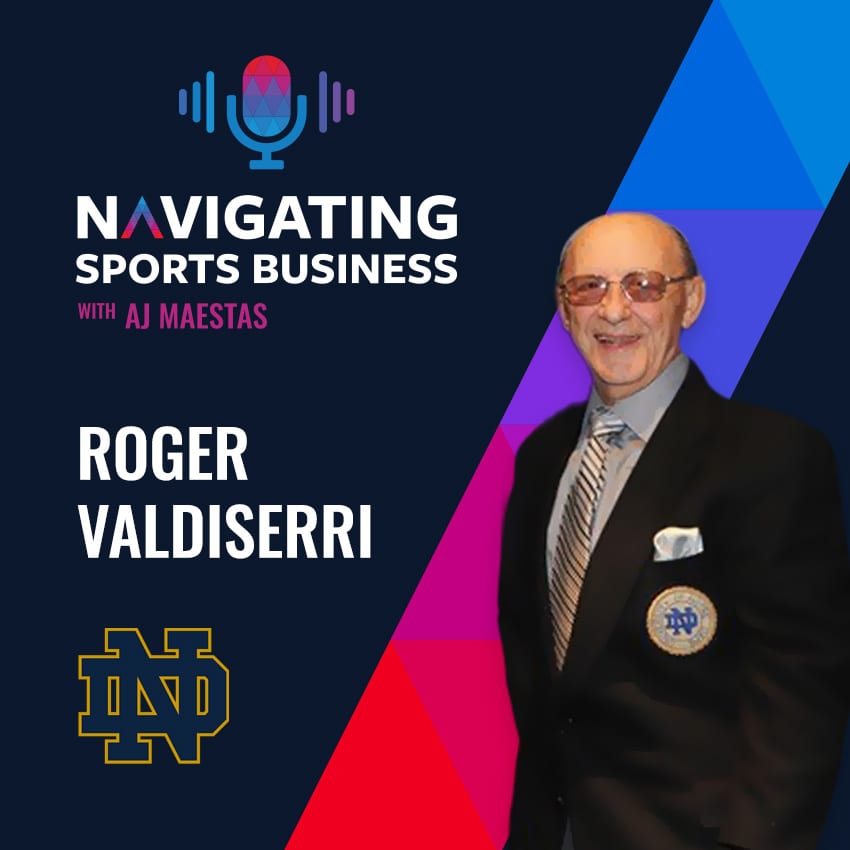
On this week’s episode of Navigating Sports Business, AJ interviews his close friend Roger Valdiserri, former Sports Information Director at Notre Dame. Over the course of his 28-year career, he was an eyewitness to some of the most important moments in college athletics and beyond.
The conversation includes stories from Roger’s time at the Olympics with the famous 1992 “Dream Team,” his friendship with legendary Fighting Irish coach Ara Parseghian, and the year he spent with the Kansas City Chiefs before returning to his beloved Notre Dame. His leaving the NFL was due to a profound enthusiasm for college sports, and not because he once threw up on Hall of Famer Buck Buchanan, although he does admit to the latter.
Roger even provides the inside scoop on the time he convinced the world to pronounce then freshman quarterback Joe Theismann’s name “like Heisman.”
Transcript
+^Roger Valdiserri: [00:00:00] I always tell young people, if you’re going to go into this business, the one thing you have to know is that you never ever lie. Because once you lie, you’ve lost all credibility. And credibility is what you hang on.
AJ Maestas: Hello and welcome to the Navigating Sports Business Podcast. I’m your host AJ Maestas founder of Navigate, a data-driven consulting firm, guiding major strategies and decisions in sports and entertainment. We started this podcast hoping to share the interesting stories and experiences of the amazing people we get to work with at Navigate. And even though they’re visionaries and famous, in many instances, their true stories aren’t often heard. Since they’re not on the playing field, our hope is you get to know them better and learn from them as we [00:01:00] have. Today I’m joined by someone who’s not well defined by their title and their history and their career. Roger Valdiserri, who I consider not just a Notre Dame legend, but a legend in the history of collegiate athletics. He’ll be embarrassed by this, but he’s also way too humble to really, let me give his full bio. I would describe him as the Forest Gump of Collegiate athletics if it was big and it was important in the last 50 years, he was somehow. There. Roger has also become a friend and a mentor, and someone who feels like a family member. I’m so grateful to have you join us, Roger.
Roger Valdiserri: Glad to be with you, AJ.
AJ Maestas: Yeah, I wish you knew how much that meant for me to say too. I can’t resist sharing a bit about Roger’s bio and background. Just as a teaser. Roger was a part of the Formation of the Night Commission working with Father Hesberg. He was among the first Americans to enter China in the sixties. He was a [00:02:00] part of the original Dream team. He’s worked on 22 Final Fours. He’s in seven or eight Sports Hall of Fames. The list goes on and on and on. So I’m so grateful that we get some time with Roger here just to walk through some of his most interesting and favorite stories. Roger, I think you’ll never avoid this story. I’ve heard people who don’t even know you that talk about as I understand it, you convinced not only Joe Esman to pronounce his name Seman, but even his family to this day pronounces it. Fen, do you mind sharing the story?
Roger Valdiserri: Yeah, that’s correct. AJ and I’ve always said that they’re gonna put that on my tombstone. He changed Joe Wiseman’s name, it was Esman. And when he came to Notre Dame, I said he told me his name. Joe Fesman. It’s Seman as in Heisman. And it’s stuck with him. And now his family goes by the name of Seman. [00:03:00] So I changed the whole family name.
That’s amazing. And he
AJ Maestas: was a freshman at the time, right? I mean he wasn’t even a starter, if I remember it correctly. And you’re already thinking about his Heisman campaign?
Roger Valdiserri: Yeah, you know, he was 150 pounds when he came to Notre Dame. They were running out on the field and somebody said, oh, there goes Joe Esman. And I said, no, that’s Heisman, as in Heisman. And from that point on it stuck. So as I said, his family goes. By the name of Pfizer now. So I didn’t know I was gonna have such an impact.
AJ Maestas: I love it. I love it. And you know, without knowing it, you’re one hell of a marketer, your whole career. There are so many Notre Dame legends. I’ve had the good fortune of being able to. Tailgate with you and your family right out front of Gate C, right? Right on the southern edge of the stadium. And it’s sort of this hall of fame walk as people enter the [00:04:00] stadium and pay homage and come by and say, hi. I don’t want to exhaust you with the full list. I know there’s hundreds and hundreds of athletes and administrators and coaches that. Hold you in a special place and vice versa. But, just for fun, do you mind sharing some of those characters that will always be a part of your history and memory?
Roger Valdiserri: I wouldn’t know where to start. AJ.
AJ Maestas: You told me once you love them all. When I said, who’s your favorite? You know, throughout the history of Notre Dame, I learned about the Romeo Club maybe 10 years ago. Which stands for retired Old Men Eating Out. And you’re telling me this story about how you get together with some of your old buddies and then you drop the name era. And I think to myself, and of course I asked because at the time I wasn’t even aware the man was still alive. Do you mind sharing that little Wednesday lunch for so many years, you and all those guys getting together?
Roger Valdiserri: Yeah, AJ it was me, my good friend Jim. Who, was a assistant basketball and assistant coach, and the final member was an Elkhart [00:05:00] businessman by the name of Artio. Just passed away this past week, and so that may, that means that three of the original four are now deceased. Makes me sad quite a bit.
AJ Maestas: I’m very sorry to hear that. I guess you’re the last standing member, but, I know you’ll see the beginning. Well all those years of getting together, what did you guys do? Do you know how many passionate Notre Dame fans would kill to be a fly on the wall at your lunches? Do you, do you mind sharing with me what you discussed?
Roger Valdiserri: Oh, we, we discussed everything awesome. From sports to politics. And we had some lively discussions. Believe me. We never agreed with each other and we would argue about our point of view. And so it was, it was fun and it was in live name, you know, so it made for a good Wednesday and it was great to have that kind of [00:06:00] discussion. It kept us to the point of. You know, knowing what was going on in politics, in sports, it kept us on point.
AJ Maestas: I knew you and Arrow were very close and, it was a loss for everyone in college football and Notre Dame, a few years ago. Just for posterity, what do you most remember about him? Or is there. A fun story you can share that always stays with you.
Roger Valdiserri: The one thing I have to say about ERA is that he was the most principled man I’ve ever met. He was right to the point, always told the truth, would never. Never mislead you. He was, again, as I say, very principled, wonderful guy. Loved the man, and we all miss him. All miss him. Yeah. No, he was a great football coach, great football coach. He won so many games and he carries success very well. He never let on [00:07:00] that he was. I don’t think he knew he was famous to begin with and he was a very highly principled man and somebody that everybody could look up to, and he was a great role model for all his players. I don’t know if you knew him or not.
AJ Maestas: Never met him in my life.
Roger Valdiserri: Well, that’s too bad. You would’ve liked him as much as we did. He had a great sense of humor. He could be very serious. He always told the truth. Would never mislead you. I asked him one time, I said, would you ever pay a player to come to Notre Dame? He says, oh my gosh, no. He said, if I paid a player, how could I look at him in the face and try to correct him? Which, which is something to think about. He couldn’t correct the person or a young man and be true to himself or true to the player. He was a great [00:08:00] person. Sorry you never met him.
AJ Maestas: I’m sorry to, but I get to know him through you. You talk about him being a principled man. I think that’s pretty high praise coming from you. You just said, he said never lie, and I remember that being your advice to so many mentors of yours. Our industry is littered with people who look up to you. Or were directly mentored by you. And, if I remember correctly, your parting advice was always, uh, never lie. I don’t know if you mind expanding on that or you know, was that born out of era?
Roger Valdiserri: No, I think my son was probably inculcated that in my daily lives. I always tell young people, if you’re going to go into this business. The one thing you have to know is that you never ever lie. Because once you lie, you’ve lost all credibility. And credibility is what you hang on in this profession. I know you, you are as principled as anybody that I know, aj, and, uh, that’s to your credit.
AJ Maestas: Well, that’s kind of you [00:09:00] to say. I’m doing my best to fall in your footsteps here. Your entire life, your entire adult life has been in South Bend, with the exception of one year, and we’ll get to that later. And working with and for Notre Dame, do you mind helping us get to that place that sent you to Notre Dame? You were raised outside of Pittsburgh Family Bakery. There was a time where possibly you weren’t even gonna go to college. Do you remember that story? And can you tell us how you even ended up in South Bend?
Roger Valdiserri: Yeah. It was an accident, believe me. But there was a former Notre Dame football player who was a bakery salesman who sold a hundred pound sack of flour, a hundred pound sack of sugar and all bakery goods. And my parents owned a bakery in a small town in Pennsylvania. He called on our bakery one time and I was there scrubbing pans and he said, where are you gonna go to school? I said, I don’t [00:10:00] know. I said, I’ve written to a number of schools like Stanford, Harvard. I always had my eye on a, on Harvard or Princeton. I really wanted to go to Princeton. I wanted to go to an Ivy League school to begin with. So Princeton was always my favorite. The young man said, if you want Notre Dame, he said, I know the admissions director, father Lou Thornton. He said, if you write to him, maybe you can get in. So I wrote and asked for an application and I filled it out. Returned it. He wrote back. He said, I submitted my high school transcript, and he wrote back and said, you’re missing geometry. I said, well, if I can make that up at my local high school, will you accept that? He said, yes. So that’s what I did. I went to my high school and. Asked the [00:11:00] principal if I took the exam with the seniors, if I could be granted the credit, and he said yes. So that’s what I did. I took the exam with the seniors and asked it and. That’s how I got my qualifying credit. You know, I got in by the skin of my teeth, so to speak. I had a great career at Notre Dame. I was able to accomplish quite a bit, the best thing that ever happened to me, except meeting my wife Elaine, who I lost much too young. But yeah it was a great career at Notre Dame. The funny thing that I didn’t know anything about Notre Dame. I didn’t know where it was. I didn’t know it was all boys school at the time. I didn’t know it was a Catholic school, and I knew nothing about that place, [00:12:00] but I was so fortunate to get there. And again, it’s the best, one of the best things to happen in my life.
AJ Maestas: I’m so glad to hear you say that. And you spent 50 years there a decade roughly as the right hand person to Father Hesberg. So you got a inter look at the university and the operations university. Decades as the Sports Information Director, if I’m my memory’s correct, you are the first person to have marketing in their title in the history of collegiate athletics. And I know you served up there in the booth for years after your official retirement, but there’s this one year where you took a hiatus. Do you mind telling that story?
Roger Valdiserri: Yeah, it was just a after Elaine passed, then I took a sabbatical, six month sabbatical and went to Europe and backpacked all through Europe. At the age of 60, I went all through Western Europe, Sweden, Switzerland, Norway. And that was so eye opening and I’m so glad that I did it because [00:13:00] it, it opened my life up to quite a few adventures and, uh, it’s something I’ll never forget.
AJ Maestas: I always think of you as being a bit of a renaissance man. Learning new languages, Spanish and Italian. Later in life, learning to cook in Italy your last name is obviously Italian. And there’s actually a valley, and some beautiful mountains there in the Alps that, resemble your name. And, all these things that you’re doing later in life are such an inspiration, just so you know.
I always think about that. Even your kids, I know you’ve traveled to Europe with your kids on some of these adventures. Anything that you take away as far as lessons learned or things that all of us listening to this who love you and care about, you could learn about those experiences?
Roger Valdiserri: Well, I’m especially proud of my youngest daughter, Susan, because she went to Notre Dame, majored as a electrical engineer, and then she took her fifth year in Italy. So she was a double major chemistry [00:14:00] and Italian. And uh, we went over and visited her when she was going to school in Italy. And uh, that was quite an experience. I know she, she learned a lot outside of the classroom and it was a great experience for her and it was the kind of experience that every young person should experience. She was able to travel to other countries from Italy on weekends. She went to France, Spain.
AJ Maestas: And now all your kids went to Notre Dame, right? And if I remember correctly, you didn’t throw your weight around to get them in. Several were student athletes. One daughter won a national championship and fencing. Two of your sons still work in sports to this day, right? Kenny and Tommy.
Roger Valdiserri: Both of my daughters were fencers as well as Tommy was a fencer. Tommy was on a national championship team. As a matter of fact, Susan ended up being an All [00:15:00] American in fencing. She was pretty good, you know, you wouldn’t wanna cross swords with her.
AJ Maestas: And didn’t Kathy also win a national championship?
Roger Valdiserri: Yes, both, both girls did very well in, in sensing, Kathys are lefthander and fencing favors lefthanders because. You know, if you take the pose, the fencing pose, all the right hand side of their body, the opponent’s body, you know, favors your left hand. She was very quick and so she was very effective. She hated for me to go watch their matches so that Susan, you know. So I had to hide while watching them fence.
AJ Maestas: I can picture you sneaking around, but, they can’t really hide from you and your involvement in athletics. Well, you, you did take one hiatus from Notre Dame. You went to work for the Kansas City Chiefs and it only lasted a year. Do you mind sharing the story?
Roger Valdiserri: Well, I don’t like the [00:16:00] word lasted. It sounds like I was dismissed. No, I knew Hank Stran, who was the coach of the Kansas City Chiefs. He wanted me to join them when they were in Texas. They were in Texas. Then they moved lock, stock and Barrel to Kansas City. So when they got to Kansas City, he called me again, wanted me to come work for them. So I did. And I was there only one year when Notre Dame called me back and offered, offered me the job as sports information director. You know, they called me on a Sunday, and on Monday I was back at Notre Dame. But I mean, I’ve had a pretty satisfying life career. I wouldn’t exchange it for anything. Do you mind sharing with us all how they recruited you away from Notre Dame to join the Kansas City Chiefs and then [00:17:00] back again to Notre Dame a year later?
AJ Maestas: I’d love to even know what you were paid. I remember you sharing that with me a few years ago.
Roger Valdiserri: As I said, I knew Hank Stran because he was at one time, assistant football coach here at Notre Dame and we became very good friends when he, joined the chief as head coach. He called me and wanted me to join him.
In Texas, in Dallas, that’s where they were at the time. I said, Hank, I can’t pack up five little kids and move to Dallas and I appreciate the offer, but I just can’t do it at this time. But then when they moved to Kansas City, my kids were a little older. I was able to move with them and, so that’s how I ended up with the Chiefs and I liked them even today. You know, I pulled for them all the time. I was really happy the other night when they, [00:18:00] when they won. And Patrick Mahomes is really doing a great job with them. Yeah. It’s a thrill to watch them play now.
AJ Maestas: Yeah, they are certainly on a roll. Well that reminds me, you shared a great Buck Buchanan story one time. Do you mind revisiting?
Roger Valdiserri: Well, Buck Buchanan was like six foot nine, 300 pounds. He was a giant of a man and he was with a Kansas City Chiefs and he and I got to be good friends. And, one time we on a trip and coming back on the airplane, I sat next to my Buchanan and he was sprawled all over the place because he was so huge and he you know, his one leg was over on my side and his arms were [00:19:00] taking space from me. During the course of the flight, he fell asleep, but during the course of the flight, I got sick and I didn’t know what to do. I sure didn’t wanna wake him up. He would’ve thrown me. He would’ve thrown me out the window, I think. But anyway, he woke up and he looked down. Oh, and I forgot. I did get sick all over Buck Buchanan’s lap. And I stood there. Yeah, I stood there frozen. Uh, I didn’t know what to do, and he did eventually wake up and he looked down at his lap, looked over at me, and I looked up at him and I said, you feeling better now, buck?
AJ Maestas: Did he ever, did he ever find out that it was you that puked on him?
Roger Valdiserri: Oh, yeah, because I was sitting next, right next to him. You [00:20:00] know? Who, who else could it have been? Well, I couldn’t have lied. Lied my way out of that one.
AJ Maestas: I thought, I thought maybe he would’ve bought your story that he got ill. Well, he is a legend, you know, NFL, hall of Famer, college Football Hall of Famer, for those not familiar with Buck Buchanan as a d lineman, and he was a giant of a man. Even today. He would be a giant of a defensive lineman.
Roger Valdiserri: He is a great, great person. I love the guy. Yeah, he’s a real loss to, to you. I’ll always be in good to him because. We became good friends. And you know, when you’re working as a PR director for a football team, especially a pro football team, you get to know those young men and they become your friends. That was a great part of being, being with the Kansas City Chiefs because I got to know all the players. Lenny Dawson was a quarterback at Purdue during his college career, [00:21:00] and he ended up with the Kansas City Chiefs as their quarterback. So, he’s a great young man. You meet, you meet so many people. When you work for a football team, especially the pro football team, you do all the traveling. You travel to all the other. Venues. So it’s quite a, quite an experience. It adds to your whole being, you know to be able to travel to the various cities and meeting all these people from other teams. I learned a lot. I sure learned a lot. During that time, and, you would’ve loved that job, AJ, knowing your personality and everything, you would’ve, you would’ve been very popular.
AJ Maestas: Thank you. That’s nice of you to say. Well, the Dream Team has been in the news just because of the Netflix show, the Last Dance about Michael Jordan’s career. And I couldn’t help but think of you when I was watching all the scenes in [00:22:00] Barcelona. From, you know, the original dream team and to think that, you know, you were there and a part of all that. There must be some memories that stand out. Is there anything you can share with us about your time in Barcelona or any of the Olympics that you worked?
Roger Valdiserri: You know, I did work, the Olympics in Los Angeles. In Barcelona and, the Barcelona gig was really great. It’s such a great city, very popular, especially today, but they spent $2 billion opening up, Barcelona to the. They had to tear up a railroad track and the railroad station, they opened the gateway to the sea and it made for a beautiful city. I worked at the Olympics there and I remember the diving. Venue. It was way, it was up on the mountain and, uh, to watch the divers springboards [00:23:00] was just a beautiful venue. It, it’s something I’ll never forget because it was so inspirational. Working the Olympics was great. I worked the U Olympics, one in Los Angeles, one in Barcelona. I worked nine Super Bowls. I worked 21 straight, 21 consecutive final fours as a member of the media relations committee. And boy, I’ll tell you what, aj, I saw some great basketball during those final fours. 21 Street Final Fours. Yeah. I have seen, I tell people that they can’t get over how lucky I was.
AJ Maestas: I actually thought you worked more than 21. I thought. You’d been at 22 plus. I thought you’d been at more Olympics. I thought there was a third games that you’d been a part of. You did work a World Cup as well, correct?
Roger Valdiserri: Right. World Cup Final Fours, nine Super Bowls. Two Olympics. Yeah. Those were all great [00:24:00] experiences. Wouldn’t trade them for anything.
AJ Maestas: Is there anything you remember Yeah. About, about the Dream team in Barcelona? It was such a collection of superstars and Hall of Famers. Uh, you must have a store here too. You’re willing to share about Michael Jordan and all of those superstars on one team.
Roger Valdiserri: It was a real honor to be able to work with that team and, uh, got to know all the players pretty well. That was a great basketball team, aj. Uh, nobody would, would’ve been able to beat them. I mean, there are too many superstars. And the thing about it is. That they got along. You know, there were no egos that had gotten in the way. They had a great time playing together, and I had a great time watching watching them. That was a very period in my life and in my experience. So you can imagine AJ was to be around those [00:25:00] caliber of those players. As I said, nobody could have beat them. Nobody. I think, I think they, they won the, the medal. The gold medal, gold medal the day that they were named as a team.
AJ Maestas: That’s about right. That’s about right. So my memory was that you were among the first Westerners, when China reopened in the sixties as a part of, I believe, basketball diplomacy. Is there anything you can do to jog my memory? Because I think that’s, this is one of those Forest Gump moments where it just doesn’t seem possible. You’re in all these places, Raj. Yeah, that was 1973. We were the first Western group admitted to China. So, that was pretty special. It was a great experience. I feel very fortunate to have been able to do that. Imagine now 50 years later, and, basketball’s as popular as you could imagine in China.
Roger Valdiserri: Yeah, you know what I’d like to go back [00:26:00] now. That would be fun.
AJ Maestas: Imagine the progress. You are also a part of the formation of the original Night commission, which, oversees and attempts to influence amateurism in college athletics as Father Hess Bird’s right hand person. I’m sure there’s a million stories you have, but I’d love to know. What it was like in those early days and what you think of now the role of the Night Commission and where Collegiate Athletics is going. Yeah. Father Hesberg was one of the co-chairman to work with Father Hesberg on the Night Commission.
Roger Valdiserri: That was special because we interviewed great number of football coaches, basketball coaches, athletic directors, so that was pretty special. I remember we interviewed Bobby Knight, if you can picture that. We interviewed a number of football coaches, basketball coaches, female athletes. Male athletes got their perspectives on what [00:27:00] college athletics was like and what they felt was an advantage being an athlete today, a student athlete. The recurring theme from all the student athletes was, there’s not enough time for the last work and that you could see that it was a, a burden they were willing to put up with because they felt it was, uh, something to learn how to, uh, manage their time. And the discipline it took to be a student athlete today. I think that’s what people overlook, is the fact that it takes quite a bit of time to be a student athlete today. They have to maintain their. Grades in order to be eligible to participate in athletics. And, uh, they’re willing to do that [00:28:00] because they feel it’s well worthwhile.
AJ Maestas: If you could fast forward to today everything that’s going on in collegiate athletics, like name, image, and likeness, where athletes will have the rights to go earn money on endorsements and appearances. And you look at the, um, division of Power five and Group of five and Notre Dame. Increasingly becoming a part of the a CC conference. When you look at it from that lens over the life of your career, how do you feel about the state of collegiate athletics and where do you think it’s going?
Roger Valdiserri: I was not in favor of paying athletes. I have a hard time excepting it, but when you look at it from their point of view. You know, they’re putting in the time, they’re sacrificing time to represent your university and why shouldn’t they be paid? But I guess, I guess that’s how everybody feels now. How about you? How do you feel about that.
AJ Maestas: I feel very conflicted because [00:29:00] I love collegiate athletics. It’s the only thing I’m a true, serious, passionate fan of. I love my Washington Huskies and I do believe the connection to student athletes and the full sound, mind and body experience is a part of that. And I. I believe you can’t separate that experience of being a classmate and it’s your alma mater from your fandom. It’s part and parcel. But sometimes I feel guilty given what we do at Navigate, because we’re usually moving the business side of sports Forward and Forward would be giving those athletes rights to control their name, image, and likeness.
It would be giving them the opportunity to earn. They’re fair market value and compensation for those sacrifices for that busy schedule that you described. So I spend a lot of time conflicted and at odds because our work tends to generate revenue and move the business of collegiate athletics forward. And that is in opposition at times to amateurism and historical structure. It’s tough. It’s really tough.
Roger Valdiserri: Yeah. Yeah. I have a hard time accepting is the [00:30:00] professionalism in what is supposed to be amateur athletics. You know, if you have to be paid for participation, I’m not sure that equals amateurism and not, that’s the only part that I have a problem. With right now. But I suppose if you look at it from their point of view, you say, oh heck, why not? We’re sacrificing our time. We’re sacrificing class time just to represent your university. So. I don’t know. I guess in time I’ll accept them very easily. It’s tough. Yeah. There’s a black market out there for their talent.
AJ Maestas: Right. And so, is that fair? Your, your own grandson is a, a recruiting analyst. Among other things, including honor your talent for Notre Dame in the football department, as far as being a recruiting analyst. I’ve gotten to know Nick, and is obviously a wonderful young man. [00:31:00] I believe in my conversations with him that, Notre Dame is running an old school clean program where the, the student athlete experience is a part of what they’re selling, but that is the exception, you know, not the rule out there. So it’s tough because you’re playing by a different set of rules versus the folks you meet on the field every week.
Roger Valdiserri: Yeah. Nick is now as bowling green. I didn’t know that. Yeah. But he’s happy and he, he likes what he is doing. And that’s what’s important in this life, is liking what you do. It’s not like a job when you enjoy doing what your last work is. Yeah. But he’s a great young man and i’m so proud of him.
AJ Maestas: Since he was a little kid helping out all his cousins at tailgates. I’ve known that he was a great person. There’s no question, and not all of us can work their entire career for one employer. I’ve always thought of his story, kind of like a Rudy, where, you know, he transferred [00:32:00] and did everything he could to get into Notre Dame and to be a part of that community. So this probably won’t be his last stop at Notre Dame. Good for him, though. In the move to Bowling Green, by the way speaking of Rudy, you were in that movie. I’m sure you were reluctant, but, uh, can you take us back to any memories in the filming and production or even your role in the movie?
Roger Valdiserri: I was on the shoot every day. So. I know that movie from the inside out and, it was a great experience to see how, how a movie is put together, how it’s, how it’s filmed, and the final result. It was good. I think it’s been named one of the three top sports movies of all time and that’s pretty good. I really enjoyed being on the shoot every day and, getting to know the people who was at, Sean was [00:33:00] Rudy and, I’m trying to think of first name.
AJ Maestas: Well, that movie, for a lot of people, that was a, you know, there’s a generation of people who I think were introduced to Notre Dame through that movie, through Rudy. So no question.
Roger Valdiserri: Oh, oh yeah. I have people even today saying, you know, oh, I saw the, the movie Rudy. I really liked it. And now I’ve become a Notre Dame fan. Yeah, that was Vince. Vince Bond. Yeah, it was in the movie.
AJ Maestas: That’s right. Yeah, that’s right. He’s one of the players right on Notre Dame, if I remember right.
Roger Valdiserri: I remember. I remember us trying to find fields where we could simulate a football game or a football practice so it can be filmed. And I was scouting all the fields around Notre Dame trying to find the appropriate venue. But as I said, it was fun to, to be on the [00:34:00] shoot every day.
AJ Maestas: You had to feel like that a little bit, right? I mean, at your parents’ bakery in, in, in almost Pennsylvania.
Roger Valdiserri: Exactly. Who would ever have thought that from the bakery? I’d be on a shoot of a film?
AJ Maestas: Yeah. Or in more than half a dozen Hall of fames yourself, Roger. I mean, the, the list goes on. I can’t, resist talking about our late and great friend Don Bernstein, who did many things. He was an SID at uc, Santa Barbara, and at the University of Washington, but most notably at ABC. He was this key influential figure on what was the game of the week before a lawsuit was won. Before there was deregulation and people could control their own media rights, it was nationalized and there was one game of the week on ABC.
Roger Valdiserri: What a great person he was. And he was with ABC, he would call up and say, uh, we’re gonna come out this [00:35:00] week. We’re gonna put Notre Dame on tv. ’cause you could only be on TV like three times a year, maybe twice nationally and once regionally. And uh, Don would always. Loved to come out to Notre Dame because we were really good friends and, uh, had many left together. I was so sad by his passing. It’s still hard to accept.
AJ Maestas: He was a great man. I had the, good fortune of getting dinners with him when I was in New York. Yeah. Which it’s, for all those years, he finished his career and life in New York City. It could be argued that. Notre Dame is Notre Dame because of its national television appearances, and it could be argued that your relationship with Don Bernstein in getting Notre Dame a lion’s share of those national ABC broadcasts when no one else was able to broadcast nationally. You can, you can walk back from that. But, but I would love to know how it [00:36:00] happened, what it took. And I don’t think it’s a stretch to say that Notre Dame is, you know, a national brand because of a disproportionate amount of appearances in those games. You and Don is who I give credit.
Roger Valdiserri: Well, I mean, we, we were just here. It was fun working with him. I’ll tell you that he had worked, he had replaced Bino Cook, Bino Cook with, uh, himself and legend. And, he worked, for ABC and then when he left, Don Bernstein took his place. Don Phil did very well. He made his own reputation. We had so many laughs.
AJ Maestas: Well, Bino Cook himself was pretty favorable to you and Notre Dame. Isn’t that fair to say?
Roger Valdiserri: No, he, you know what he would say he hated. Notre Dame. Uh, that’s good. That’s good to know. Yeah. He, he said, I hate Notre Dame. He said, if Notre Dame was playing the Russians, I’d root for the Russians.
AJ Maestas: That blows my mind. He was always so favorable to Notre [00:37:00] Dame, though, in, in public, in the press. And in his selection of games on Saturdays.
Roger Valdiserri: Yeah. Well, I think that’s part of his job. He, he was something because he, when he would say, I hate Notre Dame. I said, oh, good know. I’ll tell Father George, you said that. You know, father George is our executive Vice president, and, so that we shut Bino up. He was a, he was a card, believe me.
AJ Maestas: Speaking of Notre Dame, just some quick hitters, Raj, and I know it’s hard for you, you don’t wanna play favorites, but. Who was the greatest athlete you ever saw perform?
Roger Valdiserri: Probably Paul Horney. One time I said to Paul, you know what Paul, Tim Tebow reminds me, A lot of you plays quarterback. He even plays fullback sometimes. And Paul said, oh, is that right? He said, did he play defense? Did he kick extra points? Did he [00:38:00] pump and horney list all the things that he did? And Paul Horney was a great athlete. We were two and eight his senior year, and he won the Heisman Trophy. Now is that Improbable or what?
Yeah, but a great player. Great player that called him the Golden Boy because he was so handsome and he had. That blonde hair. And, here comes the golden boy. You know, he was offered a part in the movie because of that, because he was good looking kid and so he went out to Hollywood and took part in the movie about that. I don’t remember the movie. Yeah, he went out and did it.
AJ Maestas: So not too shabby. Hall of Fame, NFL. Running back for the Packers. National Champion, Notre Dame and Movie Star Heisman. Heisman Trophy. Heisman Trophy. Yeah. Yeah. How about coaches? Uh, who’s the greatest coach you ever got to [00:39:00] experience?
Roger Valdiserri: Oh, I think Ara Parseghian, but we’ve had some good ones. Jerry Brennan was 25 years old and he was the head coach at Notre Dame. How about that? 25 years old.
AJ Maestas: Yeah. You wouldn’t see that today, would you?
Roger Valdiserri: No. No. I doubt it. I doubt it. He won the Chicago Catholic Championship. At Mount Carmel and, so Father Hesberg brought into Notre Dame and he ended up being the head coach for five years, and I worked for him as his personal assistant. So I got to meet a lot of people through that office.
AJ Maestas: Is there a favorite Notre Dame team? Is there one season that, uh, that you’d choose over all the others?
Roger Valdiserri: Probably 66 National championship team.
AJ Maestas: What was their defining one, do you remember?
Roger Valdiserri: Oh, the Alabama game in the Sugar Bowl when, Tom Clemens, the quarterback, [00:40:00] went back into his zone, end zone to throw a pass intended for Robert Weber that tied in, but actually was called. By Dave Casper. And uh, that was a tell you what you talk about a celebration that was a great football game.
AJ Maestas: I assume you’re standing there in the press box or the sidelines. Uh, I was on the sideline by the way. If I could go back to family stuff. You talked about that move as a young from Pennsylvania to South Bend and virtually never leaving. And you brought up Elaine. Did she come with you? Did you move together or what was the timing and sequence of that?
No
Roger Valdiserri: I went home. We were dating of course, and I came to Notre Dame and, we were on break for Easter and so we got married at Easter. Yeah. And that allowed her to move out to South Bend then.
She, she loved Notre Dame. She loved the basketball and the [00:41:00] football games. She was my heart and soul.
AJ Maestas: Back when you used to spend your winters here in Scottsdale, you said to me something I’ll never forget. I regretted asking it, but it was one of the most beautiful things. So I hope you don’t mind me repeating it, but, I asked you, how often do you think about Elaine knowing that you’d lost her 30 plus years too soon. You, you told me you think about her every day all the time. Beautiful, but also unfair. There’s all those years that you could have had together.
Roger Valdiserri: Yeah. Yeah. That was, that was a real jolt, believe me. She was such a great person. Everybody loved her, you know, and she was so talented. She painted. That’s what inspired me to paint. She was a great, great cook, believe me, a great cook. And she, she would knit, she would embroidery. She did calligraphy. She was so talented.
AJ Maestas: I remember you saying that. I remember you telling me she was the most talented person you’d ever met.
Roger Valdiserri: [00:42:00] Yeah. And she was a varacious reader. Oh. She finish one book and pick up another. She was so well read, and Susan reminded me that Elaine would write a synopsis of the book she read every book. She had it. She wrote a synopsis of it. Who does that?
AJ Maestas: That’s so, it’s so funny. I read a lot myself. Maybe a book a week, but, Lacey does me the favor of. Highlighting a few that she knows I won’t read or don’t wanna read and I get to cheat. So she was writing book summaries before the concept even existed.
Roger Valdiserri: Oh, great. Tell Lacey I said hello. Would you please?
AJ Maestas: Yeah, I will. No doubt. She’s, she’s here today cause we all work from home now, right. Before we wrap things up, is there anything I should have asked that I didn’t? Is there a good one that I missed?
Roger Valdiserri: No, I think we covered the waterfront, so to speak. I got in everything I wanted to get [00:43:00] in.
AJ Maestas: Good, good, good. I remember that you almost accept an offer at the Pittsburgh Pirates, and that was, that was kind of like going home, right? Uh, and you love baseball. Do you mind sharing that story?
Roger Valdiserri: Oh, yeah. All my life, all, all I ever wanted to do was work for the Pittsburgh Pirates. I used to go down to Pittsburgh to, to the games. I remember going up to the ramp and my heart beating rapidly, you know, so I pay my dollar and go to the right field stands and watch the game. And one of my heroes was branch rookie. And one time I, I was in Pittsburgh, I went. To see my friend Joe Oto and who was the assistant general manager, who do I see walking up the walk with Branch Ricky walking towards me and I couldn’t believe it. I could tell. It was him by his walk and I [00:44:00] waited until he got close and then I went up to him and introduced myself and told him how much I admired him. And I’ve always followed his career, but he was so, so nice. And, to think that he would spend time to talk to this little snip of a guy. You know, that was a big, big deal in my life to meet him because I always, always admired him and admired what he did for baseball. You know, he is the one that started the helmets. He, he was making helmets in the basement of Forbes Field and I mean ba like bat helmets for baseball.
AJ Maestas: Helmets for batters for the first time, is that what you’re saying?
Roger Valdiserri: Yeah. Baseball helmets. Yeah. He would, he would’ve this sheet of plastic and it would put it in the mold. And [00:45:00] then press it. And that came a helmet. Leave it at the branch, Rickey to find an extra outlet for income.
AJ Maestas: That’s amazing. I did not know that. I should have known that, but I didn’t. Well, why didn’t you take that job at the Pirates? What, what happened if it’s your dream job?
Roger Valdiserri: When I announced it because they came after me three times and, uh, each time I said no.
Then the third time I weakened and, accepted and it was released. To all the media that I was going to Pittsburgh Pirates. Then when I came back to southbound, the fencing coach, my best friend and said, you can’t leave us. You know? So I had to. I had to withdraw. That was embarrassing, but I had to do it. My oldest son, was 15 at the time, and, I was sitting on the couch with him and, he [00:46:00] said, why do you want to take us away from Notre Dame? I said, well, Rick, I can do a lot more for you kids because I’ll be making more money and I’ll be able to do a lot more for the family and for you kids. And he said, dad, we don’t need anything. And I said, that’s 15-year-old has more sense than I do. He says we don’t need anything.
AJ Maestas: And, and just for context, what were you making at that time at Notre Dame? What was not needing anymore than represented by.
Roger Valdiserri: 15,000 a year.
AJ Maestas: That’s amazing. Yeah.
Roger Valdiserri: That was, that wasn’t very much, believe me. No. But sports information directors across the country weren’t making that much. I was probably one of the higher paid sports information directors.
AJ Maestas: Oh, I believe it. I mean. And I think we know people sacrifice a great deal to work in sports, not [00:47:00] just financially, but without question financially. Branch Ricky, by the way, you were talking about him when you were talking about Branch Ricky being your hero. He, I’d never associated him with the Pittsburgh Pirates. I always thought of St. Louis and then obviously when he helped break the color barrier by bringing in Jackie Robinson, Jackie.
Roger Valdiserri: That’s another, that’s another thing about him. You know, he did so much for baseball.
AJ Maestas: It’s probably about time to wrap up anyway. I’m gonna ask you one more question and then we’ll, we’ll wrap things up. ’cause I realized we’re over our scheduled time anyway. What advice would you have for people who want to follow in your footsteps? You know, for young people listening to this. I don’t think it would be easy or possible to replicate your career, but from all the lessons you’ve learned in life, from all the wisdom that you’ve gained and gathered, what can you pass on to us?
Roger Valdiserri: I would say number one, always tell the truth. Don’t ever lie. Cause once you lie you lose. As I said before, you lose all credibility. And credibility is [00:48:00] the one thing you need in this business. So yeah, that would be the one. A GA. That would be what I would emphasize to anybody that wanted to get in this business. Always tell the truth, never lie and be sincere. And what would you want for your legacy to be?
AJ Maestas: I mean, I know how I feel about you, but what do you want your legacy to be?
Roger Valdiserri: If I have a legacy at all. I hope it’s that I told the truth always and was sincere in the performance of my job. So, yeah, no, that’s, that’s what I would hope. That’s what I want to be for.
AJ Maestas: I think your legacy’s gonna stand for a lot more than that. Roger, I’ve met hundreds of people who know you and love you. You’ve made one hell of an impression on all of them, but, integrity does always come through in everything they say. I’m super grateful you joined us here today. I hope, you know, I think of you as almost a father figure more than a friend.
I actually wish I was a part of your [00:49:00] amazing and beautiful family, and I love you. Thank you very much.
Roger Valdiserri: Same here.
AJ Maestas: If you’d like to join the conversation, email us at info@NVGT.com or check out our website at NVGT.com. I’m AJ Maestas. Join us again next week for Navigating Sports Business.