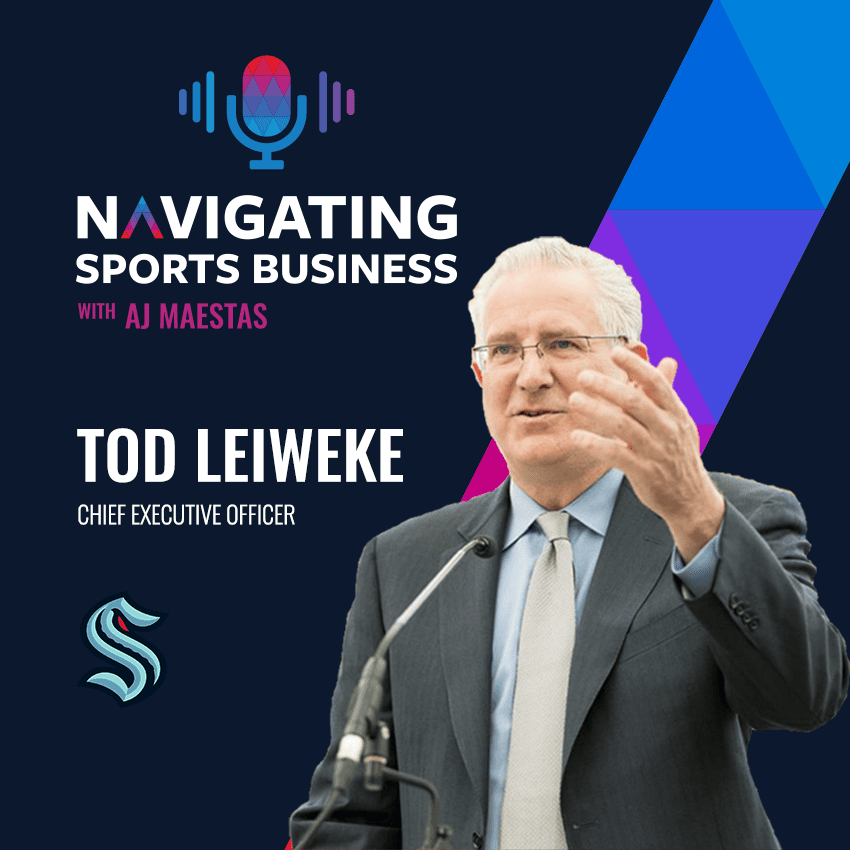
Podcast Alert: Tod Leiweke – Seattle Kraken
Tod Leiweke – CEO of the Seattle Kraken – is an accomplished sports executive with an impressive résumé and a compelling personal story. He has held leadership positions at the Seahawks, Sounders, Trail Blazers, Tampa Bay Sports & Entertainment, and the NFL. He is also a minority owner of the Seattle Sounders.
This week’s episode features a great conversation about Tod’s path from being a child in St. Louis to becoming a sports industry leader. He and AJ also discuss the excitement and challenges of launching a new NHL team, and the vision that Tod has for the Kraken.
Listen here.
Transcript
+^Tod Leiweke: [00:00:00] That’s the one thing for sure in life is we know we will face adversity, but it’s the ability to take that and turn that into something. And I’ll never forget my stepmother, I will never, ever forget her words to me. I’m not going to make it. You are making the most of every day.
AJ Maestas: Hello and welcome to the Navigating Sports Business Podcast. I’m your host, AJ Maestas, founder of Navigate a data-driven consulting firm, guiding major strategies and decisions in sports and entertainment. We started this podcast hoping to share the interesting stories and experiences of the amazing people we get to work with at Navigate. And even though they’re visionaries and famous, in many instances, their true stories aren’t often heard. Since they’re not on the playing field, our hope is you get to know them better and learn from them. As we have [00:01:00] today. I’m happy to be joined by Todd Leiweke. CEO and President of the Seattle Kraken, first of all, thank you for joining me, by the way.
Tod Leiweke: My pleasure.
AJ Maestas: And just for some background, for people who might not know you, you started in indoor soccer in Kansas City and New York City and went on to run three NHL franchises. I think one of the really golden eras of Seattle sports was when you came to Seattle and ran the Seahawks, launched the Sounders, which in my opinion, became a playbook on how to launch an MLS franchise. As well as ran the Portland trailblazers between all that you were the chief operating officer of the NFL. And here you are now launching a new NHL franchise in Seattle. So not only for background, but also help us understand how did that all happen? How did you do it?
Tod Leiweke: Yeah, so most of that’s true. Not all of [00:02:00] it. So, you know, and some of it I’m, I’m willing to confirm some of it i’ll deny. My real beginning in sports began by working with my two brothers who started a team in the MISL from scratch, and we all came together in Kansas City. My brother Tracy was the President. My brother Tim was the General Manager. And I was referred to an article as an office hand. So be it when you’re 22 or 23. But really my first significant opportunity came when a guy named Matt Levine, who was working for the Golden State Warriors as a consultant, reached out to me one day. And lo and behold, I found myself on a trip out to the Bay Area and I interviewed with the Golden State Warriors and the interview went pretty well. I became the Vice President of marketing and at the age of 27, really the journey in many ways began and it’s been a phenomenal journey.
AJ Maestas: Well, no question. It has and, and I hope you don’t mind me getting personal, but there’s very few people, in my opinion, in my experience, [00:03:00] that sit in seats like yours that have your background. I know you lost your mother at a young age. You even lost your stepmother before you were 18. You didn’t go to college. Can you help me and those who are listening understand how does someone rise to these levels? I get that first job step, but how is this even possible?
Tod Leiweke: Well, I think that one of the great inhibitors for people is doubt. And certainly, when you don’t go to college, you know, I had a lot of doubt. And, and what happened for me is my father. We lived a normal life in St. Louis, but my mother battled cancer for years and finally succumbed to cancer. When I was nine years old my father found himself a widower with six kids. He was lonely. He actually remarried. That marriage lasted one year, and it was a part of this story because as that marriage didn’t last, we ended up losing our home and it was almost like piling on and my father was still lonely. He [00:04:00] was well he was in his forties. He had six kids. Many of them left the home. There were three of us remaining, and he ended up meeting a woman named Pat Fontaine, who was a weather lady in St. Louis. She was on tv. She was doing the weather and they had all of these things in common. They enjoyed playing cards, they loved music, but one of the things they loved was the country. So on weekends, my younger sister and I would be on these forced marches to go camping and one day my dad said, Hey, we’re gonna go down and look at some property. And that was the beginning of us leaving St. Louis, moving two and a half hours south of St. Louis into a county with 8,000 people where half the people lived below the poverty line. As I used to say, the movie Deliverance was actually a documentary there. Yeah, and it was a crazy way. I had 23 kids in my class. I got there when I was a freshman in high school.
Went to high school at Lester High [00:05:00] High School and worked that whole time. We lived on a piece of property. We had horses and pigs and cows and chickens. But I miss my friends in St. Louis. They’d come down and, you know, come on camping trips and those were wild sorts of affairs. But when I was a junior in high school, my stepmother wasn’t feeling well. Went to the town north of us in Ironton, Missouri, and saw Dr. B, who knew immediately that there was real trouble, and sent her directly up to St. Louis where she was diagnosed with terminal cancer. So my father now loses two wives, and I know he loved my mother, but I really define love in my life going forward as the love that my stepmother Pat Fontaine and my dad had. And you know, it was a shocking sort of thing. I, when I graduated from high school, got on a bus left. I ended up moving to Colorado, thought I would make a career in the hotel business. I moved [00:06:00] up to a ski area, loved the mountains and the outdoors. Lo and behold, my brother started this soccer team and I cut my teeth, but I was the kid brother and I wasn’t really in toll.
I had a chance to do my thing with the Golden State Warriors that I sort of embarked upon my own career, but, you know, not being college educated. There were a lot of things that sort of hindered me early on. And made me always feel compassion for people who didn’t feel like they belonged. And I’ve never lost that. I get to hang out with a lot of very well educated people and, you know, affluent people who own teams, but I never lost my connection for people whose lives maybe didn’t quite turn the way they wanted or they felt. Some inadequacy. ’cause I felt that a good part of my life. And now I’m 61. I don’t really feel it anymore, but I have a lot of empathy for people who do.
AJ Maestas: Thank you for sharing that. I, I mean, there’s certainly a lot of tragedy and challenges in that, but there’s [00:07:00] some beauty too. I mean, when you talk about.
Tod Leiweke: Well people, that’s the one thing for sure in life is we know. We will face adversity. We are all born and we will all die. Some people die before their time, but it’s the ability to take that and turn that into something. And I’ll never forget my stepmother, I will never, ever forget her words to me. I’m not gonna make it. You are, make the most of every day. And even as I say it now, I feel emotion. I feel my eyes water just a little bit. And we all, every one of us on this journey have things that we can tap into that give us streak, that help us through that adversity. Because that’s the one thing for sure they say tax is and adversity. But I think it’s, we all know what adversity is, the ability to overcome that adversity. Creates this journey we’re on and, and makes it so worthwhile, and that that’s why people do love Sports is in a very condensed, compressed period of time.
[00:08:00] We see if people can overcome adversity, whether it be a fumble, an interception, an early goal, or two, and people relate to those who consistently overcome adversity like Tom Brady. You know, it’s, it’s when teams overcome that, and that’s been my favorite part of, you know, the sports journey is being with organizations that did things that on paper they weren’t supposed to.
AJ Maestas: Well share some, do you mind sharing some examples of that?
Tod Leiweke: Yeah, you know, my whole career I’ve been around, you know, and, and on paper the way the leagues are built, if you win, you draft last, if you win, the assistant coaches want to become head coaches and want pay raises, and so. You know, when you win, sustaining it is really hard because you get all these weights added to, to your ankles, and so lots of examples of, you know, my, one of my favorite memories was with the Minnesota Wild. Our third year we made the playoffs. And it wasn’t because we had a roster Chalk with Stars. It was [00:09:00] a very lean roster, but our players bought into the coach Jacque Lamere’s system in that year. We went to the playoffs but found ourselves down in the first round, three games to one. So Colorado’s up three games to one. We came back, beat ’em in game seven in their building. Remarkable. Well, the next series we find ourselves down three games to one, to the Vancouver Canucks. Came back, won the series in their building. So two back to back series where we were down three to one, and the probability of doing that two series in a row, everyone knew it, but the players, because they found that inspiration to do things and they were called upon to do things that were unique and different and monumental.
And so I’ve been to the Stanley Cup finals, I’ve been to the Super Bowl. I’m not sure there was any greater moment than that Minnesota Wild being down two series three games to one and coming back. [00:10:00] And that’s hockey country too, right?
AJ Maestas: Yeah. It’s unbelievable. Thank you for sharing. I agree. And, and it does seem like extraordinarily successful. People always take the something positive or many positive things from adversity. There’s a question we ask at our dinners, you know, that sort of says, tell us about the. Greatest challenge you’ve ever overcome in your life. And invariably someone shares the challenge, you know, and, and then it precedes the greatest success story of their life. I don’t know if that’s revisionist history, but that’s just, it always seems to be that way.
Tod Leiweke: So, yeah. And our country need, needs those lessons more than we’ve had. This has been a, an incredible year. On so many levels with, you know, what’s happened from a social unrest and the inequities that we find ourselves confronted with the political division and then a global pandemic. And if there was ever a country that needed to learn from the challenges in the adversity, and if we do, we’ll be better for it. I’m hopeful. I [00:11:00] hope that our country’s best days are in front of it. But if they are, it’s going to be because we’ve learned from the adversity and we’ve taken lessons that have motivated us to be better.
AJ Maestas: I heard a story about sort of a stoic perspective on, the pandemic in the very early days where, where a person basically, you know, the. The classic, who’s to say, who’s to say There’s not a net positive out of all the things that have happened the last couple years. And in Seattle, you know, Seattle’s a microcosm of that, right? My brother’s a cop in, in Capitol Hill, and between the homelessness and the riots, and granted there’s this tech industry and this booming sort of, you know, financial sector in Seattle. But Seattle could use some unification. A new franchise could be a big part of that, right?
Tod Leiweke: Yeah. And that’s seems tried a little bit to talk, to talk about sports in light of some of that but I can’t help but believe that we actually can be part of the solution. If we do what we have the opportunity to do. Right. And it’s so important to do it right. And we’re trying, we’re trying to build one of the most diverse [00:12:00] organizations in sports and rather than grandstanding on it. It should be a way of life, and I know lots of companies are hiring chief diversity officers. I hope we’re never one that needs to do that. I hope that our diversity becomes a way of life for us, and then if that’s the case, if we’re indeed building a very diverse organization, it’s really important that we also be a high performance organization so people can look at what we’ve done and say, Hey, there’s a better way to do this. We’re right now 43% gender diverse. About 23% bipoc diversity, and it’s important. It’s one of the most important things that I feel I’m doing and we’re doing.
AJ Maestas: Well, and I can confirm that, you know, from very early stages when we were working with you in the Seattle Center and some of the stuff with the city. You know, to get the arena done and all that, it was openly spoken that, you know, this needs, this organization needs to reflect this community. And there were some very specific hires at even just mid and junior levels, you know, that were, [00:13:00] were notably seeking candidates to reflect Seattle and the country and world at large. So, yeah, I can confirm that that’s not just talk. I’ve seen it, I’ve seen you do it from the very beginning of building this thing. So moving to the Kraken, and I know we’re skipping, you know, decades of very cool things. I want to talk about like, you know, world championships and things along those lines. But your brother owns the company that’s building the arena and that will have ownership in the arena. I mean, was this like a brother to brother? Cause you’re the chief operating officer of the NFL. This is a job so many people would dream of. You had so much success with the Seahawks, I’m sure there were plenty of people. I was one of them thinking, what would it be to mean that Todd Leiweke could be, you know, the next commissioner of the NFL and suddenly you’re running another NHL franchise. So, I mean, was this a, was this a family conference call?
Tod Leiweke: Actually, my NFL relationship was really about one guy when that was Roger Goodell and we had a bit of a religious experience together. We climbed Mount Rainier which was the last act of a United Way campaign that I chaired. I took on the United Way Capital campaign. [00:14:00] It was a goal of 110 million, and I signed up two years before the year came. So I signed up in 2007 and in 2009 we were in a very, very difficult economy. So we did all sorts of creative things. The players on the Seahawks were phenomenal. We were having a tough year, but those players. I have such admiration for professional athletes, but specifically for that team and those players who helped us on that campaign. But the last act of the campaign was to climb Mount Rainier with some corporate partners who pledged, I think we generated on that climb like $600,000. But we got Roger Goodell to come out and he told me once that it wasn’t until he looked out the window of the plane as they were passing near, when he really realized what it, what the hell he got himself into. We climbed it. It is hard, it was pretty emotional for him on this. The morning of the summit, it was 2:00 AM and he got to CVAs and wasn’t so sure he wanted to keep [00:15:00] going and you know, the message came down, the climber’s rope that Roger was gonna quit. The world famous mountain climbers, a dear friend of mine who took us up there said, okay, I’m an unclip and you’re gonna have to go by your teammates and tell him why you’re quitting. And Roger turned him, dropped the F-bomb, and the rest is history. Made it to the top. And, but he was really the reason I went to the NFL, so I’d never had aspirations of being the commissioner. I wanted to take what was going on and make it better. By the way, he’s not going anywhere, nor should he. One of the most epic growth periods for any league in the history of sports in the entire world. I admired the guy. I admired him for lots of reasons, but you know, a small part is the courage who showed that day on rodeo. He’s got a lot of that in him. So I, I really liked my job. We were enjoying living in New York. We probably weren’t gonna live there forever, but it was such a different slice of life. I told you earlier about. Being a kid from Westerville, Missouri while living in New York, and I remember [00:16:00] riding my bike past our office the Sunday before the Monday that I began.
I’m like, holy smokes. I can’t believe I’m working here. And it was a fascinating place to work lot. So many fantastic things come to your door first. You meet so many brilliantly smart people. You meet people with dreams and ambitions and really an amazing place. But meanwhile, we love the northwest. We love Seattle. 30 years in the business, and I’ve never really worked with my brother, and I was the guy that said to him, I think you could fix that arena. Most people said you couldn’t. And all I had was a suspicion. He ultimately had incredible courage and gule to say, we can do this. And there certainly were architects and engineers that said, no, you can’t do that. You can’t pull the 44 million pound roof in place while you construct a brand new arena underneath it. It’s not possible. And if it were, it would be [00:17:00] crazy expensive. Well, he ran into some engineers and he ran into some architects that said, no, I think we can do this. That’s who he chose to run with. And so he, he ran with them.
[00:17:12] They built a plan and it’s proving to have been a brilliant idea. We get to play under an absolute epic historic roof that was a part of the world’s fair. And under that roof, amazing things happen. So we have this historic roof built to replicated Native American rain hat. Designed by an architect who was very involved in the World’s Fair coming to Seattle, Paul Thiry and the Roof had purpose and meaning, and in fact was as big a city, a symbol for the city as the Space Needle was in that day. We get to preserve it, build a brand new arena under it, and day one, that building has a soul. And I am big into, you know, if you said what’s been different about your career? A lot of sports architecture in my career, working on facilities and [00:18:00] this building will have feng shui. It will have intense meaning and purpose and I couldn’t be more proud about what we’re doing.
AJ Maestas: Well, I’m glad to hear that. I understand it’s a historic site. You know, I got a chance to, to tour in the early days there and understand the original glass is going to go in and, you know, some things that you, you can’t believe are real, but, but you’re, I’ve actually been able to witness the, the roof kind of held up there as well, thinking, oh my God, this is not going to be cheap. But, but pretty cool, pretty cool. The Seattle Center and all that.
Tod Leiweke: It wasn’t cheap. I can, I can verify that. But it’s ending up being about the price of what you’d expect in your arena. And I think it’s actually it, for me. I can submit to you here today that it’ll be the most beautiful arena in the world. If you want me to verify that, I’m happy to do it, but I do believe that the only arena located in a park in the world under a historic roof, incredibly fantastic [00:19:00] steep sidelines because it’s a sub training. And then, interiors done by the great. David Rockwell. It’s going to be spectacular.
AJ Maestas: I do look forward to seeing it. Quick question on Rainier. Hypothetically speaking, if you and Steve Griggs were hiking together, who would who would summit first?
Tod Leiweke: Oh, he would, but I’d get up to the top with two beers.
AJ Maestas: Is that true?
Tod Leiweke: Yeah, no, he, so he’d be sitting up at the top, but I’d probably show up about a half hour later and say, Hey, do you want a beer? He is fantastic. And to watch he and that organization win the Stanley Cup, phenomenal. Tampa’s had quite a run with the, the Super Bowl, what the Rays did, but my beloved Lightning couldn’t be happier for him . But one of my great mentors, Jeff Finnick.
AJ Maestas: Success has many fathers, and I hope and assume you put yourself in that group. I mean. It, it was a real turnaround, what you did for the Lightning, that was pretty incredible. But you keep doing incredible things. This is going to be incredible. I mean, by my [00:20:00] estimation, the cracker are gonna be top three in the league in just about any metric you can think of business-wise or otherwise. It’s been an honor to have our small role in that, and it’s been very impressive to see because I, I went to UDub. I, I had a decent familiarity with Seattle. You know, we’d worked with pretty much every organization in town on pretty important and big deals. And the stuff that you all are getting done is, is it’s extraordinary. Really, it really is.
Tod Leiweke: You know, we also found that there was more revenue than in the market than maybe what had originally been budgeted. So the revenue kept pace with those costs increase, but I would say greater than the cost increase is this building and its beauty and grandeur. It’s going to be. Such an incredible building, acoustically from a music standpoint, it’s going to be unique, and I could go on and on and wide. We’ve customized this building to make sure it makes sense for music, but I also believe it’ll be the home to the NBA And some say that, oh, the NBA needs their own building. I don’t know one owner that will [00:21:00] pay whatever the price is gonna be. That then fills the need to also build an arena when we’ve built the economics to work. And so, you know, this building is a great symbol of hope for our city, and I love our city. And our city again, should, should hope that its best days are in front of it and I personally believe they are.
AJ Maestas: When are the sonics coming back then?
Tod Leiweke: Well, I think that’s really up to the league and it’s up to the commissioner. Our job is to be prepared. So what does that mean? Well, we’re doing a lot of that now by building this incredible arena. But we also did hard work in making sure that the economic model was really, really good for the NBA team. And someone, you know, informed said, oh, it’s gonna be like the Islanders when they were playing in the Nets building, that there’s not enough economic opportunity for that. That second team. That’s just simply not the case. In our building, we’ve created an economic model that will make this NBA [00:22:00] team top tier in revenue and bottom tier in expenses. So with the arena Rubik’s Cube finally solved, I believe personally, it’s only a matter of time until the sonics and the NBA return.
AJ Maestas: Well, I believe you, and certainly that’s what we’ve been hearing for quite a while through, not just through you all, right, through other sources and what have you, and, and, you know, ready made brand new building the history of the sonics, the latent demand, waiting for the sonics to come back to Seattle. Obviously I have a lot of friends from Seattle, given college and all that. Will you be involved? Live Nation has equity in the building, right? So we can expect a bunch of amazing concerts. So I’m glad you bring up music and entertainment, but will you have. Will that be a part of your job if the sonics come back?
Tod Leiweke: Yeah, I mean, I think that our journey’s not complete until we get the NBA back. Any role that I can play or any, you know, anyone on our team, well, we wanna be as constructive in that, but we’ve, you know, a lot of the hard work is, is being done right now and in the fall. One of the most spectacular facilities will open, [00:23:00] and the only thing that won’t be activated is the NBA locker room. It’ll be the proud home to the Seattle Storm. Could be more either Kraken or it’s just gonna be spectacular music. There will be an empty locker room space just waiting for the return of the NBA.
AJ Maestas: I know how they’ll be received. There’s plenty of questions, right, from a business perspective that I’d love to learn more about, but I know it’ll be well received. Well, the Kraken have started off so successfully, the brand i i the launch everything, right? The demand. What do. What do you attribute all this success to?
Tod Leiweke: I always start with fans. So March 1st in 2018, I was in the league, the NFL office as my brother. Called me, but I was in a meeting with my boss. He called again, he finally sent a text saying, please call me a surgeon. And I called him and he reported that the team had taken 10,000 deposits in the first 12 minutes. And at the end of the day, by the time they shut the spigot off, 32,000 deposits had been placed for [00:24:00] tickets. And those fans were so excited. ’cause in 2020 we were gonna launch the team and the building. Well, it got pushed off a year. And then we went through all of those things you and I have talked about and including a global pandemic. And yet our fans never wavered. And so early on when my brother asked me, I said, Tim, I believe the Seattle fans are the greatest sports fans in the world. So when you take the fans and then you add them into our ownership.
OVG and the phenomenal work they’ve done in developing this building, redeveloping this building. But my boss, David Bonderman, the conviction he’s had to this project, he’s never wavered. And the flight to quality has just been extraordinary at any turn in the road. And early on, even when we saw the cost going up, there were a list of things that we could value engineer outta the building. Not only, we not value engineering engineer, we took on additional costs to do it right. Things [00:25:00] like David Rockwell doing interiors. Never before had a firm like his who developed some of the most high-end nightclubs, restaurants and hotels, never before had they taken on the work of an arena. Now the seven clubs within this building are spectacularly designed as they should be, and so there’s a lot of things have to come together to see something like this happen, including the city and many people like blasting the city and its vogue and they baited me into wanting to do it. I can’t. The city has been a good partner. Robert Lums, who runs Seattle Center has been phenomenal. At the end of the day, this got down to the owners and their conviction and courage and then ultimately it’s all about the fans. And the fans have been phenomenal.
AJ Maestas: If I remember right, Robert’s a basketball guy too.
Tod Leiweke: He is, yeah. I think he’s probably ready to see some Sonics. He was one of the depositors. He waited patiently, his number came up and he bought season tickets, [00:26:00] and I think he is gonna be uniquely proud early on. People ask me every day for about two and a half years of my life, what’s the team name gonna be? Robert was one of those, anything but the Kraken guys. But you know, the day we revealed it, he looked and said, okay, it’s kind of cool. Maybe I’m in. And he wasn’t.
AJ Maestas: I have to admit, I was in that camp, you know we were working with the launch of the XFL and I know there was some conflict issues with names and things like that. And I don’t know why I’m not into the mythical re thing or whatever. And I just thought there was so much heritage in the Northwest. I grew up in Alaska, as you know. Some of the things that were contemplated, there was just some cool ties, right? I was picturing sockeye salmon and all the ways that could play out into fun and humor. And I, I didn’t know what the right thing was to do by any means, but I didn’t love the idea and I was clearly wrong cause it was, it’s been immediately adopted.
Tod Leiweke: Yeah. You know, and I’m gonna be honest, it wasn’t on my top 10 lists, but it wasn’t our job to interpret our feelings. It was our job to understand what the fans wanted and before we entered the [00:27:00] COVID world. We sold our club. Seats. Seats. And so I would go over to the preview center almost every day and and fans would walk in and proactively, Hey, what should the team name be? And for those who said the Kraken, I had additional questions like, well, what in the hell is it? Then there was a consistency of feedback where people said, I’m not so sure and what it was, and what, you know, it was a dynamic where it was living in their mind. In the theater of their mind. And there it was more dangerous than something we would explicitly draw. So ultimately, when we named the team the Kraken, we designed a mark. That didn’t really reveal. There’s a an S and it’s got ribbed and there’s an insinuation of a tentacle and there’s an I. But we allowed it to continue to live in the theater of people’s minds and you know, it’s been super well received.
We then went out and it put together. An incredible staff, including a guy named Johnny Greco who’s [00:28:00] going to take that brand and interpret it in the game experience. And that part is really now coming on and it’s a lot of fun. It’s fun to develop the things like the game experience, the broadcast piece. But I was just on the phone with around Francis, our great general manager. So that’s the most important thing we’re gonna be developing here in the coming months, is the actual team.
AJ Maestas: Right. Right. And I’m, I’m thinking fans. Well, it, it was a great job and it’s not what I would’ve done intuitively, but clearly and you know, you talked about unifying Seattle, right? With all the divisiveness of the last few years in our country and in the world. I do think that a new fresh name, something anyone can adopt. There’s a lot of transplants in Seattle. I mean, it’s grown a great deal because of tech and more, you know, in the last 20 years since you first moved here, the first time you were in town. So it gives people an opportunity to have something that’s theirs. You know, if they’re a first generation Seattleite. Right. So, very good. You mentioned David Bonderman. I’d love to know more about him. You worked for Paul Allen and I [00:29:00] assume that was an amazing experience. He was so generous to Seattle and the state and the world in so many ways. I don’t know if you’re willing to compare the two or, or help us understand more about David and his vision.
Tod Leiweke: Paul, God rest his soul. And I would say this, that there are things that you want to say to people that you might not, ’cause you’ll do it another day. Don’t assume that. And there were some things that I wish I had said to Mr. Allen before he passed. I really admired the guy. I think we did really good work for him and building, getting the Seahawks up and running. And you know, before I left, we hired Pete Carroll and John, and, you know, we got the Sounders started, but. There was a lot there with him. He was a, he was an amazing guy and his journey was extraordinary. There’s a book called Idea Man that is a brilliant read of his life from growing up and working for educators to later dreaming about spaceships and putting people into space and everything in between. [00:30:00] And so it was a privilege working for him. And then I went to work for another amazing guy and a different guy. But you know, one of the amazing parts of the journey of life is meeting interesting people. And it’s one thing to communicate, but listening is such an important thing. Cause if you listen. The wisdom, wisdom that is available to us all around us and almost on a daily basis is incredible.
David Bonderman is a man of few words. He listens more than he speaks. At first, it took a little bit of time to get to know him. It took a little bit of a time to build a relationship with him, but over time, I just absolutely love working for the guy. The amount of wisdom that he’s accumulated the amount of respect. He’s been in a tough business. He’s an investor and he drives for results, but he is, I think, a very rare person in that business, in that he is so widely respected and his wisdom is so valued. You know, I just love the cut and the great [00:31:00] news is he is so excited about what we’re building and he’s seen it turn the corner from a concept and organizing it and getting the organization right, then going to market and trying to monetize while you’re building. And now we’ve turned the corner and everything we had set out to do, we’re getting done. Not because of me, but because of the idea. Of our leadership because of our team and, you know, ultimately the fans. And when I told him when I had dinner with him, one, you know, early, early on in New York City and said, these are the greatest fans in the world. I think he was, you know, like, okay, I’d expect him to say it. And I think today he truly believes it. He is just been a perfect boss.
AJ Maestas: That’s good to hear. What can a fan expect from him as an owner?
Tod Leiweke: Well, they’re getting it. He allowed us to hire Ron Francis a whole year early. He was the guy that pushed for David Rockwell to do our interiors. Populace has done such a fantastic job, but [00:32:00] Bondo knew of Rockwell and regarded him really as an artist, and so he pushed us to spend tens and tens of millions of dollars more to engage Rockwell. So the fans are gonna feel the. The touch of David Bonderman in every part of this journey that we’re on in this experience. And I think he is, he is really excited now to see us build out the team and we’re almost to that point where so much of the other work is now done. We’re getting close to checking the boxes on some things. Now you get to the part of building out the guest experience, the fan experience, the team. And it’s really fun.
AJ Maestas: You know, I’m a big fan of populace that you just mentioned. And, you know, we, we work with them on the stadium experience of the future type stuff. And I do think there’s some really cool things about this arena being subterranean, right? The clubs right. The way that you’ll be able to enter and exit and, you know, the amount of. Real estate you carved out of the land. You know, the footprint wasn’t anywhere near adequate to be a modern arena, you know, from the, what [00:33:00] was known as key arena. So pretty cool stuff. I don’t know if there’s any highlights you’re willing to share.
Tod Leiweke: I think architects are truly artists. You know, sports architecture is going through lots of phases. This feels like a phase in the older buildings, the Chicago Stadium and the Boston Garden, where there was a real sense of intimacy. Yet we’ve doubled the size from 400 to 800,000 square feet. We have all the modern amenities, but I would say one of the things I’m most proud about the building is the name of the building and what it’s stands for. Center into a partnership with Amazon to name this building after such an important and such relevant issue to not just our world, but the city of Seattle where Earth Day was created 51 years ago, we will be the first zero carbon building. It took a lot of work. It took money to get this building to the point that we eliminated all the fossil fuels, and it’s gonna take different kinds of operating policies to make sure that. When we certify, we are on an annual [00:34:00] basis, a zero carbon building, but we’re there all the way too. Major big , tanks embedded that will collect rainwater from the roof filtered, and that’ll be the eyes that the players skate on.
AJ Maestas: It is an unbelievable accomplishment for, for those that are not, you know, well versed in these subjects because it is a historical ability. So, you know, being on the historic registry to be zero carbon f. While still having to bring back things like pane glass windows that are originally a part of entry. Yeah. Like, like not easy to pull off. So, yeah. Well, I think it’s fair to say you have a little bit of the minus touch. I mean, everywhere you’ve gone in the last 15, 20 years, right. You win in business and you win on the field, the court, the ice. Whatever it might be.,
Tod Leiweke: I went to the Super Bowl and lost and the Stanley Cup final and lost. So if that’s the modest touch. Okay. I’m not so sure there’s a big market for it, but so be it.
AJ Maestas: Just a couple quick questions just to wrap up for fun. And this is just to get, you know, you just a little bit better. Where is your favorite place to travel?
Tod Leiweke: Well, anywhere you go, I, I [00:35:00] say this all the time, but you know, anywhere you go, you see amazing things. And so I would say in Seattle, we lived there for eight years, but now we’ve really discovered the Sailor Sea, which is the Puget Sound. So we love traveling anywhere around the Puget Sound, specifically by boat and specifically our cabin, up in the same lots, just spectacular.
AJ Maestas: The Sam ones are amazing. It reminds me a lot of Alaska. Are you living on the water? Are you somewhere accessible to the
Tod Leiweke: We’re on the lake and lake boating is fine, but man, once we started boating in the Sailors Sea, the Puget Sound, it’s just spectacular.
AJ Maestas: It is pretty amazing. So I’m sure you’ve heard this question before, you could have dinner with anyone in the world. It could have been, it could be someone passed, it could be someone modern and living today. But if you could have just one dinner date, who would you choose?
Tod Leiweke: I would say my mom and dad, there’s a lot I would’ve liked to have told him. There’s a lot I would’ve liked to have shared with him. And, my dad passed about seven [00:36:00] years ago and there’s not a day that goes by where I don’t think about him. And, and then my mom and the courage she showed for all those years battling cancer with six kids. And, you know, I’d give anything to have one dinner with them probably wouldn’t be enough when the check came. I’d pay the bill.
AJ Maestas: Yes, you would. I know you’re generous.
Tod Leiweke: Martin Luther King would’ve been an amazing person. Gandhi. I had a chance to meet the Dalai Lama, which was extraordinary. So those names come to mind, but I think from a a personal standpoint, it would be my mom and dad. That’s fair. Except for anyone that might be listening. If your mom and dad are still alive. Set aside whatever daily differences we might have with one another and realize that life is a finite thing we have and engage and tell people you love them.
AJ Maestas: I think that’s really good advice and it, it is hard to not be able to go back. Right. For those You’ve lost it. Yeah . no question. What is the greatest piece of advice you’ve ever received?
Tod Leiweke: Well, that would probably be from [00:37:00] my stepmother cause I never forgot it where she said, I’m not gonna make it. You are, make the most of every day. Never forget it. I think about it all the time. I don’t always take that advice. There are some days where, you know, I feel sorry for myself or the circumstance I’ve found myself in, but if I just live by that, acknowledging that there are others that haven’t made it, I have make the most of every day, then how can you go wrong?
AJ Maestas: That’s fair. Yeah. It’s a, it’s a top goal of mine this year to be in the present moment more often. It’s a challenge for me.
Tod Leiweke: Yeah. It’s a challenge for so many of us, especially hard chargers like you and others who, who might be listening to this podcast. It’s how we got to where we are. And that’s how we enjoy the things we have, but it’s really being present. If we’ve learned nothing from COVID, and God [00:38:00] forbid this event happens and we don’t take something out of it that is constructive in our lives going forward. So what is that being present, living in the moment.
AJ Maestas: Do you have any passions or hobbies I might not know about?
Tod Leiweke: Hobbies and passions? Yeah. I mean, we, we’ve fallen in love with the cabin up in the San Juans. We’re fixing it right now. Just beautiful time’s up on that water, you know, fishing, it’s, it’s great. I got my brother, we just bought it this past summer. I got my brother Tim up there with my. My brother Tracy and my nephew, and it was, it was a fantastic time. So it is a little hard to pursue hobbies too much. I played golf about, three weeks ago and my brother said you haven’t played lately. I’m like, no, not a lot of time. A project like this could be. Developing, but it’s also, you know, some of this is my hobby and some of this is my passion and I can’t wait until we get to deliver for the fans. It’ll be a fantastic moment and you and I will drink the good wine that night, sir.
AJ Maestas: Yeah, I’ll hold you to that. It sounds like a plan, and [00:39:00] I think it will be a celebration. And I think the success is inevitable. I didn’t know your brother Tim Leiweke took breaks. That’s interesting to hear.
Tod Leiweke: It was, it was a little bit of a forced march, but he does take breaks and he’s a much better golfer. He plays golf more often and he’s doing very well. Where I’m working on one project, he has like eight of these going on and it’s really something. He’s also brilliant. You know when the good Lord passed out, the brains in our family, he got the double dose, but we’ve formed a pretty good team. His daughter Francesca is also part of that team, and it’s been a privilege to be on this journey with him and doing what we’re doing here.
AJ Maestas: Think you’re being too humble, but I’ll let it slide. I said something so I guess I didn’t let it slide, did I? Well, I’m really grateful you joined. I mean that, it’s just a pleasure to see it and connect in this crazy time and also learn from you and be able to share that with other people. So thank you very much.
Tod Leiweke: Well, you’re, you’re a you are one of the greats in this business, and so in the middle of this day to pause and have an opportunity to talk to you about things bigger than [00:40:00] budgets or construction schedules. It’s been a real pleasure and everything your company has done, and in fact the work you’re doing for us now on the campus. I have a call this afternoon to talk about that very work. So we’re, we’re super grateful, but more than what you’ve done. It’s your personality, it’s your endearing personality. And you have had success because people like being around you and have trouble saying no to you. And it’s just who you are. Your background in Fairbanks, Alaska is more interesting. And so one day I’d like to come on your podcast and actually turn the tables and I’ll interview you and if you’ll have me. I’d love to do that someday because I know that that background of yours, growing up where you did in a place so abstract in America. You know, I’ve been to Alaska many times. Fairbanks is a, you know, Anchorage is a big city, relatively speaking. It’s an amazing place. I’ve been to Fairbanks once. Yeah.
AJ Maestas: It’s not so different than the way you grew up. I think I have a feeling, right [00:41:00] out in the middle of nowhere in Missouri.
Tod Leiweke: Hey, we’ll have a, we’ll have a home and a away some day, and I’ll let you judge. Okay?
AJ Maestas: Yeah. Well, yeah, that’s a good point. I’d be up for it. I’m, you’re being too kind, but you always are. I remember when you came to our office, you and Adrian Hanau, Steve, Greg, some of the guys, these like legends and I remember thinking, what in the hell are they doing here? Why, why am I this lucky? Like what is happening? Really, that was a big highlight for us.
Tod Leiweke: Great, great work.
AJ Maestas: Well, thank you. That’s really kind you say, and I really am grateful for your sharing your time. Really proud to say I know you and that that you’re having the kind of success you’ve had time and time and time again, and you’re about to, again, in a very big way, you deserve it and you’re an inspirational story and I’m grateful that you share it with people because. You are a uncommon person in an uncommon time, and I think it somehow makes for the perfect fit for Seattle. I love that you love the city so much too. So congratulations on everything you’ve had up to this point and what I know is about to follow when the puck drops.
Tod Leiweke: Thank you and we’ll see you next fall.[00:42:00]
AJ Maestas: If you’d like to join the conversation, email us at info@nvgt.com or check out our website @nvgt.com. I’m AJ Maestas. Join us again next week for Navigating Sports Business.